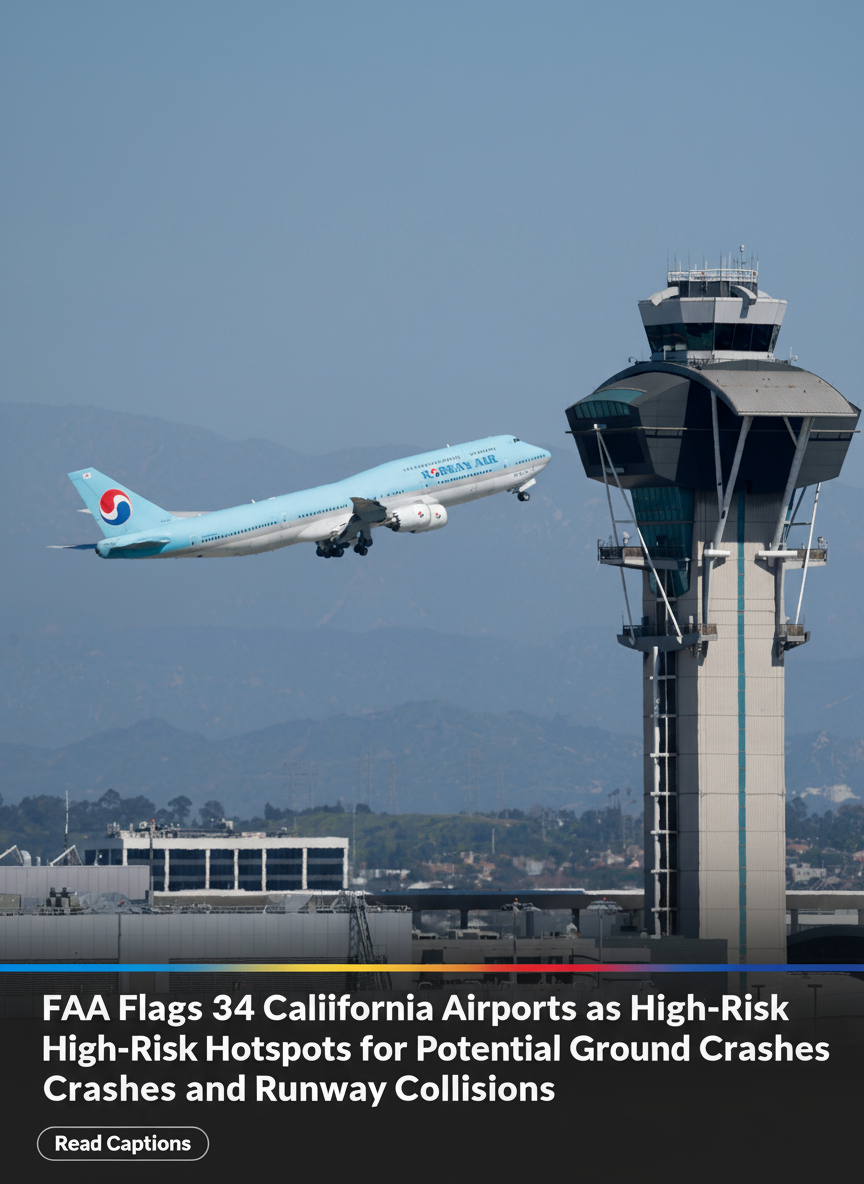
Safety on the Tarmac: 34 California Airports Flagged as FAA ‘Hotspots’ for Collision Risks
In a sobering revelation for West Coast travelers, the Federal Aviation Administration (FAA) has officially designated 34 airports across California as “hotspots”—areas on the airfield where the risk of surface collisions or “runway incursions” is significantly heightened. The list, which includes some of the nation’s busiest travel hubs, highlights the growing complexity and congestion facing one of the world’s most active aviation corridors.
Understanding the ‘Hotspot’ Designation
According to the FAA, an airport hotspot is defined as a location on an airport movement area with a history or potential risk of collision or runway incursion. These are typically areas where the geometry of the runways and taxiways is complex, or where pilot confusion has historically led to dangerous near-misses. While the designation is intended as a safety tool for pilots and air traffic controllers, the sheer number of sites in California—34 in total—underscores the logistical challenges of managing the state’s massive volume of air traffic.
For the average passenger, the term “hotspot” may sound alarming. However, aviation experts note that these designations are part of a proactive strategy to prevent accidents before they happen. By identifying these specific “danger zones” on airport charts, the FAA provides pilots with a heightened sense of situational awareness during taxiing, takeoff, and landing.
Major Hubs and Complex Corridors
The list includes a mix of massive international gateways and smaller, yet high-traffic, regional airports. Major hubs such as Los Angeles International (LAX), San Francisco International (SFO), and San Diego International (SAN) are prominently featured. These airports are often characterized by intersecting runways, short taxiway distances, and a constant stream of departures and arrivals that leave little room for error.
In Southern California particularly, the density of the airspace adds another layer of risk. With airports like Van Nuys, Long Beach, and John Wayne operating in close proximity, the ground movement of aircraft requires precision and constant communication between the cockpit and the control tower. The FAA’s report suggests that as traffic volume returns to—and in some cases exceeds—pre-pandemic levels, the margin for error on the ground has narrowed.
Human Error and Mechanical Complexity
The “hotspot” list focuses heavily on “complex airfield geometry.” At many older California airports, runways were designed decades ago and have since been surrounded by urban sprawl, preventing the kind of expansive, simplified layouts found at newer international airports. This leads to “confusing intersections” where pilots might inadvertently cross a runway without clearance.
Data from the FAA indicates that human error remains a primary factor in runway incursions. Misinterpreted instructions, distractions in the cockpit, and the physical difficulty of navigating large airfields at night or in poor weather contribute to the risks identified at these 34 locations.
The Path Toward Enhanced Safety
In response to these findings, the FAA has initiated several safety enhancements. These include the installation of “Runway Status Lights” (RWSL)—automated systems that warn pilots when it is unsafe to enter or cross a runway—and improved surface markings and signage. Additionally, the agency is leveraging new technology to provide real-time alerts to air traffic controllers when a potential conflict is detected on the ground.
“The goal of identifying these hotspots is transparency and prevention,” said an FAA spokesperson. “By acknowledging where the risks are highest, we can implement targeted infrastructure improvements and ensure that pilots are extra vigilant in the most critical areas of the airfield.”
Conclusion: A Call for Vigilance
While flying remains statistically the safest mode of transportation, the FAA’s latest report serves as a reminder that safety is a constant effort. For the millions of passengers traveling through California each year, the “hotspot” list is not a reason to avoid flying, but rather a testament to the rigorous monitoring systems in place to keep the skies—and the ground—safe.
As California continues to lead the nation in aviation activity, the pressure on its 34 “hotspot” airports will only grow. The focus now shifts to how federal and local authorities will invest in these sites to ensure that “hotspots” eventually become a thing of the past.