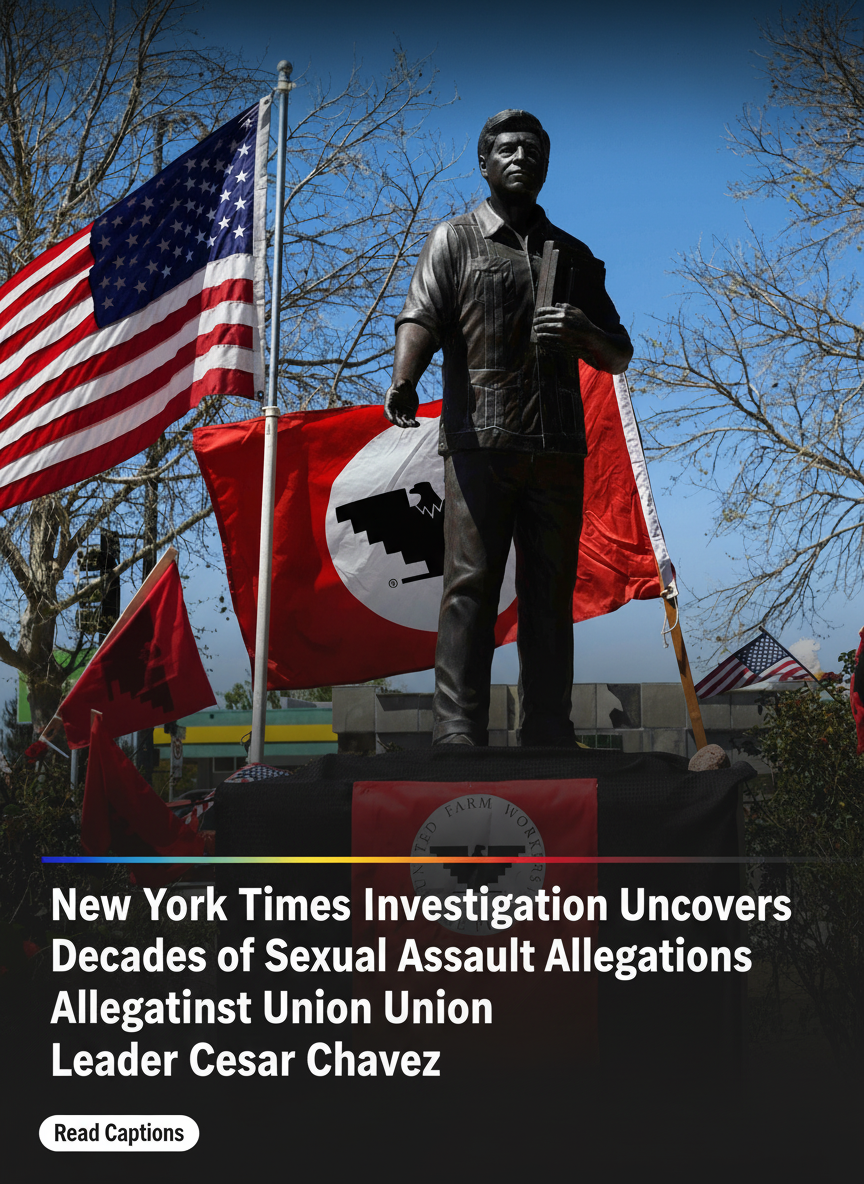
A Labor Icon’s Darker Chapter: 6 Takeaways From the Investigation Into Cesar Chavez
For decades, Cesar Chavez has stood as the moral compass of the American labor movement—a saintly figure whose nonviolent advocacy for farmworkers earned him the Presidential Medal of Freedom and a place in the pantheon of civil rights heroes. But a sweeping investigation published Wednesday by The New York Times reveals a harrowing hidden history that threatens to dismantle that legacy.
Drawing on dozens of interviews with former United Farm Workers (UFW) staffers, volunteers, and family members, as well as previously unreleased archival documents, the investigation details a pattern of sexual assault and systemic abuse that spanned the height of the movement. Here are the six key takeaways from the report.
1. A Pattern of Abuse Spanning Decades
The investigation identifies numerous women who describe a consistent pattern of behavior by Chavez beginning in the late 1960s and continuing until his death in 1993. The allegations range from persistent harassment to violent sexual assault. Victims describe an environment where Chavez’s absolute authority within the movement made it nearly impossible to refuse his advances without facing professional ruin or social excommunication.
2. Allegations Involving Minors
Perhaps the most disturbing revelation in the report involves allegations of sexual misconduct with girls, some as young as 14, who were living at La Paz, the UFW’s headquarters in Keene, California. These women, now in their 60s and 70s, describe a predatory dynamic in which Chavez used his status as a spiritual and political leader to isolate and exploit young volunteers who viewed him as a father figure.
3. The Use of “The Game” to Enforce Silence
The Times investigation explores how Chavez adapted “The Game”—a confrontational group therapy technique borrowed from the Synanon cult—to suppress dissent and silence victims. Survivors claim that any woman who attempted to speak out about Chavez’s behavior was subjected to hours of verbal abuse and public shaming during these sessions, often being branded as a “traitor” to the cause or a “provocateur” for the FBI.
4. A Culture of Complicity Among Leadership
The report suggests that Chavez’s behavior was an “open secret” among a small inner circle of UFW leadership. While many rank-and-file workers were kept in the dark to preserve the movement’s public image, high-ranking officials allegedly helped facilitate Chavez’s encounters or looked the other way. The investigation highlights several instances where women who complained were reassigned to remote field offices or forced out of the union entirely.
5. Corroboration Through Archival Records
Journalists uncovered internal memos and personal diaries that appear to corroborate the survivors’ timelines. In one particularly damning find, a 1978 letter from a former aide explicitly warned Chavez that his “personal conduct” was becoming a liability to the union’s mission. These documents suggest that the movement’s survival was frequently prioritized over the safety of the women within it.
6. A Movement in Turmoil
The fallout from the investigation has been immediate. Within hours of the report’s publication, several prominent Latino advocacy groups and labor unions issued statements expressing “profound heartbreak.” There are already growing calls from activists to rename the many schools, parks, and streets that bear Chavez’s name. For the UFW, the report represents a foundational crisis, forcing a reckoning with how its celebrated history of empowerment was, for some, a history of trauma.
This story is part of an ongoing series investigating the intersection of power and gender in historical labor movements. If you have information to share, please contact our investigative desk.