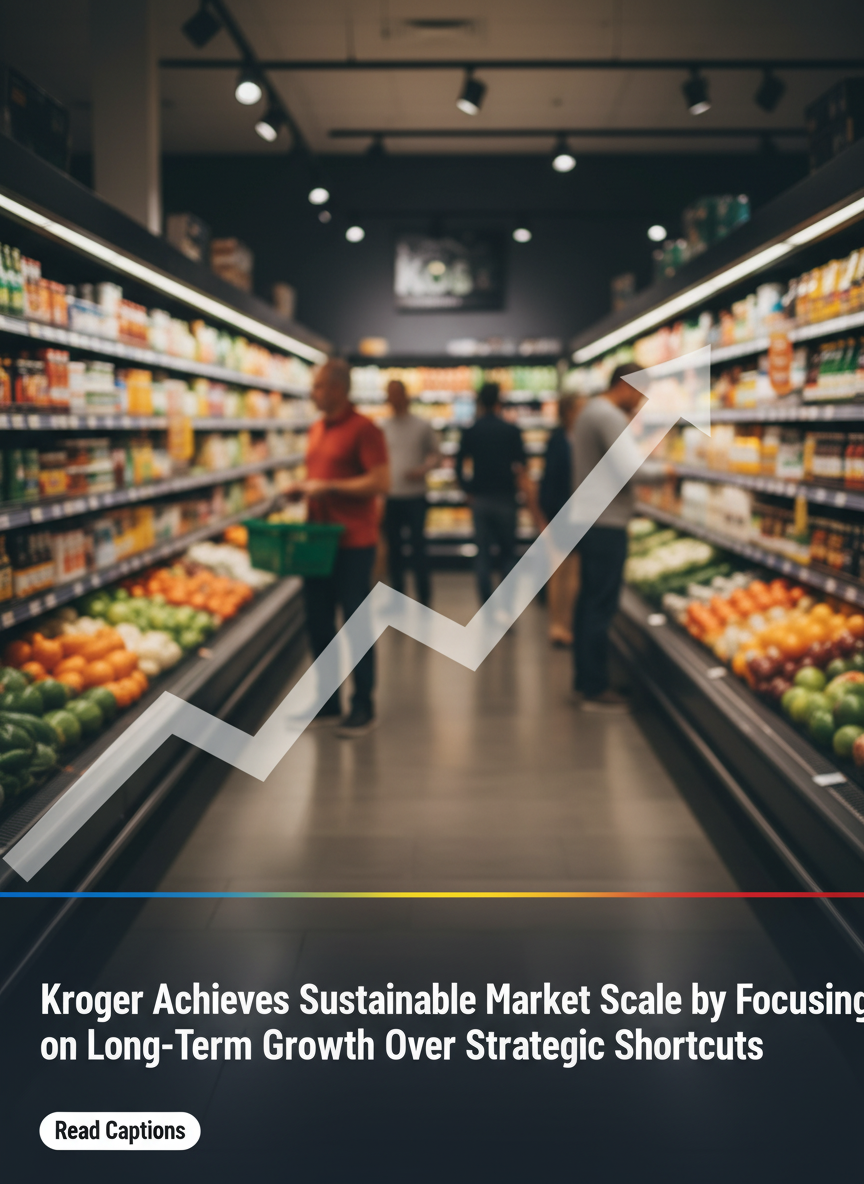
Beyond the Merger: Kroger’s High-Stakes Pivot to Organic Growth in a Post-Consolidation Era
CINCINNATI — For years, the retail industry watched as Kroger attempted to engineer a future through massive consolidation. The goal was clear: achieve a scale that could rival global titans and provide a definitive buffer against razor-thin margins. However, following the high-profile collapse of its proposed merger with Albertsons, the grocery giant finds itself at a critical crossroads. In 2026, Kroger is discovering that scale is no longer a strategic shortcut, but a complex engine that requires precise, organic tuning to remain competitive.
The Post-Merger Reality: No Easy Wins
The regulatory resistance that ultimately stifled the Albertsons deal has forced Kroger to abandon the “growth by acquisition” playbook. While consolidation was once viewed as the primary pathway to efficiency and market dominance, the current landscape offers no such simplicity. Instead, Kroger must now drive growth from within, navigating a market where size alone no longer guarantees stability.
Industry analysts note that the collapse of the merger has shifted the burden of performance back to Kroger’s core operations. Without the added footprint and procurement power of Albertsons, the company is doubling down on its existing infrastructure to prove it can outpace competitors through execution rather than expansion.
Data and Private Labels: The New Strategic Pillars
In response to these challenges, Kroger has pivoted toward a strategy centered on data-driven intelligence and the aggressive expansion of its private label portfolio. By leveraging vast amounts of customer data, Kroger is attempting to personalize the shopping experience in ways that traditional discounters cannot match. From targeted promotions to hyper-efficient inventory management, the company is using insights to ensure that every square foot of its stores earns its keep.
This “data-first” approach is mirrored in the resurgence of Kroger’s private brands. As shoppers become increasingly price-sensitive, Kroger’s ability to offer high-quality alternatives to national brands has become a vital defensive moat. This strategy not only protects margins but also fosters consumer loyalty in an era where brand switching has become the norm.
A Market of Extremes
The competitive environment in 2026 has polarized into a market of extremes. On one side, Walmart continues to exert immense pressure through its sheer price dominance. On the other, hard discounters are gaining ground with simplified, low-overhead models that appeal to the budget-conscious consumer. Kroger sits in the middle, attempting to offer the variety of a traditional grocer with the efficiency of a discounter.
This balancing act is further complicated by external volatility. Geopolitical tensions and fluctuating input costs—exacerbated by global supply chain disruptions—continue to put pressure on the bottom line. Kroger’s management is tasked with a delicate mission: investing heavily in digital transformation and store improvements while simultaneously protecting margins from inflationary shocks.
Conclusion: The Path of Precision
Kroger remains a formidable force in the retail sector, backed by a massive infrastructure and a household name. However, the lesson of 2026 is that the “shortcuts” of the past—namely, massive mergers—are no longer a viable substitute for operational excellence. To thrive, Kroger must translate its vast assets into a clear competitive advantage defined by precision, agility, and a deep understanding of the modern shopper.
The road ahead is devoid of easy fixes. Kroger’s success will now depend entirely on its ability to execute its organic strategy with clinical accuracy, proving that even without a merger, it has the scale and the savvy to lead the American grocery landscape.