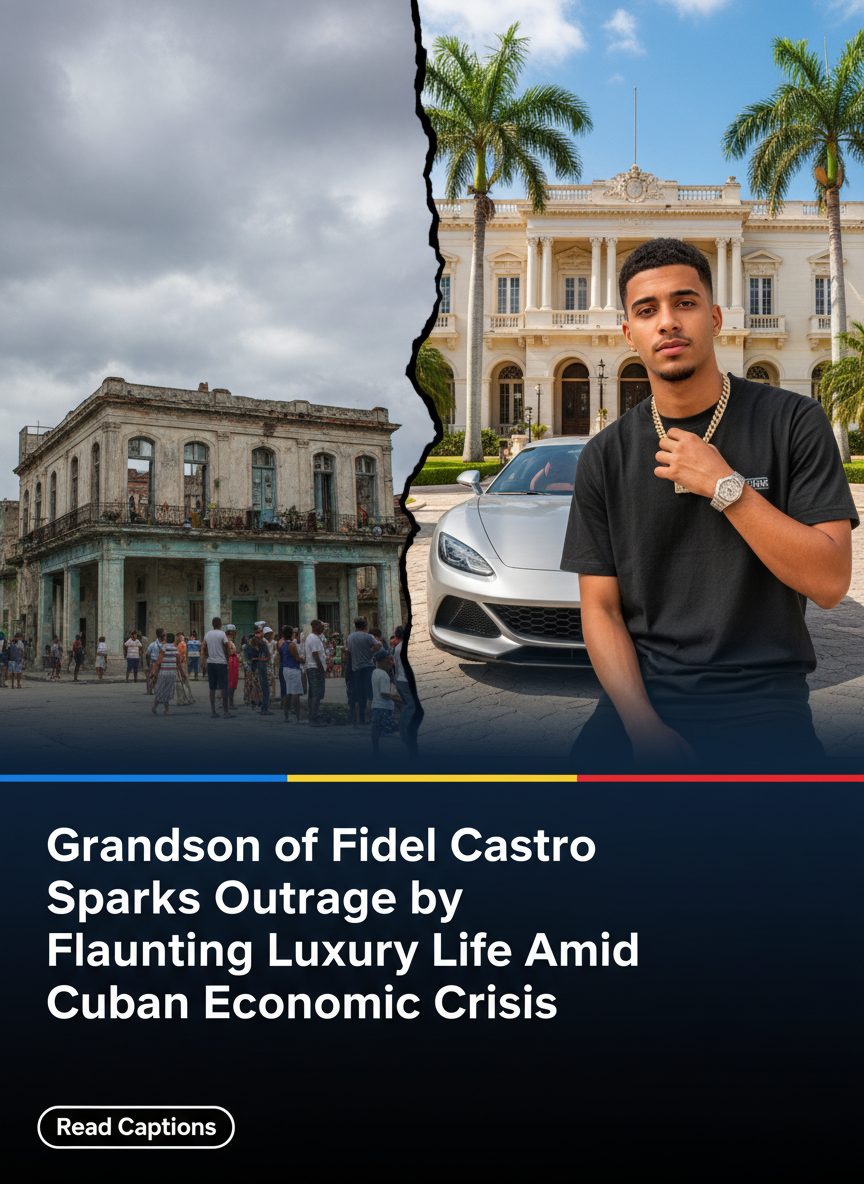
The Socialist Scion: Fidel Castro’s Grandson Stirs Controversy with Luxury Lifestyle and Political Satire
HAVANA — In a nation where the revolutionary slogan “Socialism or Death” still adorns crumbling limestone walls, a new digital window has opened into the lives of the “Red Aristocracy.” Sandro Castro, the grandson of the late revolutionary leader Fidel Castro, has become the center of a national firestorm, not for political manifestos, but for an Instagram feed brimming with imported beer, designer Nikes, and biting satire regarding the very economic decay his family’s legacy helped shape.
A Life of Leisure in a Land of Scarcity
While the average Cuban citizen grapples with record-breaking inflation, chronic power outages, and hours-long queues for basic rations, Sandro Castro’s social media presence tells a different story. His recent posts depict a life of high-end consumerism that is virtually unattainable for 99% of the island’s population. From high-speed drives in European luxury cars to snapshots of premium American sportswear, the imagery stands in stark, jarring contrast to the egalitarian ideals championed by his grandfather during the 1959 Revolution.
Particularly galling to many observers is the blatant display of “Yankee” luxury. Sandro is frequently seen sporting the latest Nike sneakers and drinking imported beverages—items that were once condemned by the revolutionary guard as symbols of “imperialist decadence.”
Satire Amidst the Ruins
What distinguishes Sandro’s recent activity from simple “wealth-flexing” is a newfound penchant for satire. In several posts, he has used dark humor to point out the deterioration of Cuba’s infrastructure and the absurdity of daily life on the island. By mocking the state of the economy, Sandro occupies a peculiar position: he is an insider laughing at a system built by his own lineage.
Adding a layer of modern political irony, Sandro has also leaned into jokes regarding former U.S. President Donald Trump and American capitalist tropes. Whether it is a tongue-in-cheek comment about “making Cuba great again” or riffing on the complexities of U.S.-Cuba relations, his content suggests a young man more interested in global influencer culture than in maintaining the ideological purity of the Communist Party.
The “Red Aristocracy” and Public Backlash
The backlash has been swift, both from the Cuban diaspora in Miami and from residents within the island who risk state scrutiny to voice their frustration. To many, Sandro represents the “Juniors”—the children and grandchildren of the revolutionary elite who enjoy the fruits of capitalism while the state continues to enforce a socialist command economy for the masses.
“It is a slap in the face,” says one Havana resident, who asked to remain anonymous for fear of reprisal. “We are told to sacrifice for the revolution, to endure the ‘Special Period,’ while they show off Nikes that cost more than a doctor’s yearly salary. They are no longer revolutionaries; they are just celebrities living off the family name.”
A Legacy in Flux
The Cuban government has traditionally been highly protective of the private lives of the Castro family. However, the rise of mobile internet and social media has made it increasingly difficult to maintain the veil of revolutionary asceticism. While Sandro has occasionally apologized in the past for “showing off”—notably after a 2021 video of him speeding in a Mercedes went viral—his current trajectory suggests a brazen indifference to public perception.
As Cuba navigates its most severe economic crisis in decades, the optics of the “Socialist Scion” may pose a significant PR challenge for the current administration. Sandro Castro’s Instagram feed is more than just a collection of photos; it is a digital testament to the widening gap between the rhetoric of the Cuban state and the reality of its ruling class.
Conclusion
For now, Sandro Castro continues to post, his feed a surreal mixture of party life and political commentary. Whether he is a symptom of a system in its twilight or simply a young man enjoying the spoils of his inheritance, his digital footprint has become a focal point for a nation’s collective frustration. In the Havana of 2026, it seems the revolution will not be televised—it will be filtered, captioned, and posted to Instagram.