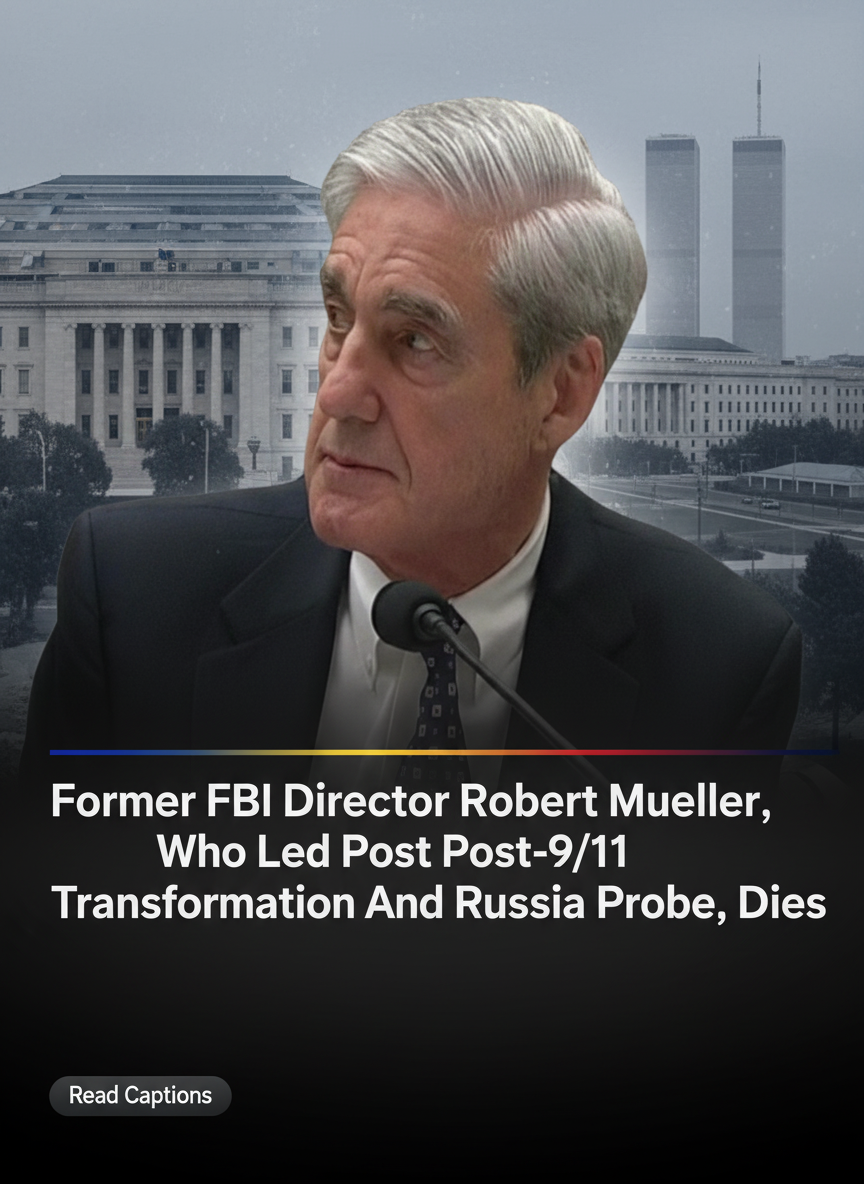
Robert Mueller, Former FBI Director and Special Counsel, Dies: A Legacy of Service and Stoicism
WASHINGTON — Robert S. Mueller III, the formidable former FBI Director who steered the bureau through the aftermath of the September 11 attacks and later led the high-stakes investigation into Russian interference in the 2016 election, has died. He was 81.
Mueller’s passing marks the end of a career defined by an uncompromising sense of duty and a “marine-like” discipline that earned him respect across the political spectrum for decades—before he became a lightning rod in one of the most polarized eras in American history.
Transforming the Bureau
Mueller took the helm of the FBI in September 2001, just one week before the terrorist attacks on the World Trade Center and the Pentagon. Tasked with a monumental mandate, he oversaw the most significant transformation in the agency’s history, pivoting the FBI from a traditional domestic law enforcement body into a global intelligence and counter-terrorism powerhouse.
His leadership was so highly regarded that in 2011, President Barack Obama asked him to stay on for an additional two years beyond his 10-year term—a request that required a special act of Congress. When he finally stepped down in 2013, he was the longest-serving director since J. Edgar Hoover.
The Special Counsel Era
While his work post-9/11 secured his place in history, Mueller returned to the national spotlight in 2017 when he was appointed Special Counsel to investigate ties between Donald Trump’s presidential campaign and Russia. For two years, Mueller became a silent but ubiquitous figure in the news, maintaining a strict policy of “no comment” while his team issued dozens of indictments against Russian operatives and high-ranking Trump associates.
The investigation culminated in the 2019 Mueller Report, which detailed extensive Russian efforts to influence the election. While the report did not find a criminal conspiracy between the campaign and Moscow, it notably declined to exonerate President Trump on the charge of obstruction of justice, famously stating, “If we had confidence that the President clearly did not commit a crime, we would have said so.”
A Life of Public Service
Born into a wealthy family and educated at Princeton, Mueller’s path was largely shaped by his service in the Vietnam War. As a Marine Corps platoon leader, he earned a Bronze Star and a Purple Heart, experiences that colleagues say instilled in him the rigid integrity and “straight-arrow” persona he maintained throughout his life.
Before becoming FBI Director, Mueller served as a federal prosecutor in San Francisco and Boston, and later as the head of the Justice Department’s criminal division. To many in Washington, he was known as “Bobby Three Sticks”—a nod to his Roman numeral suffix and his reputation as a formal, old-school institutionalist.
A Polarizing Final Chapter
The latter years of Mueller’s career were marked by intense political scrutiny. To his supporters, he was a steady hand defending the rule of law. To his critics, particularly on the right, he became a symbol of what they termed the “deep state.” Despite the noise, Mueller remained famously detached from the political fray, testifying before Congress in 2019 with a deliberate, sparse style that prioritized the written record over partisan theatrics.
Conclusion
Robert Mueller’s legacy is inextricably linked to the protection of the American institutional framework. Whether through his reorganization of national security or his navigation of a historic political crisis, his life was a testament to the rigors of public service. He is survived by his wife, Ann, and their two daughters. Funeral arrangements have not yet been announced.