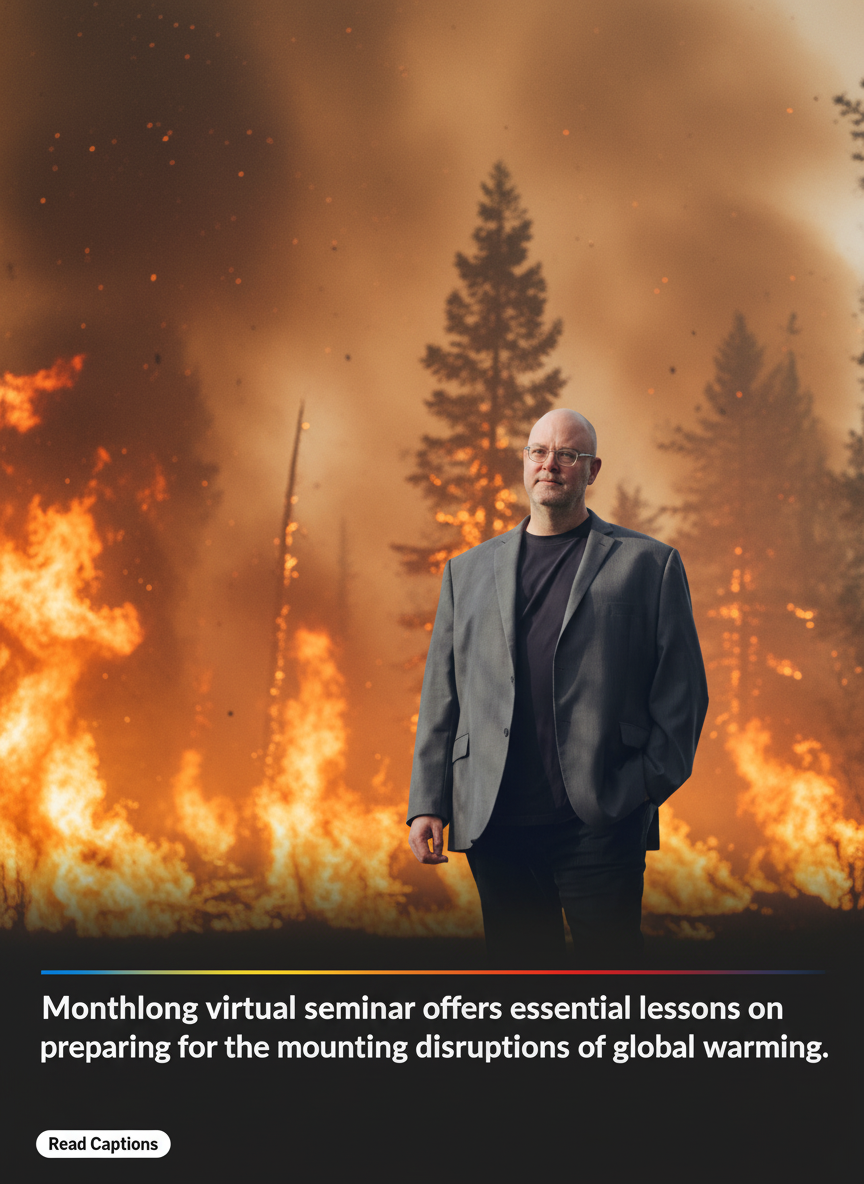
The following article is a comprehensive report based on the recent developments surrounding climate adaptation education and the virtual seminar mentioned in recent headlines.
Navigating the Unthinkable: New Yorkers Turn to Virtual Classrooms to Brace for Climate Chaos
NEW YORK — As the impacts of a warming planet transition from distant warnings to daily disruptions, a new kind of education is taking root in the digital sphere. For many, the traditional focus on “saving the planet” has shifted toward a more immediate, personal question: how to survive it.
Across the tri-state area and beyond, hundreds of residents have enrolled in a monthlong intensive virtual seminar titled “Anticipating the Unstable.” The course, which concluded its first session this week, offers a sobering curriculum on how to prepare for the systemic shocks of global warming—ranging from localized infrastructure failure to the collapse of global supply chains.
From Anxiety to Action
The seminar’s popularity highlights a growing phenomenon: climate anxiety is moving out of therapist offices and into practical workshops. Participants are no longer just looking for ways to reduce their carbon footprints; they are seeking a roadmap for a world where the “old normal” has been permanently discarded.
“We used to talk about climate change as something our grandchildren would face,” said Elena Rodriguez, a 42-year-old high school teacher from Brooklyn who attended the seminar. “Now, I’m looking at my basement flooding twice a year and food prices doubling. I’m not here to learn how to recycle. I’m here to learn how to keep my family safe when the power stays off for a week.”
A Curriculum for a Changing World
The seminar, led by a coalition of urban planners, disaster relief experts, and ecologists, breaks down the vast, overwhelming concept of “climate change” into manageable, actionable modules. Key areas of focus include:
- Hyper-Local Resiliency: Identifying “micro-climates” within urban environments and understanding which neighborhoods are most vulnerable to heat islands and flash flooding.
- Resource Independence: Lessons on off-grid energy solutions, water filtration basics, and urban gardening for supplemental nutrition.
- Economic Hedging: Financial strategies for a volatile future, including how to assess real estate risks and insurance gaps created by shifting climate zones.
- The Psychology of Chaos: Mental health techniques to manage the chronic stress of living in an era of constant environmental flux.
Dr. Julian Aris, a lead instructor and former emergency management consultant, noted that the goal is not to foster “doomerism,” but to build agency. “Chaos thrives on the unexpected,” Aris said during a recent Zoom session. “If you have a plan for the disruption, it is no longer chaos; it is simply a condition you are prepared to manage.”
A Shifting Perspective
The rise of these virtual classrooms reflects a broader shift in the public consciousness. While international policy debates continue to focus on mitigation—the slowing of carbon emissions—a growing segment of the population is pragmatically pivoting toward adaptation. This “prepper-lite” movement is increasingly mainstream, attracting professionals, parents, and retirees who once viewed survivalism as a fringe subculture.
In the New York region, where the memories of Hurricane Ida and the smoke-filled skies of recent wildfire seasons remain fresh, the demand for this knowledge is particularly high. The seminar organizers reported a 300% increase in enrollment compared to their pilot program last year.
The Community Component
Perhaps the most vital aspect of the seminar isn’t the technical advice, but the community it fosters. Virtual breakout rooms allow neighbors who might never have met in person to coordinate local response networks. Participants are encouraged to form “resiliency pods”—small groups that check on one another during extreme weather events or shared crises.
“There is a profound relief in being in a room—even a virtual one—where everyone admits they are scared,” said Rodriguez. “Once you stop pretending things are fine, you can actually start doing the work to make things better.”
As the monthlong session ends, participants are left with more than just a survival kit; they have a new lens through which to view their environment. In the face of mounting disruptions, these virtual students are proving that while the climate may be changing, the human capacity for foresight and cooperation remains a constant.