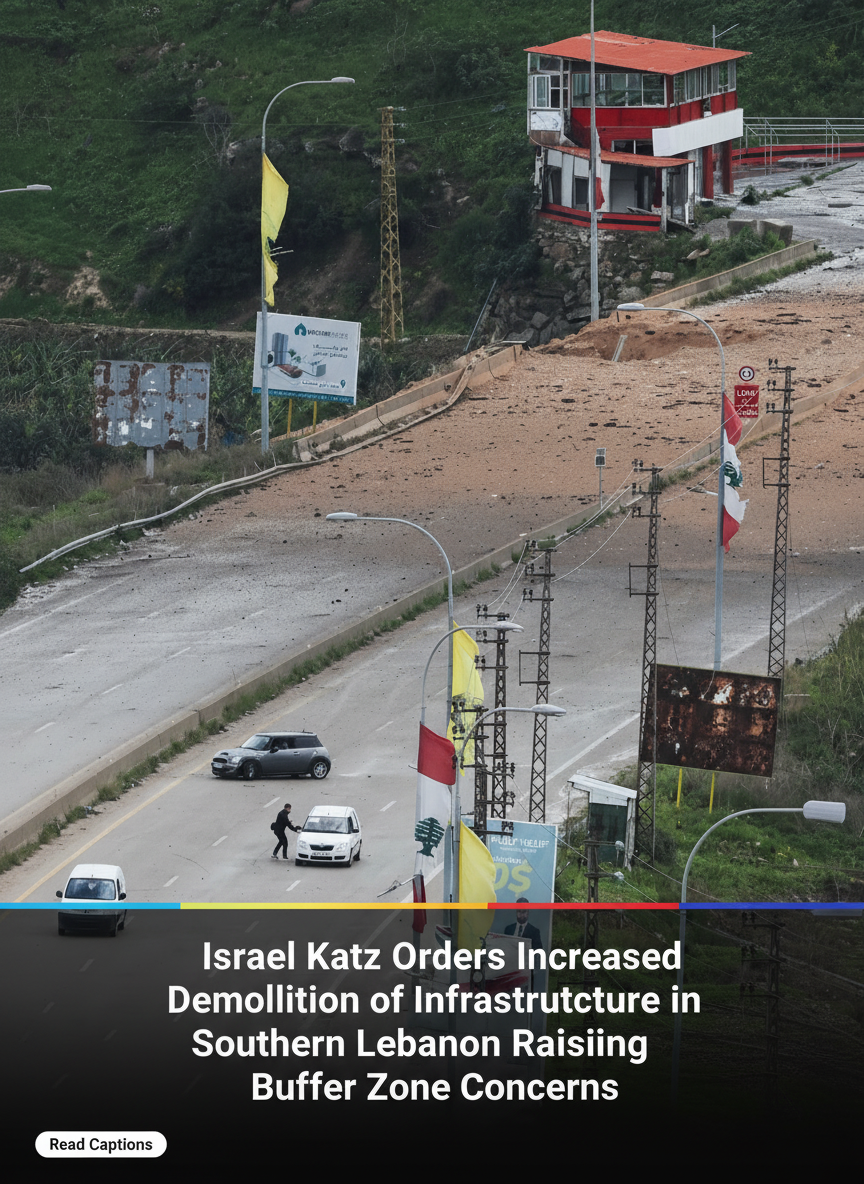
Strategic Ruin: Israel Orders Military to Intensify Demolitions in Southern Lebanon
By Global News Dispatch | Published March 22, 2026
JERUSALEM — In a move that signals a significant and potentially permanent shift in the landscape of the Middle East conflict, Israeli Defense Minister Israel Katz announced on Sunday that he has ordered the Israel Defense Forces (IDF) to “intensify” the destruction of infrastructure and residential buildings across southern Lebanon.
The directive, which specifically targets bridges, key transit routes, and structures suspected of being utilized by Hezbollah, has ignited fears among international observers that Israel is moving to establish a deep, uninhabitable military buffer zone. The escalation suggests that the current campaign has evolved beyond a mission to neutralize immediate threats into a broader strategy of territorial denial.
A “Systematic” Approach to Border Security
Speaking from a military briefing near the northern border, Minister Katz framed the new orders as a necessary step to ensure the safety of Israeli citizens. “Our instructions are clear,” Katz stated. “We are removing the infrastructure of terror. This is not merely a tactical necessity; it is a strategic imperative to ensure that Hezbollah can never again use these villages and bridges as a launchpad for invasion.”
Since the beginning of the month, IDF engineering units have been utilizing controlled demolitions to level entire city blocks in border towns like Meiss el-Jabal and Mhaibib. Under the new directive, these operations are expected to expand further north, targeting logistics chains and civil infrastructure that the Israeli military claims provide “dual-use” support for militant activities.
The Creation of a De Facto Buffer Zone
Military analysts and human rights organizations are increasingly concerned that the “intensified demolitions” are a precursor to a permanent military-controlled zone. By rendering southern Lebanese towns uninhabitable, Israel effectively creates a “no-man’s land” that would prevent displaced Lebanese civilians from returning to their homes even if a ceasefire were reached.
“What we are seeing is the systematic reshaping of the geography of southern Lebanon,” said Elena Rossi, a regional security expert. “By destroying bridges and leveling residential areas, the IDF is making it logistically impossible for a conventional life to resume in these areas. This looks less like a temporary military operation and more like the creation of a permanent security vacuum.”
Escalating Tensions and International Alarm
The Lebanese government in Beirut has condemned the order, calling it a “scorched earth policy” that violates international law and Lebanese sovereignty. Prime Minister Najib Mikati urged the United Nations Security Council to intervene, warning that the destruction of vital infrastructure would lead to a humanitarian catastrophe for the hundreds of thousands of civilians already displaced by the fighting.
In Washington, the White House expressed “deep concern” regarding the reports of widened demolitions. While reaffirming Israel’s right to defend itself against Hezbollah rockets, a State Department spokesperson cautioned that the “wholesale destruction of civilian infrastructure” could complicate future diplomatic efforts and further destabilize the fragile Lebanese state.
The Path Ahead
Hezbollah has responded to the increased demolitions by launching several barrages of long-range drones and missiles into northern and central Israel, indicating that the group is far from deterred. The militant organization issued a statement claiming that the “destruction of stones will only harden our resolve.”
As the smoke rises over the hills of southern Lebanon, the human and geopolitical cost of the conflict continues to climb. With the IDF now authorized to expand its demolition campaign, the prospect of a diplomatic resolution appears more distant than ever, replaced by the grim reality of a landscape being dismantled brick by brick in the name of security.