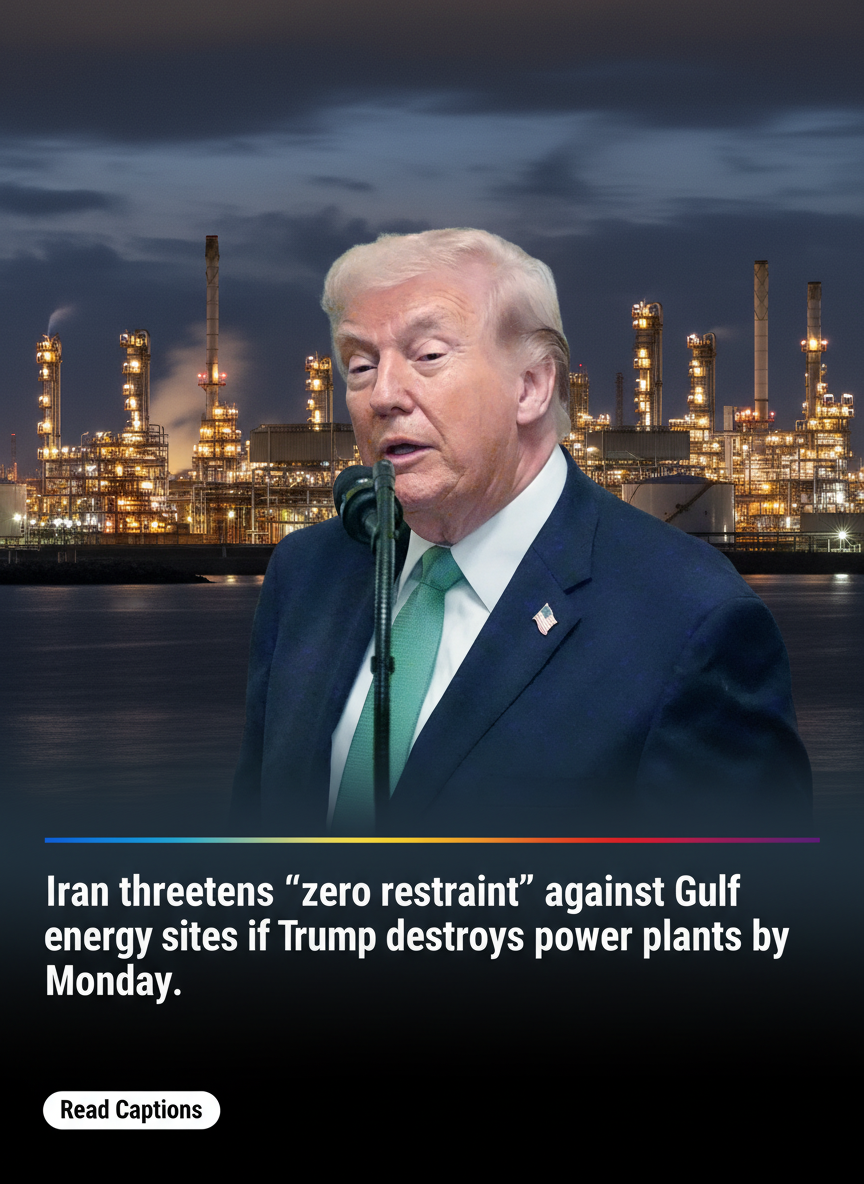
Global Energy Crisis Looms as Iran Vows ‘Zero Restraint’ Against Trump’s Ultimatum to Strike Power Plants
TEHRAN / WASHINGTON — The specter of a major regional conflict and a global economic shutdown has intensified as Tehran officially announced a policy of “zero restraint” regarding Persian Gulf energy infrastructure. The declaration comes as a direct response to President Donald Trump’s looming ultimatum, which threatens the “obliteration” of Iran’s domestic power plants if specific demands are not met by Monday night.
A Deadline for Destruction
Tensions reached a fever pitch over the weekend following a series of aggressive social media posts and official White House briefings. President Trump, citing national security concerns and Iranian regional “aggression,” issued a stark warning: if Tehran does not immediately halt its controversial enrichment programs and cease support for regional proxies, the United States military will begin a systematic destruction of Iran’s electrical grid and power generation facilities.
“The clock is ticking,” the President stated during a press conference on the South Lawn. “Iran has been warned for years. We will not allow a regime that threatens our allies to keep the lights on while they plot in the dark. By Monday night, if they don’t comply, their power plants will be gone.”
Tehran’s ‘Zero Restraint’ Counter-Strike
The Iranian leadership did not wait long to respond. In an emergency broadcast via state-run media, Iranian officials detailed a new military doctrine of “zero restraint.” Under this policy, any strike on Iranian soil will be met with immediate and disproportionate attacks on energy facilities, oil tankers, and refineries throughout the Persian Gulf—including those belonging to U.S. allies.
“If the United States chooses the path of fire, the entire region will be consumed by it,” a spokesperson for the Iranian Revolutionary Guard Corps (IRGC) said. “Our finger is on the trigger. If our citizens are forced to sit in the dark, the world’s energy supply will be extinguished alongside them. There will be no restraint, no limited response, and no sanctuary for those who support Washington’s madness.”
Global Markets on Edge
The escalating rhetoric has sent shockwaves through international markets. Oil futures surged by nearly 12% in early trading as analysts warned that a conflict in the Strait of Hormuz—the world’s most critical oil chokepoint—could push prices to historic highs. Shipping companies have already begun rerouting tankers, while insurance premiums for vessels in the region have skyrocketed.
In Europe and Asia, diplomatic missions are working frantically to de-escalate the situation. UN Secretary-General António Guterres called for “immediate calm,” warning that the world “cannot afford another war in the Middle East, nor a total collapse of the global energy transition.”
A Region Bracing for Impact
Military movements have been reported on both sides. U.S. Central Command (CENTCOM) has reportedly moved additional carrier strike groups into the North Arabian Sea, while Iran has been observed mobilizing mobile missile batteries along its southern coastline.
Domestically, the Iranian population is reportedly bracing for the Monday night deadline, with citizens in Tehran and Isfahan rushing to stock up on fuel, water, and food. In the U.S., the President’s ultimatum has drawn a mix of staunch support from hawks in Congress and fierce criticism from those who fear an unchecked escalation into a full-scale ground war.
Conclusion: The Final Countdown
As the Monday night deadline approaches, the international community remains in a state of high alert. The standoff represents the most significant brinkmanship between the two nations in decades. With the U.S. military poised to strike and Iran vowing to take the global energy market down with it, the next 24 hours will determine whether the path forward is one of diplomatic compromise or a devastating regional conflagration.
This is a developing story. Follow our live blog for real-time updates on the Middle East crisis.