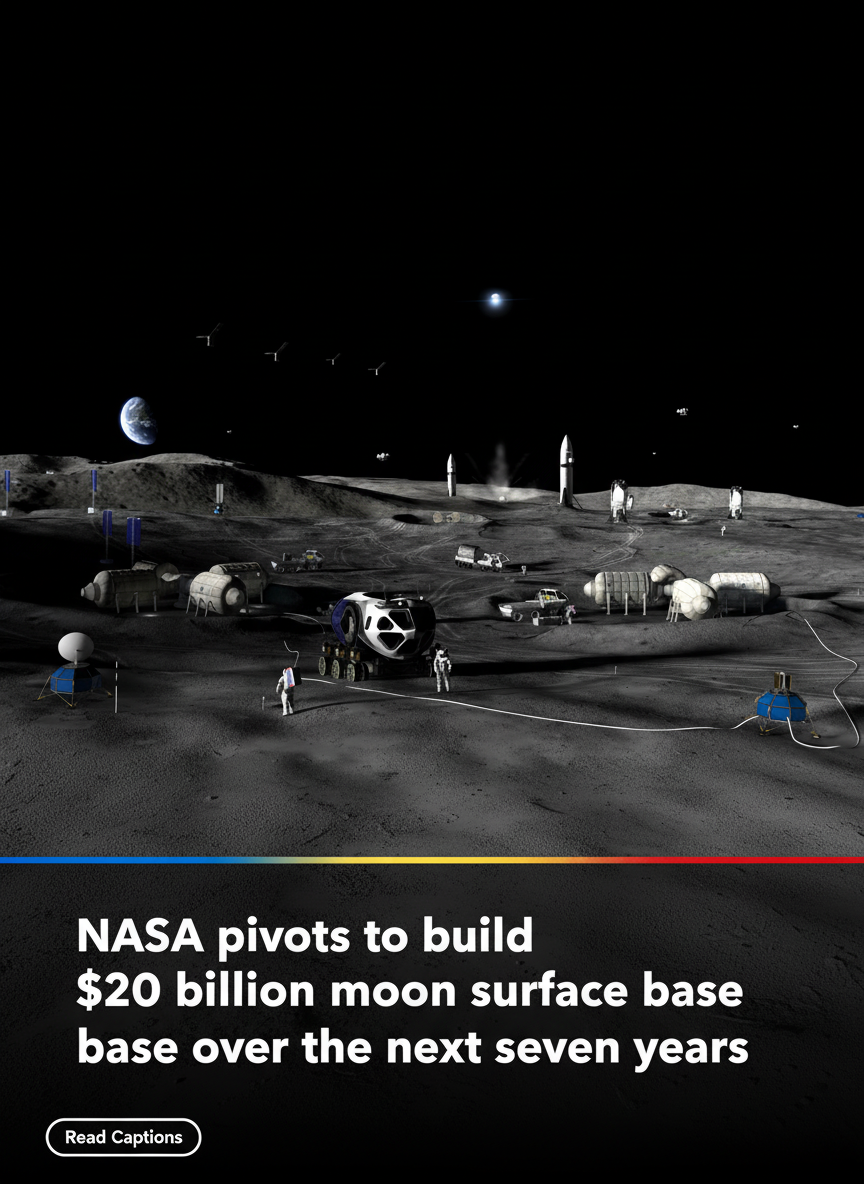
From Orbit to Surface: NASA Pivots to $20B Moon Base, Scraps Gateway Station
WASHINGTON D.C. — In a monumental shift for the future of deep-space exploration, NASA announced Tuesday a radical pivot in its Artemis program. The space agency is officially scrapping plans for the “Gateway”—the long-anticipated space station intended to orbit the Moon—in favor of a permanent, $20 billion habitable base located directly on the lunar surface.
A Strategic Reversal
For years, the Gateway was envisioned as a vital “pit stop” for astronauts traveling to the lunar surface and eventually to Mars. However, citing the need for more direct scientific engagement and the logistical benefits of a fixed ground site, NASA officials confirmed that the orbiting station’s components will now be repurposed for “Artemis Base Alpha.”
The decision marks one of the most significant course corrections in NASA’s history. By moving resources from orbit to the surface, the agency aims to establish a “sustained human presence” that can tap into lunar resources, such as water ice located in the Moon’s permanently shadowed craters, more efficiently than an orbiting platform could.
How Long Will Construction Take?
The timeline for this ambitious project is remarkably aggressive. NASA Administrator Bill Nelson stated that the agency expects the base to be fully operational within the next seven years, targeting a completion date of 2033.
“We aren’t just visiting the Moon anymore; we are moving in,” a NASA spokesperson said during the press briefing. “By repurposing the modules already developed for the Gateway, we are shaving years off the development cycle for a surface habitat. We expect the first foundational modules to touch down by late 2028.”
The $20 Billion Reallocation
The price tag for the base is estimated at $20 billion. While the figure is staggering, economists note that much of this funding is being redirected from the now-cancelled Gateway contracts. By consolidating the budget into a single surface-based goal, NASA hopes to avoid the “complexity tax” of maintaining two separate multi-billion-dollar environments (one in orbit and one on the ground).
The $20 billion investment will cover:
- Pressurized Habitats: Living quarters for up to six astronauts.
- Power Grids: Advanced solar arrays and kilopower nuclear reactors to survive the 14-day lunar night.
- Mobility Systems: Pressurized rovers that allow astronauts to travel miles from the base.
- Resource Extraction: Pilot plants to test the conversion of lunar regolith into building materials and oxygen.
Why the Change?
The pivot comes amid increasing competition in the “New Space Race.” With international players and private entities like SpaceX and Blue Origin accelerating their own lunar plans, NASA felt the need to establish a “boots-on-the-ground” presence sooner rather than later. Experts suggest that a surface base provides a much more effective testing ground for the technologies required for an eventual mission to Mars.
“A station in orbit is a feat of engineering, but a base on the surface is a colony,” said Dr. Aris Thorne, a senior space policy analyst. “This move prioritizes geology, resource utilization, and long-term survival—skills we need if we ever want to see a human on the Red Planet.”
Looking Ahead
While the cancellation of the Gateway station may frustrate international partners who had already committed modules to the project, NASA has assured its allies that their contributions will be integrated into the surface architecture. The European Space Agency (ESA) and Japan’s JAXA are expected to play key roles in the life-support and communication systems of the new $20 billion base.
As the seven-year countdown begins, the world will be watching to see if NASA can turn this bold vision into a reality. If successful, the year 2033 will see the Moon transformed from a distant satellite into humanity’s first true outpost in the cosmos.