‘Systemic Failure’: Investigators Reveal Deepening Confusion in Deadly LaGuardia Air Canada Collision
NEW YORK — Federal investigators released alarming new details Tuesday regarding the catastrophic collision at LaGuardia Airport involving an Air Canada jet and an airport firetruck, painting a chilling picture of institutional confusion that spanned from the air traffic control tower to the tarmac.
The updated report from the National Transportation Safety Board (NTSB) suggests that the tragedy, which has sent shockwaves through the aviation industry, was not the result of a single mechanical failure, but rather a cascading series of communication breakdowns and procedural lapses.
A Breakdown in the Tower
According to the latest investigative findings, the moments leading up to the impact were defined by a “total loss of situational awareness” within the control tower. Transcripts and radar data indicate that controllers were struggling with a high volume of traffic and shifting weather conditions, leading to a critical oversight regarding the position of emergency ground vehicles.
Investigators revealed that the Air Canada flight—an Airbus A220 arriving from Toronto—had been cleared for landing on Runway 4 while a Port Authority firetruck was still positioned near a critical taxiway intersection. Despite advanced surface detection equipment designed to prevent such incursions, the warning systems were reportedly ignored or misinterpreted in the heat of the moment.
Confusion on the Ground
The report emphasizes that the confusion was not limited to the air. Ground crews and emergency responders appeared to be operating under conflicting instructions. “It wasn’t just a failure of the eyes in the sky,” noted one lead investigator. “The ground units were operating in a vacuum of information, believing they had clearance to cross a ‘hot’ runway during the height of the arrival bank.”
Testimony from ground personnel suggests that radio congestion played a significant role. Multiple vehicles were reportedly using a secondary frequency that was not being actively monitored by the primary ground controller, leading to a fatal gap in coordination.
The Moment of Impact
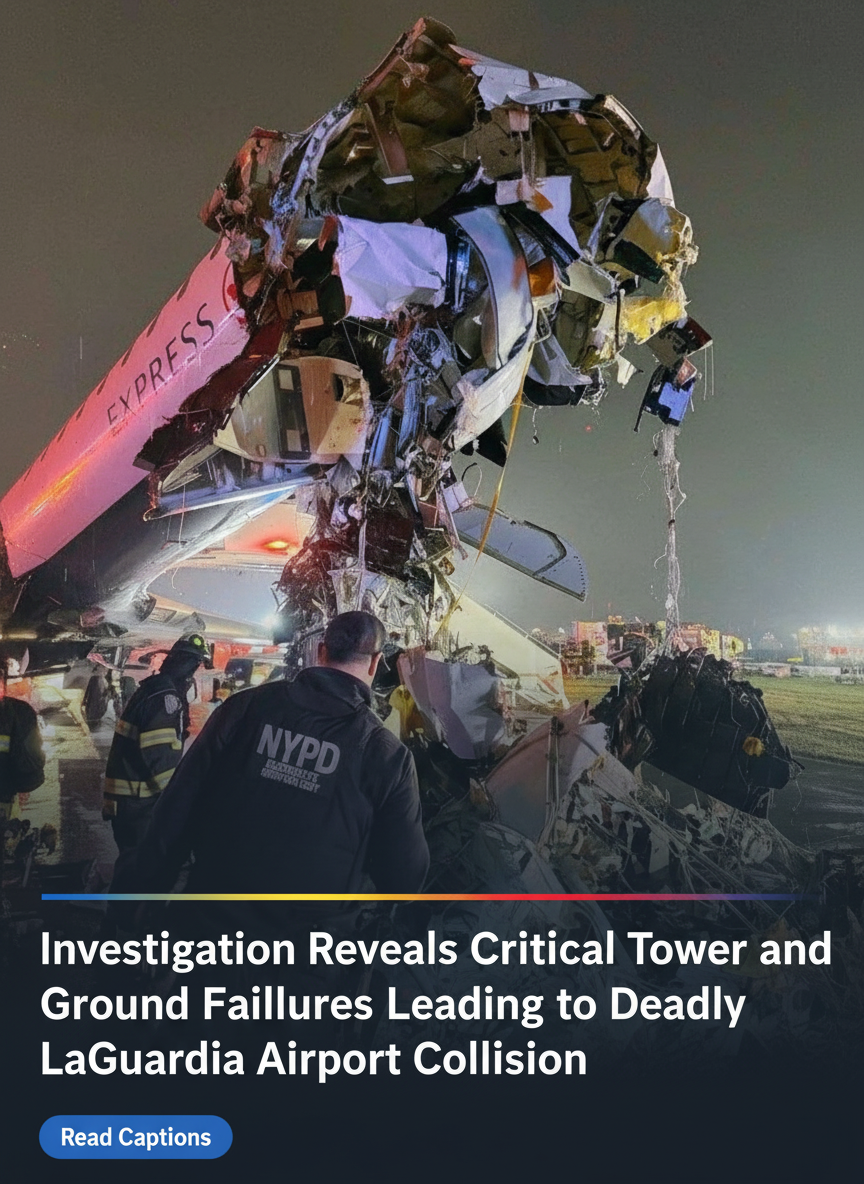
Witnesses described a horrific scene as the Air Canada jet, traveling at high speed upon touchdown, attempted an emergency maneuver to avoid the heavy rescue vehicle. The wing of the aircraft struck the roof of the firetruck, resulting in a massive debris field and a localized fire that took emergency teams nearly an hour to fully contain.
While the exact number of casualties remains part of the ongoing inquiry, the NTSB confirmed that the “deadly” nature of the crash was exacerbated by the angle of the impact, which compromised the structural integrity of both the cockpit of the truck and the passenger cabin near the wing root.
“This incident represents a systemic failure of the safety redundancies we rely on to keep New York’s airspace secure,” said an aviation safety consultant. “To see this level of confusion in a modern, high-tech tower is frankly unprecedented in the post-ADS-B era.”
Industry Repercussions and Next Steps
In response to the Tuesday briefing, the Federal Aviation Administration (FAA) announced an immediate “safety stand-down” for all ground operations at LaGuardia to review runway incursion protocols. Air Canada has also issued a statement expressing its “deepest condolences” to the families of those lost and is cooperating fully with the NTSB.
The investigation is now expected to pivot toward the “human factors” involved, including the training records of the controllers on duty and the fatigue management protocols in place at the time of the accident. A final report, which will include formal recommendations for safety improvements, is not expected for several months.
For now, LaGuardia continues to operate with heightened caution, as a community mourns and the aviation world grapples with how such a preventable tragedy could occur at one of the nation’s busiest hubs.