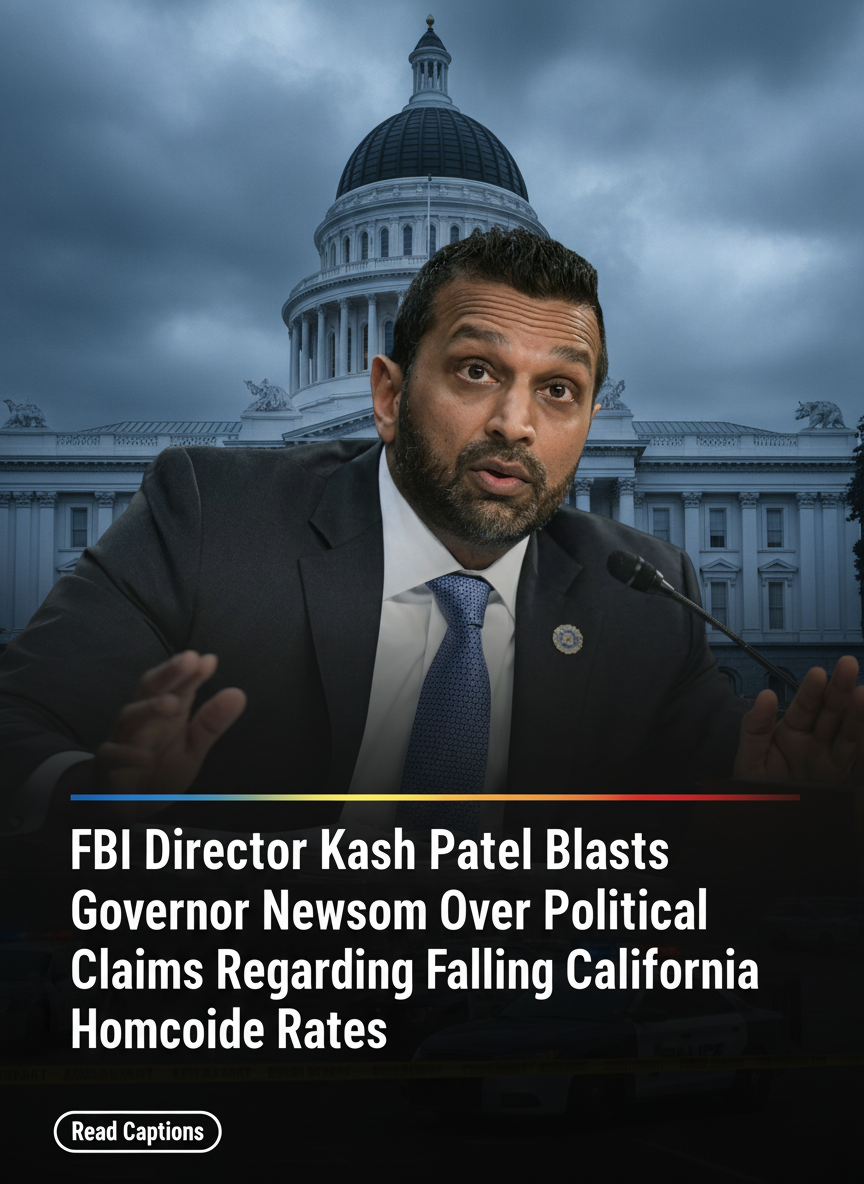
Federal Friction: FBI Eviscerates Gov. Newsom Over Homicide Statistics and ‘Soft-on-Crime’ Policies
A high-stakes digital war of words erupted Tuesday between the Federal Bureau of Investigation and the office of California Governor Gavin Newsom, signaling a deepening divide between federal law enforcement and state leadership over the nation’s public safety narrative. The conflict centered on a sharp decline in 2025 homicide rates, which Newsom’s team characterized as a landmark victory for Democratic governance—a claim the FBI quickly dismissed as misleading “statistical gaslighting.”
The social media spat began when Governor Newsom’s press shop released a series of graphics touting a significant year-over-year drop in murders across California’s major metropolitan areas. Newsom’s team framed the data as a validation of the state’s progressive justice reforms and “holistic” approach to public safety. However, the celebration was short-lived as FBI Director Kash Patel’s office issued a scathing rebuttal, accusing the Governor of taking a victory lap on the backs of hardworking local officers while ignoring the consequences of “soft-on-crime” policies.
The Statistics in Question
According to preliminary data for 2025, homicide rates in several of California’s largest cities have fallen sharply compared to the spikes seen in 2023 and 2024. Gov. Newsom was quick to link these figures to state-funded violence intervention programs and stricter firearm regulations. “The data is clear: our investments in community safety are saving lives,” Newsom stated in a post that set the stage for the federal backlash.
The FBI’s response was uncharacteristically blunt for a federal agency. In a statement released shortly after, the Bureau argued that the decline in homicides is part of a broader national trend and occurs despite—not because of—California’s controversial policies regarding retail theft and early prisoner release. The FBI’s press shop went as far as to label the Governor’s claims as an attempt to “distort the reality of the daily dangers faced by Californians.”
A War of Words
The exchange escalated throughout the afternoon, with Director Kash Patel weighing in on the necessity of “law and order” over “political optics.” Sources close to the Director suggest that the FBI is concerned that the Governor’s rhetoric minimizes the ongoing issues with property crime and open-air drug markets, which many argue have flourished under Newsom’s tenure.
“It is a disservice to victims of crime to curate statistics that ignore the broader collapse of public order in our cities,” a spokesperson for the FBI noted. “Taking credit for a drop in murders while retail theft and fentanyl distribution remain at crisis levels is a cynical exercise in political rebranding.”
Newsom’s aides hit back, accusing the FBI of “partisan posturing” and suggesting that the Bureau, under Patel’s leadership, is being weaponized to attack Democratic states. “It’s unfortunate that the FBI is prioritizing Twitter spats over the actual data showing that California is becoming safer,” a spokesperson for the Governor’s office retorted.
The Political Stakes
The clash highlights the growing tension between the federal government and blue-state governors as the 2026 election cycle begins to take shape. For Newsom, maintaining a “tough-but-fair” image is crucial for his national standing. For Director Patel and the FBI, the priority remains a pivot toward aggressive federal intervention in cities they deem “anarchic.”
Policy experts suggest that while the homicide numbers are indeed lower, the public perception of safety remains a major hurdle for Newsom. High-visibility crimes, such as organized retail “smash-and-grabs” and the persistent homelessness crisis, continue to dominate the headlines, often overshadowing the decline in violent crime statistics.
Conclusion
As the debate moves from social media to the halls of policy-making, the rift between Sacramento and Washington D.C. appears wider than ever. While 2025 may have seen fewer homicides, the battle over who deserves the credit—and who bears the blame for the remaining lawlessness—is only just beginning. For now, the “win” Newsom sought to claim remains a point of fierce contention, with the FBI making it clear they will not let the Governor’s narrative go unchallenged.