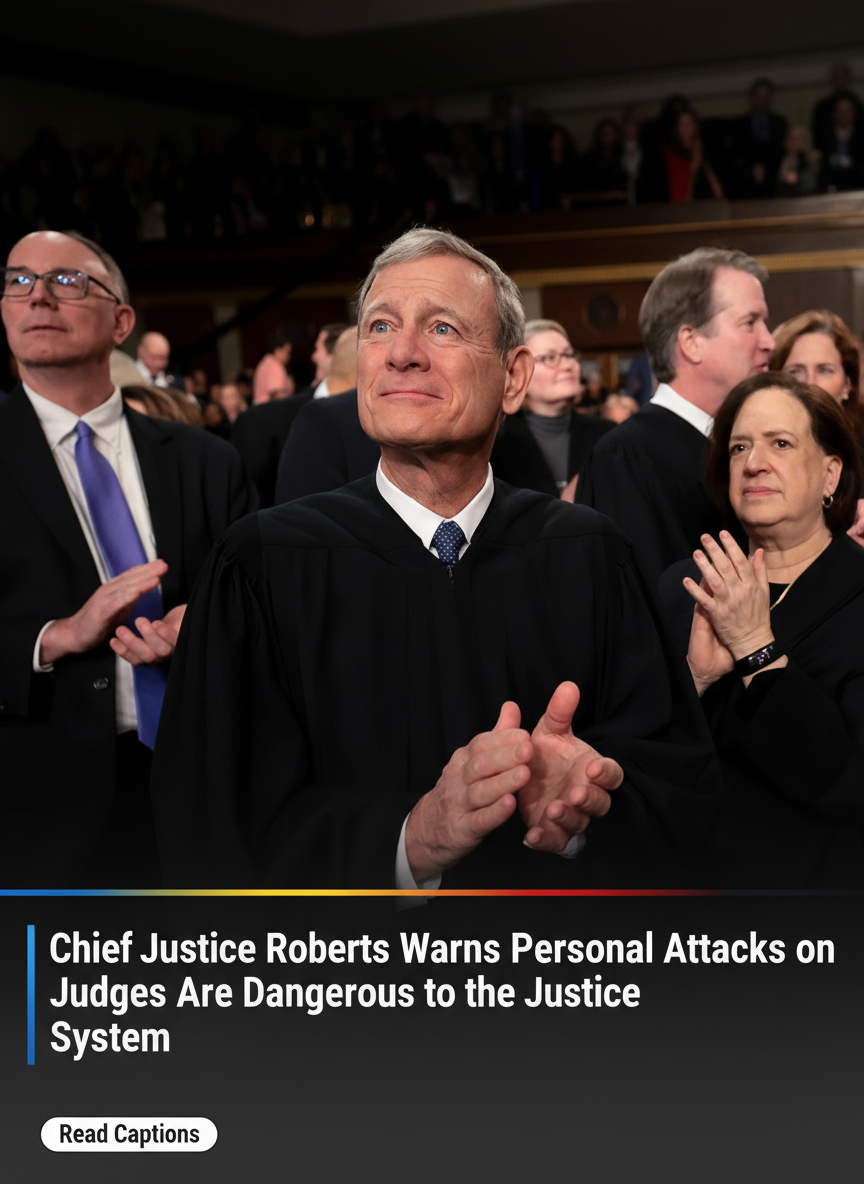
Defending the Bench: Chief Justice Roberts Warns Against ‘Dangerous’ Personal Attacks on Judges
WASHINGTON — In a rare and pointed defense of the American judiciary, Chief Justice John Roberts issued a stern warning Tuesday regarding the rising tide of personal criticism and hostility directed at the nation’s judges. While the Chief Justice did not mention him by name, the remarks are widely viewed as a direct response to former President Donald Trump’s recent social media broadsides against the court system.
A Call for Judicial Civility
Speaking to an audience of legal professionals and stakeholders, Roberts emphasized that the personal nature of recent attacks represents a “dangerous” shift in political discourse. He argued that while the law and judicial opinions are always subject to healthy debate, targeting the individuals behind the bench undermines the very foundation of the rule of law.
“The independence of the judiciary is not for the benefit of the judges, but for the benefit of the public,” Roberts noted. He cautioned that when political figures transition from legal disagreement to personal animosity, they risk inciting a climate of fear that could compromise the safety of judicial officers and the integrity of their rulings.
Context of the Conflict
The Chief Justice’s comments follow a weekend of high-octane rhetoric from former President Donald Trump. Utilizing his Truth Social platform, the former president launched a series of “tirades” against various judges presiding over his ongoing legal challenges, labeling them as biased and politically motivated.
Trump’s rhetoric has historically targeted specific members of the bench, including those in high-profile New York civil cases and federal criminal proceedings. Legal experts note that such public denunciations often lead to a surge in threats against court personnel, prompting increased security measures at courthouses across the country.
Maintaining the ‘Non-Partisan’ Shield
This is not the first time Chief Justice Roberts has felt compelled to defend the court’s reputation. Roberts has long been a proponent of the idea that there are no “Obama judges” or “Trump judges,” but rather a dedicated group of professionals striving to apply the law fairly. However, maintaining this image has become increasingly difficult in an era of hyper-polarization.
Observers suggest that Roberts is attempting to walk a fine line: protecting the institution from political interference while ensuring the Supreme Court does not appear to be entering the political fray itself. By framing the issue as one of public safety and institutional stability, Roberts seeks to elevate the conversation beyond partisan bickering.
A Growing Concern for Safety
The “dangerous” nature of these attacks is not merely metaphorical. The U.S. Marshals Service has reported a significant increase in threats against federal judges over the last several years. Roberts’ warning serves as a plea to political leaders to consider the real-world consequences of their rhetoric.
“When hostility replaces reason, the court’s ability to serve as a neutral arbiter is threatened,” said one constitutional scholar following the speech. “Roberts is signaling that the judiciary will not be intimidated, but he is also sounding an alarm that the guardrails of democracy are being tested.”
Looking Ahead
As the election season intensifies and several high-stakes legal battles involving the former president head toward resolution, the tension between the executive and judicial branches is expected to remain at a boiling point. Whether Roberts’ plea for civility will be heeded by political actors remains to be seen.
For now, the Chief Justice’s message is clear: the robes may be black and white, but the threats facing those who wear them are increasingly vivid. The stability of the American legal system, Roberts suggests, depends on a mutual respect that currently seems to be in short supply.