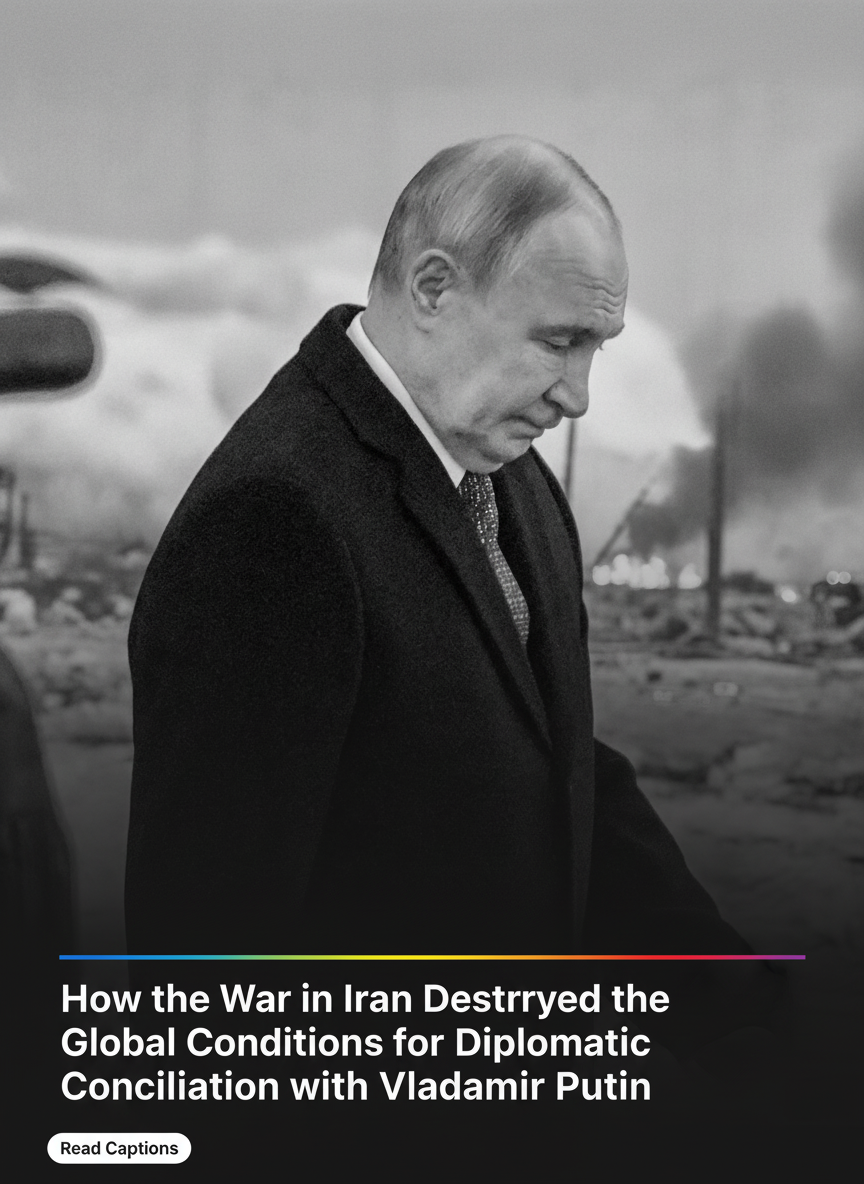
The Iranian Pivot: How a New Conflict Shattered Putin’s Hopes for a Reset
MOSCOW — For years, the strategic calculus in the Kremlin was defined by the frozen fields of Ukraine and the hope that a weary West might eventually return to the negotiating table. But as of March 2026, that era of tentative maneuvering has come to an abrupt, violent end. The outbreak of full-scale war in Iran has not just added a new theater of conflict; it has fundamentally overturned the conditions for conciliation that Vladimir Putin had spent years cultivating.
The End of the ‘Great Reset’ Delusion
Until recently, many observers believed that Russia was looking for an “off-ramp”—a way to solidify its gains in Eastern Europe and restore some semblance of economic normalcy with Europe. High-level backchannels in neutral capitals were reportedly buzzing with talk of a “grand bargain.”
However, the rapid destabilization of Iran—Russia’s most critical military and sanctioned-trade partner—has vaporized those prospects. In one fell swoop, the war has forced Putin to abandon the luxury of a slow-burn strategy. “The Iranian conflict has acted as a centrifugal force,” says Elena Sokolova, a senior analyst at the Center for Eurasian Studies. “It has pulled Moscow away from any potential compromise with the West and pushed it into a corner where aggression is the only remaining currency.”
A Mutual Dependency Turned Trap
The relationship between Moscow and Tehran has evolved from a marriage of convenience into a survival pact. Iran’s role as a primary supplier of drone technology and ballistic missiles was essential for Russia’s sustained pressure on Kyiv. Now, with Iran’s own regime facing existential threats from regional adversaries and internal unrest, the “rear guard” of the Russian war machine is on fire.
For Putin, this means the conditions for conciliation have been replaced by the necessity of intervention. Russia can no longer afford to be a passive observer in the Middle East. To lose Iran as a functional ally would be to lose the geopolitical flank that allows Russia to bypass Western sanctions and project power into the Global South.
The Geopolitical Domino Effect
The shifting tides have also sent shockwaves through NATO and the Pentagon. The prospect of a “two-front” geopolitical struggle—maintaining the defense of Ukraine while preventing a total collapse of the Middle Eastern order—has strained Western resources. Yet, for Putin, the war in Iran offers no such balance; it is a zero-sum game.
By siding decisively with Tehran in this new conflict, Putin has effectively burned the bridges he was quietly trying to rebuild with Washington and Brussels. The narrative of a “responsible great power” seeking a new security architecture in Europe has been replaced by the reality of a leader tethered to a regional conflagration that he cannot control, but cannot afford to lose.
Conclusion: A World Without Conciliation
As the smoke rises over the Persian Gulf, the vision of a negotiated peace in 2026 feels more distant than ever. Putin’s strategic “everything” has indeed changed. The war in Iran has stripped away the ambiguity of Russian foreign policy, leaving behind a Kremlin that is more isolated, more desperate, and increasingly committed to a total confrontation with the Western-led order.
For the Russian leadership, the path to conciliation is now blocked by the very alliances they built to survive. The world must now prepare for a Russia that no longer seeks a seat at the table, but rather seeks to overturn the table entirely.