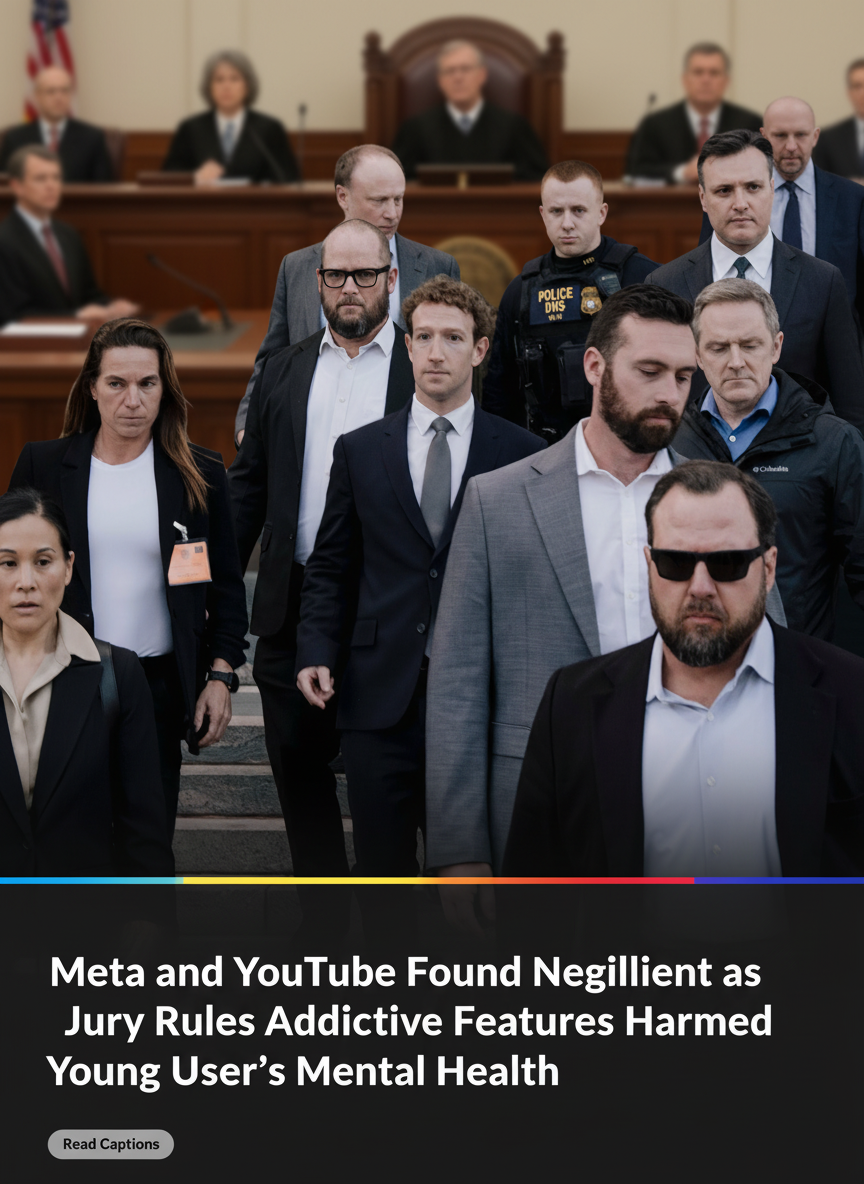
Landmark Verdict: Meta and YouTube Found Negligent in Social Media Addiction Trial
By David Sterling, Technology Correspondent
Published March 25, 2026
SAN FRANCISCO — In a decision that could fundamentally reshape the landscape of the American internet, a federal jury on Wednesday found Meta and Google-owned YouTube negligent in their design of social media platforms, marking the first time a court has held tech giants directly responsible for the mental health crisis affecting young users.
The jury in the U.S. District Court for the Northern District of California awarded $45 million in damages to 19-year-old Maya Rodriguez, who alleged that the companies’ “predatory” design features—including infinite scroll, push notifications, and AI-driven recommendation loops—led her into a spiral of clinical depression, eating disorders, and self-harm.
A Turning Point for Big Tech
The verdict follows a six-week trial that saw executives from both companies grilled over internal documents. These documents, some of which were leaked during the discovery phase, allegedly showed that engineers were aware that certain features exploited the dopamine pathways of developing adolescent brains but chose to prioritize “engagement metrics” over user safety.
“This is the ‘Big Tobacco’ moment for social media,” said Linda Thorne, a lead attorney for the plaintiff. “For years, these companies have hidden behind the shield of Section 230, claiming they are merely neutral platforms. Today, a jury of their peers said otherwise: their product is the design, and that design is defective and dangerous.”
The Case of Maya Rodriguez
The trial centered on the experiences of Ms. Rodriguez, who began using Instagram and YouTube at the age of 11. Her legal team presented data logs showing she spent upwards of eight hours a day on the apps during her middle school years. The plaintiff argued that the platforms’ algorithms specifically funneled her toward “thinspo” and “pro-ana” content, despite her initial searches for healthy recipes and fitness tips.
Expert witnesses for the plaintiff testified that the “variable reward” system utilized by Meta’s notifications and YouTube’s “Auto-play” feature created a behavioral addiction similar to that seen in pathological gamblers. The jury found that the companies failed to provide adequate warnings or robust parental controls to mitigate these known risks.
The Defense and the Appeal
Meta and YouTube defended their platforms by citing their extensive investments in safety tools and mental health resources. In a statement following the verdict, a spokesperson for Meta expressed deep disappointment.
“While we have the utmost sympathy for the challenges young people face today, we disagree with the jury’s findings,” the Meta statement read. “We have developed over 50 tools to support teens and parents, and we believe the law and the facts do not support the conclusion that our design choices constitute negligence. We intend to appeal.”
Legal analysts suggest that the tech companies will likely focus their appeal on Section 230 of the Communications Decency Act, which has historically protected platforms from liability for the content posted by their users. However, this case focused on the mechanics of the apps—the “product design”—rather than the content itself, a distinction that allowed the lawsuit to proceed to trial.
Impact on the Industry
The verdict has sent shockwaves through Silicon Valley. Shares of Meta and Alphabet (Google’s parent company) fell by 4% and 3.2% respectively in after-hours trading. Industry observers believe this ruling will embolden thousands of similar pending lawsuits across the country.
“This changes the calculus for every product manager in tech,” said Sarah Jenkins, a digital ethics researcher at Stanford University. “The era of ‘move fast and break things’ has met its match in a courtroom. We are likely looking at a future where apps are required to have ‘circuit breakers’ for usage time and far stricter algorithmic transparency.”
Conclusion
As the legal battle moves to the appellate courts, the Rodriguez verdict remains a historic rebuke of the business models that have defined the last two decades of the internet. For Maya Rodriguez, the victory is more personal. Speaking briefly outside the courthouse, she said, “I hope this means no other kid has to get lost in a screen the way I did.”