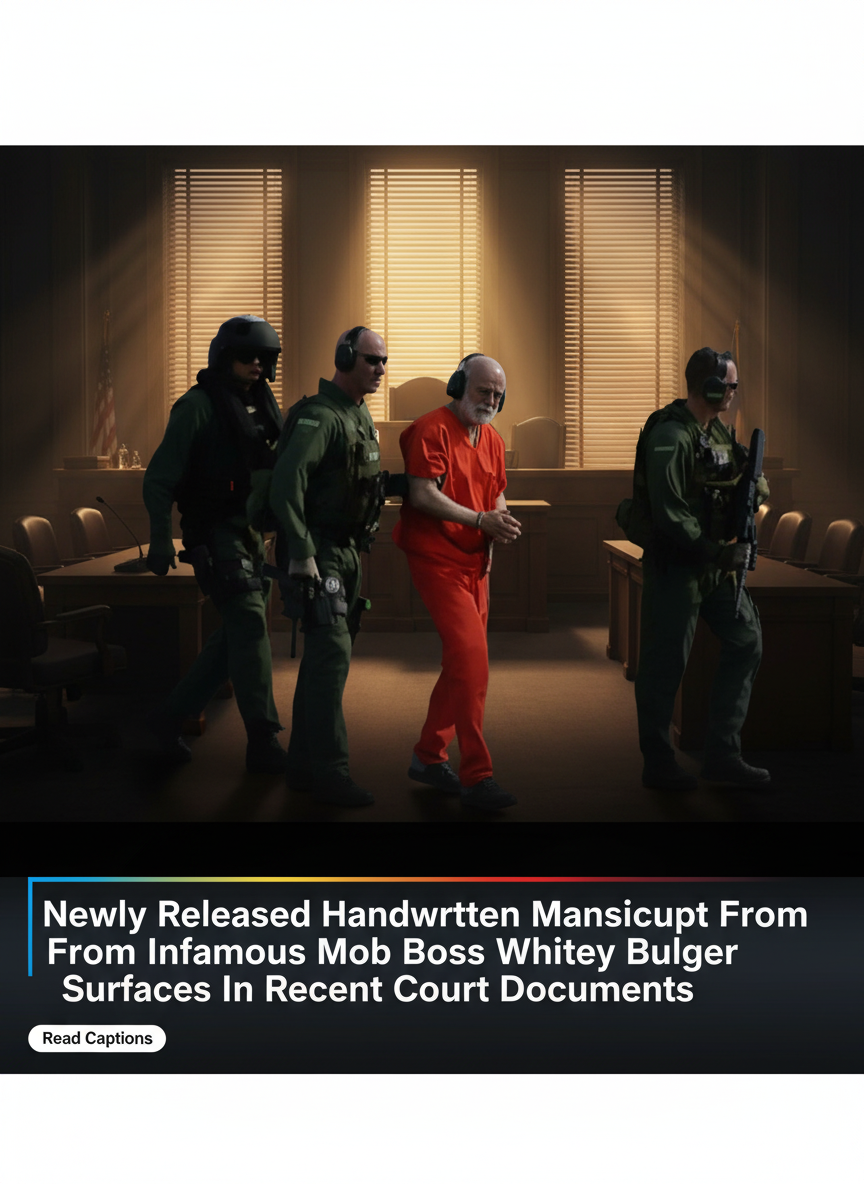
Echoes from a South Boston Cell: Handwritten Whitey Bulger Manuscript Unveiled in Federal Court
BOSTON — More than seven years after his brutal death inside a federal penitentiary, the voice of James “Whitey” Bulger has emerged from the grave. In a series of recently unsealed court documents, a 70-page handwritten manuscript penned by the notorious South Boston mob boss has been made public, offering a chilling and deeply personal look into the mind of one of America’s most infamous criminals.
A Voice from Beyond the Grave
Bulger, the former leader of the Winter Hill Gang who ruled the streets of South Boston for decades, was beaten to death in 2018 at the age of 89, just hours after being transferred to USP Hazelton in West Virginia. While the man himself is gone, the release of these documents serves as a final, posthumous testimony to a life defined by violence, secrecy, and a complicated relationship with the law.
The manuscript, written in Bulger’s distinctive cursive, was filed as part of ongoing legal proceedings involving his estate. It provides a narrative that spans his childhood during the Great Depression, his rise through the ranks of the Boston underworld, and his perspective on the sixteen years he spent as a fugitive on the FBI’s “Ten Most Wanted” list.
Reflections on the “Code of Silence”
For decades, Bulger was a figure of local lore—portrayed by some as a Robin Hood-like figure protecting “Southie” and by others as a ruthless sociopath who manipulated the FBI to eliminate his rivals. In the newly released writings, Bulger appears to lean heavily into his own mythology, reflecting on the “code of silence” that governed his life and his deep-seated disdain for those he deemed “rats.”
Legal analysts suggest that the manuscript was likely intended to be a memoir or a defense of his legacy. In the pages, he provides his own context for the crimes that captivated the nation, though he remains characteristically evasive regarding the specifics of the 11 murders for which he was eventually convicted in 2013.
The Legal Context of the Release
The manuscript came to light as part of a lawsuit filed by Bulger’s estate against the Federal Bureau of Prisons. The estate has long argued that prison officials failed to protect the elderly gangster when they transferred him to a high-security facility known for its history of violence, effectively handing him a “death sentence” at the hands of other inmates.
The documents were included in the court record to provide a fuller picture of Bulger’s mental state and his activities during his final years of incarceration. While the lawsuit continues to wind its way through the judicial system, the release of these personal papers has reignited interest in a dark chapter of Boston’s history that many hoped had been closed.
A Lasting Shadow over South Boston
Even years after his passing, Bulger’s influence remains a polarizing force in Massachusetts. For the families of his victims, the manuscript is a painful reminder of a man who evaded justice for a generation. For historians, it is a primary source document that sheds light on the corruption that allowed the Winter Hill Gang to flourish under the nose of the FBI.
As the legal battle continues, these handwritten pages stand as a final artifact of a bygone era of organized crime. James “Whitey” Bulger may have been silenced by a prison shiv in the darkness of a West Virginia cell, but through these documents, his story—told on his own terms—continues to haunt the public record.
This story is developing. Follow for further updates as more details from the Bulger manuscripts are analyzed.