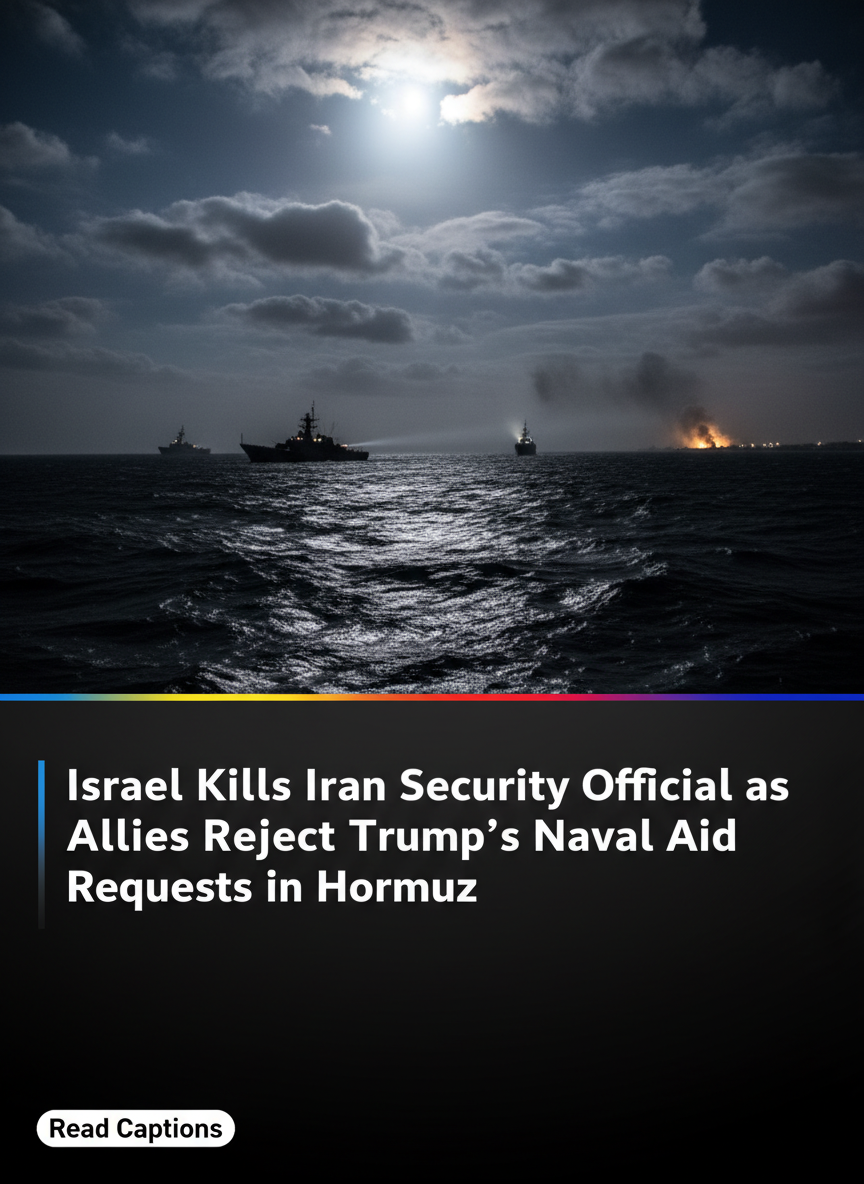
Middle East on the Brink: Israel Eliminates Top Iranian Official as EU Defies Trump’s Demands for Hormuz Intervention
JERUSALEM/BRUSSELS — The Middle East has been thrust into a precarious new chapter of instability following a high-stakes Israeli military operation that claimed the life of one of Iran’s most influential figures. As Tehran vows “crushing” retaliation, a diplomatic rift is widening across the Atlantic, with European allies formally rejecting President Trump’s calls for a joint military coalition in the Strait of Hormuz.
The Assassination of Ali Larijani
In a bold escalation of its long-running shadow war with Tehran, the Israeli Defense Forces (IDF) confirmed Tuesday that a precision strike successfully targeted Ali Larijani, Iran’s top security official and a long-time senior advisor to Supreme Leader Ayatollah Ali Khamenei. Larijani, a former Speaker of Parliament and a key architect of Iran’s regional strategy, was reportedly killed in a targeted drone strike while traveling in a high-security convoy.
Israeli officials characterized the operation as a necessary preemptive measure. “For decades, Larijani orchestrated the terror networks that threaten our citizens,” a senior Israeli government spokesperson stated. “There is no immunity for those who plan the destruction of the State of Israel.”
The loss of Larijani represents a massive blow to the Iranian establishment. Unlike previous tactical assassinations of military commanders, Larijani was a political heavyweight and a bridge between the various factions of the Iranian government. Thousands have already gathered in the streets of Tehran, demanding an immediate military response against Israeli interests.
The Standoff in the Strait of Hormuz
As tensions simmer in the Levant, the focus has shifted toward the Strait of Hormuz, the world’s most vital oil transit chokepoint. Citing intelligence of imminent Iranian maritime retaliation, President Trump has issued an urgent demand to European allies to provide naval assets and personnel to secure the waterway.
However, the call for a “Coalition of the Willing” has been met with a cold reception in Brussels and Paris. In a joint statement, European Union leadership rejected the American demand, citing fears that a Western military buildup would only serve to provoke a full-scale regional war.
“Our priority remains de-escalation and the preservation of diplomatic channels,” said an EU spokesperson. “We will not be drawn into a conflict that could have catastrophic consequences for global security and the international economy.”
Economic Aftershocks: Oil and Gas Surge
The combination of a high-profile assassination and the breakdown in Western cooperation has sent shockwaves through global markets. Crude oil prices jumped more than 6% in early trading, while natural gas futures saw a significant spike amid fears that the Strait of Hormuz could be closed by Iranian forces.
Economists warn that a prolonged closure of the Strait—through which roughly 20% of the world’s oil flows—could trigger a global recession. For President Trump, the refusal of European allies to assist complicates his “maximum pressure” strategy, leaving the United States to weigh the risks of unilateral naval intervention.
A Region on the Edge
The international community is now watching Tehran with bated breath. While Iran has often relied on proxy forces like Hezbollah and the Houthis to carry out its retaliatory strikes, the high status of Ali Larijani may force the Islamic Republic into a direct kinetic response.
With the U.S. and Europe fundamentally divided on how to handle the escalating crisis, and Israel signaling that its campaign against Iranian leadership is far from over, the path to de-escalation appears increasingly narrow. For now, the world waits to see if the next move will be a diplomatic olive branch or the spark that ignites a broader conflagration.