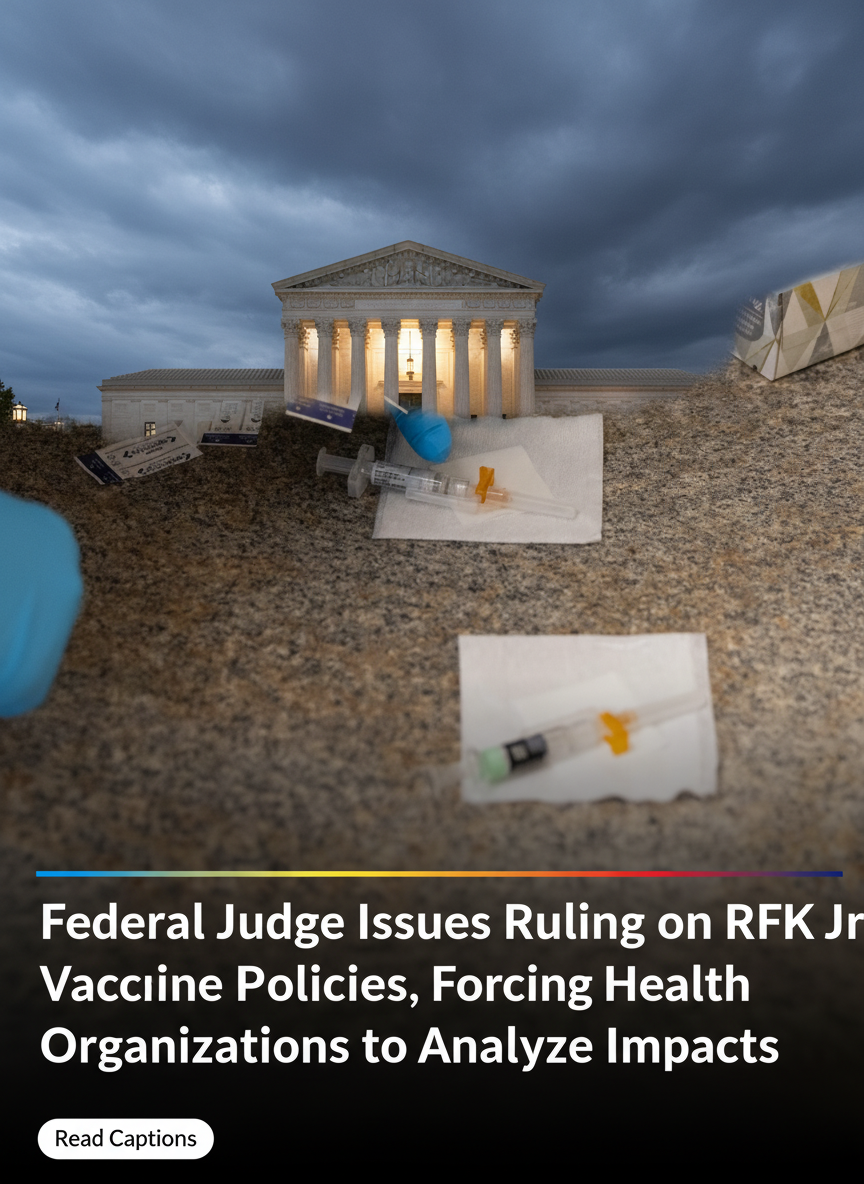
Judicial Decision on RFK Jr.’s Vaccine Policy Overhaul Leaves Medical Community in Limbo
WASHINGTON — A federal judge issued a complex and far-reaching ruling Tuesday regarding the sweeping changes to national vaccine policy spearheaded by Robert F. Kennedy Jr., leaving both government officials and the nation’s leading medical organizations racing to interpret the legal fallout.
The lawsuit, filed by a coalition of six prominent medical organizations—including the American Academy of Pediatrics and the American Medical Association—challenged the administration’s recent directives that sought to dismantle long-standing federal vaccine mandates and alter the safety-monitoring protocols managed by the Centers for Disease Control and Prevention (CDC).
A Nuanced Legal Landscape
In a 142-page decision released early Tuesday morning, U.S. District Court Judge Elena Rodriguez provided what legal experts are calling a “split verdict.” While the judge declined to issue a total permanent injunction against the administration’s policies, she did grant a preliminary stay on specific provisions that would have immediately curtailed federal funding for state-level immunization programs.
Lawyers for the medical groups characterized the ruling as a partial victory that prevents immediate “chaos” in public health, while the administration’s legal team argued the decision validates their authority to prioritize “informed consent” and “parental rights” over federal mandates.
Health Groups Express Uncertainty
The ruling has left health organizations “scrambling” to understand how to proceed with the upcoming fall vaccination season. The core of the confusion lies in the judge’s interpretation of the Administrative Procedure Act, which governs how federal agencies propose and establish regulations.
“We are encouraged that the court recognized the immediate danger of defunding immunization efforts,” said Dr. Sarah Vance, a spokesperson for the coalition of medical groups. “However, the ruling leaves the door open for significant changes to how vaccine safety data is communicated to the public, which could undermine decades of trust in our clinical systems. We are currently analyzing every line of this decision to determine our next legal steps.”
The Administration’s Stance
From the Department of Health and Human Services (HHS), the tone was one of cautious optimism. Robert F. Kennedy Jr., who has led the push for a total transparency overhaul of the vaccine approval process, released a brief statement following the ruling.
“The court has affirmed that the federal government cannot simply steamroll the concerns of American families,” the statement read. “While we disagree with the temporary stay on certain funding mechanisms, we are confident that the final resolution of this case will restore the balance of power between the state, the medical establishment, and the individual.”
What Happens Next?
As legal teams for both sides pore over the document, the practical implications for clinics and schools remain murky. The ruling allows the administration to continue its “re-evaluation” of certain vaccine ingredients and clinical trial standards, but prevents it from blocking the distribution of existing vaccines that have already received FDA approval.
Legal analysts suggest that this case is almost certainly headed for the U.S. Court of Appeals. In the meantime, state health departments are left in a state of “operational paralysis,” unsure if the federal grants they rely on for vaccine procurement will remain secure through the end of the fiscal year.
“The uncertainty is the biggest hurdle right now,” said Marcus Thorne, a constitutional law professor at Georgetown University. “The judge has essentially hit the pause button on some parts of the policy while giving a green light to others. For the medical community, trying to run a public health system under two conflicting sets of rules is an almost impossible task.”
Reporting contributed by The National Health Desk and Legal Correspondents in Washington D.C.