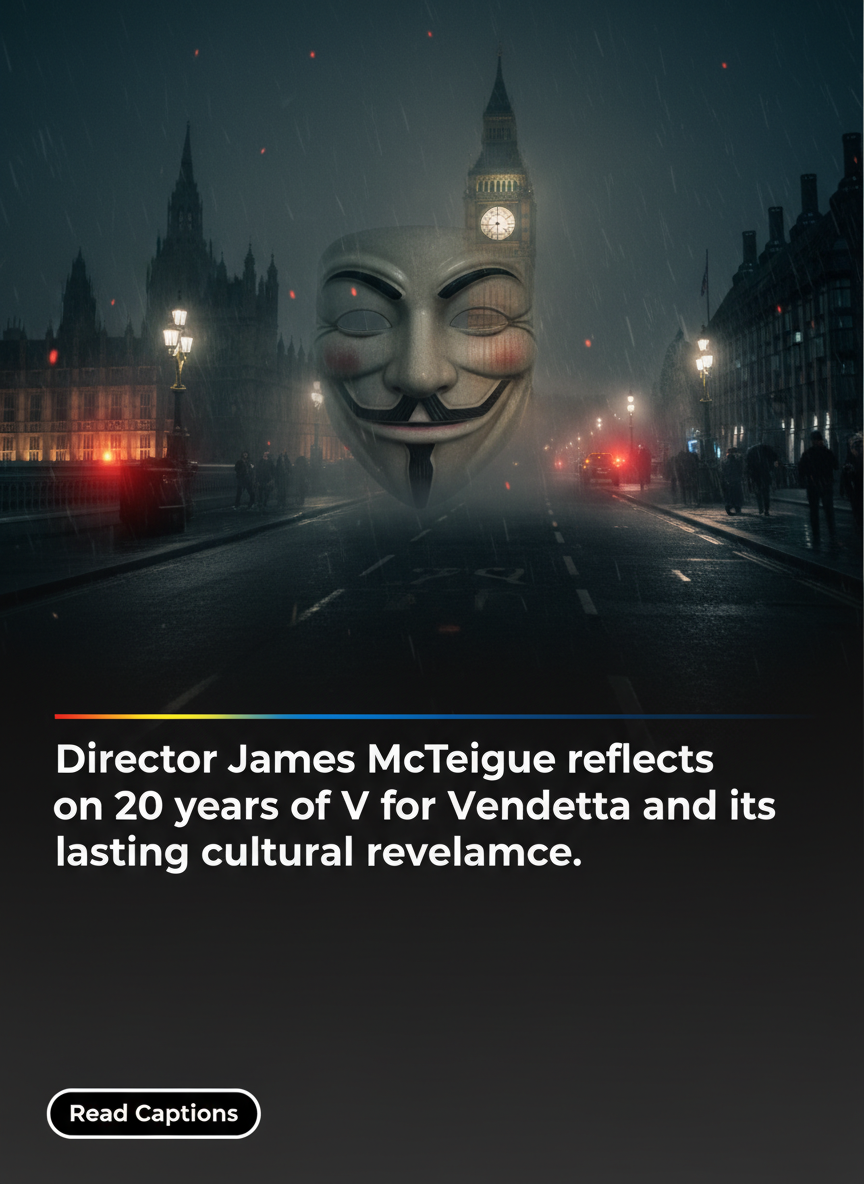
The Mask That Never Faded: James McTeigue Reflects on 20 Years of ‘V for Vendetta’
Two decades ago, a stylized vision of a dystopian London arrived in cinemas, featuring a masked anarchist, a high-stakes revolution, and a government fueled by fear. Today, V for Vendetta stands not just as a cult classic of the mid-2000s, but as a cultural touchstone that feels increasingly like a contemporary commentary. For director James McTeigue, the film’s persistent relevance isn’t a surprise—it’s a reflection of a world that hasn’t quite escaped the cycles of history.
A Timeless Dystopia
In a recent retrospective, McTeigue looked back on the production of the film, which was written by the Wachowskis and based on the iconic graphic novel by Alan Moore and David Lloyd. While the film was originally conceived in the shadow of the post-9/11 “War on Terror” and the surveillance-heavy climate of the early 2000s, its themes of authoritarianism, media manipulation, and grassroots resistance have found new life in the 2020s.
“I’m not surprised the film feels like it was made yesterday,” McTeigue remarked. He noted that the political pendulum often swings between extremes, ensuring that the film’s warnings about the erosion of civil liberties remain evergreen. The Guy Fawkes mask, once a niche historical reference, has since become a global symbol for protest, adopted by everyone from the Anonymous collective to pro-democracy activists worldwide.
The Bold Transformation of Natalie Portman
One of the most enduring images of the film is Evey Hammond, played by Natalie Portman, having her head forcibly shaved during a harrowing incarceration sequence. The scene was a pivotal moment for both the character and the actress. McTeigue recalled the logistical challenge—and the shock—that followed the physical transformation.
The timing of the filming coincided with the massive press tour for Star Wars: Episode III – Revenge of the Sith. Portman had to arrive at the prestigious Cannes Film Festival sporting her freshly buzzed scalp. The contrast between her elegant red-carpet presence and her stark, bald head became an instant media sensation.
“Everyone said, ‘Oh my God, you’ve got a bald head. What movie are you working on?’” McTeigue remembered. The dramatic look served as a walking advertisement for V for Vendetta, signaling to the world that Portman was moving into much darker, more mature territory than the space opera that made her a household name.
Behind the Scenes of a Rebellion
Making the film was a massive undertaking, requiring the production to shut down parts of London that are rarely accessible to film crews, including Whitehall and the areas surrounding Parliament. McTeigue, who had previously worked as an assistant director on The Matrix trilogy, brought a sharp, kinetic visual style to the project that bridged the gap between a comic book aesthetic and a gritty political thriller.
The director praised the collaboration with the Wachowskis, noting that their script managed to distill Moore’s dense, complex narrative into a visceral cinematic experience. While the film took liberties with the source material—much to the public chagrin of Alan Moore—it succeeded in bringing the core message of individual agency to a global audience.
The Legacy of the Mask
As V for Vendetta reaches its 20th anniversary, its legacy is measured not just in box office numbers or DVD sales, but in its visual shorthand. The “V” mask has transcended the screen to become a permanent fixture of modern political iconography.
Reflecting on the film’s conclusion—where a crowd of thousands unmask to reveal they are all “V”—McTeigue sees a message that still resonates: power belongs to the people, provided they have the courage to claim it. Twenty years later, the film remains a chilling, thrilling reminder that the struggle for freedom is never truly over.