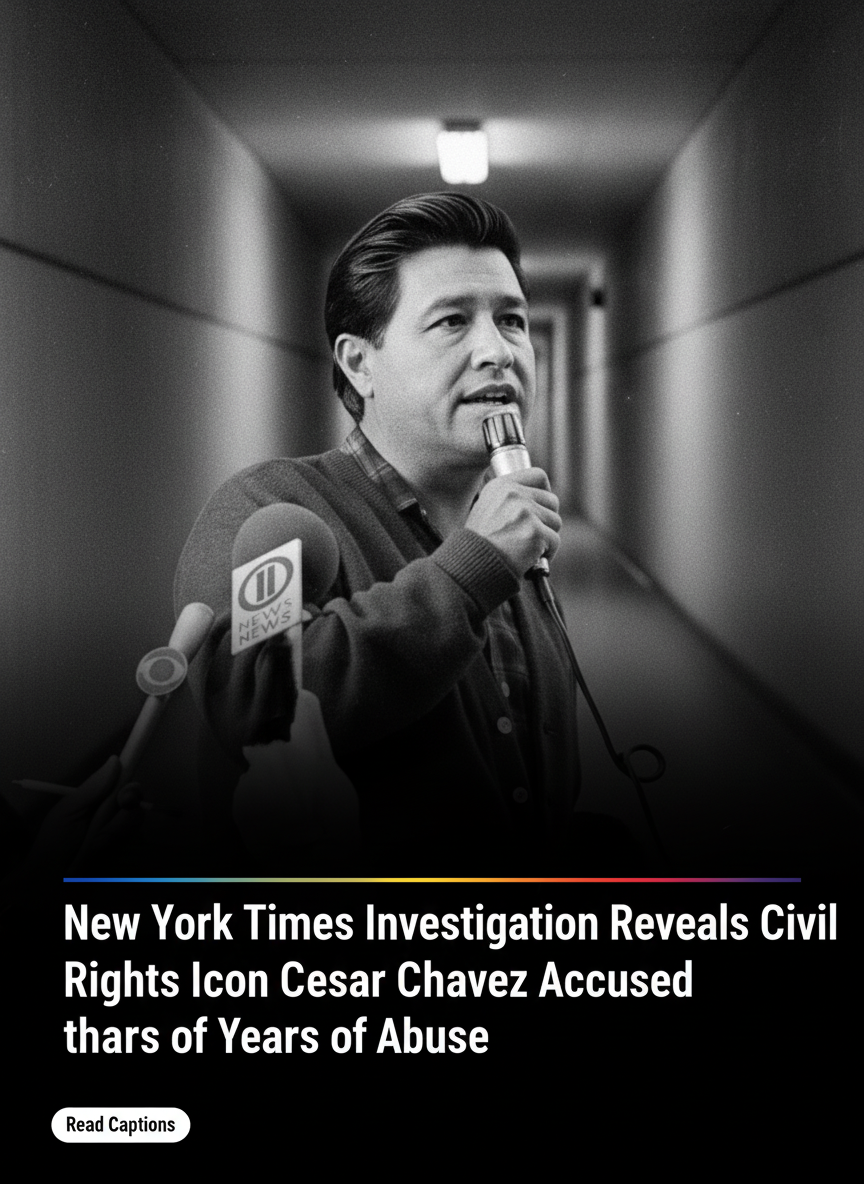
A Fallen Idol: Investigation Reveals Decades of Sexual Abuse by Civil Rights Icon Cesar Chavez
LOS ANGELES — For decades, Cesar Chavez has been revered as a champion of the marginalized, a nonviolent labor leader whose name graces schools, parks, and stamps across the United States. However, a bombshell investigation published Wednesday by The New York Times has cast a dark shadow over that legacy, uncovering extensive evidence that the United Farm Workers (UFW) co-founder groomed and sexually abused young girls who worked within the farm labor movement.
The report, based on dozens of interviews with survivors, former UFW staff members, and a cache of previously unreleased internal documents, details a systemic pattern of abuse that allegedly spanned several decades. According to the investigation, Chavez used his position of absolute authority within the movement to target the daughters of farmworkers and young volunteers—some as young as 13—often under the guise of spiritual or political mentorship.
A Pattern of Grooming and Secrecy
The Times investigation describes a “culture of silence” that permeated the UFW’s headquarters at La Paz in Keene, California. Survivors, speaking on the record for the first time, described how Chavez would isolate young girls during late-night strategy sessions or long drives between labor strikes. The accounts suggest that Chavez employed sophisticated grooming techniques, presenting himself as a father figure or a “living saint” to earn the trust of vulnerable families before initiating sexual contact.
“He was a god to our parents, so we thought what he was doing must be part of the cause,” said Maria Elena (a pseudonym), who alleges the abuse began when she was 14. “To speak out wasn’t just to betray a man; it was to betray the entire struggle for Mexican-American dignity.”
Internal Knowledge and Suppression
Perhaps most damaging to the organization’s contemporary standing are the allegations that senior members of the UFW leadership were aware of “rumors” or specific complaints and took active steps to suppress them. The Times cited internal memos and diaries from the 1970s and 80s indicating that high-ranking officials prioritized the survival of the union and Chavez’s public image over the safety of the children in their care.
In several instances, families who attempted to raise concerns were reportedly branded as “subversives” or “agents of the growers,” a common tactic used during the height of the movement to stifle internal dissent.
The Movement Responds
The United Farm Workers issued a somber statement on Wednesday morning following the publication of the report. “The allegations detailed today are harrowing and deeply painful,” the statement read. “While Cesar Chavez’s work for labor rights transformed millions of lives, no legacy can or should shield a leader from accountability for such grave harm. We stand with the survivors and are launching an independent historical audit to fully understand the scope of these failures.”
The Chavez family has also released a brief statement through the Cesar Chavez Foundation, expressing “profound shock” and stating they are “still processing the gravity of the accounts” presented in the investigation.
A Complicated Legacy
The revelations come at a time when historical figures across the political spectrum are facing renewed scrutiny. For the Chicano movement and the American labor left, the news is a devastating blow. Chavez, who was posthumously awarded the Presidential Medal of Freedom in 1994, has long been the primary symbol of Latino civil rights in the U.S.
Historians suggest that while his achievements in securing collective bargaining rights for farmworkers remain a matter of public record, the “saint-like” image carefully curated by Chavez and his supporters may now be irreparably broken. “We are entering a period of painful reckoning,” said Dr. Elena Rodriguez, a professor of Chicano Studies. “We have to figure out how to honor the movement while acknowledging the horrific reality of the man at its center.”
As the news ripples through the communities that once worshipped him, calls are already growing to rename institutions that bear his name. For the survivors, however, the primary focus is not on statues or street signs, but on the long-overdue validation of their voices.