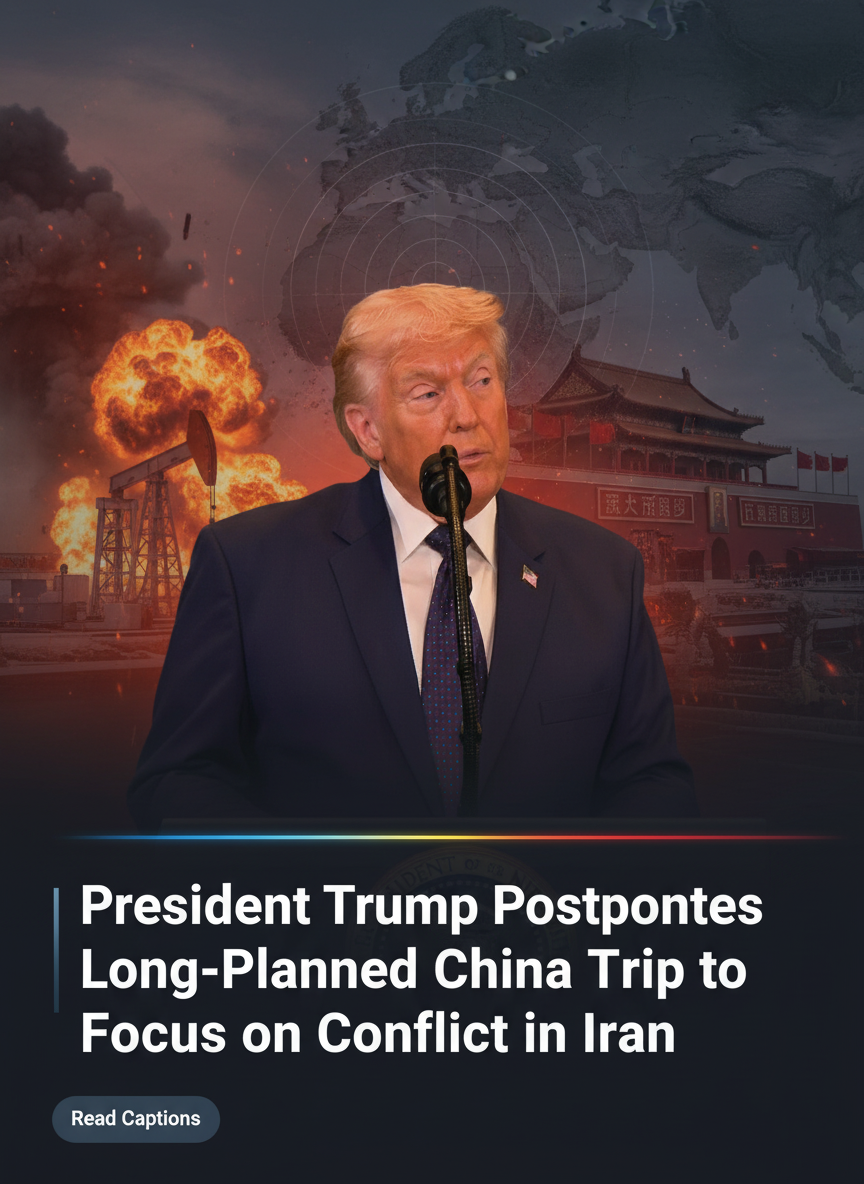
Geopolitical Shift: Trump Postpones Landmark China Summit to Navigate Escalating Iran Conflict
WASHINGTON — In a significant realignment of American foreign policy priorities, President Donald Trump has officially postponed a high-stakes diplomatic mission to China. The White House announced Tuesday that the trip, which has been in development for several months, will be delayed indefinitely as the administration pivots its full resources toward the intensifying military and political crisis in Iran.
The decision marks a dramatic turn for the administration, which had previously signaled that the Beijing summit would be a cornerstone of its second-term international agenda. However, as the situation in the Middle East reaches a boiling point, the President has reportedly opted to remain in Washington to oversee the “War in Iran” from the Situation Room, prioritizing immediate national security over long-term trade and regional negotiations with China.
The planned trip to China had already begun to show signs of strain in recent weeks. Diplomatic sources suggest the visit began to “unravel” as President Trump maintained a posture of intense pressure on Beijing regarding trade imbalances and maritime security. While the two superpowers were expected to discuss a “Phase Two” trade framework, the sudden escalation of hostilities with Tehran has forced a total recalculation of the President’s schedule.
“The President’s primary responsibility is the safety of the American people and the management of our forces currently engaged in the Iranian theater,” said a senior administration official who spoke on the condition of anonymity. “While the relationship with China remains a top priority, the immediate demands of the conflict in Iran require the Commander-in-Chief’s presence and undivided attention at home.”
The postponement has sent ripples through international markets and diplomatic circles. In Beijing, officials expressed a cautious acknowledgement of the delay, though analysts suggest the pause may further cool an already tense relationship between the world’s two largest economies. For the Trump administration, the move serves as a public declaration that the Middle East has once again moved to the forefront of the United States’ global strategy.
As the conflict in Iran continues to develop, it remains unclear when the China trip might be rescheduled. For now, the White House has cleared the President’s calendar of international travel to ensure a centralized response to the ongoing warfare. This pivot underscores the volatile nature of current global politics, where long-standing diplomatic goals can be sidelined in an instant by the outbreak of regional instability.
Further updates on the President’s revised itinerary and the status of U.S. operations in Iran are expected to be released in the coming days as the administration continues to brief Congressional leaders on the evolving crisis.