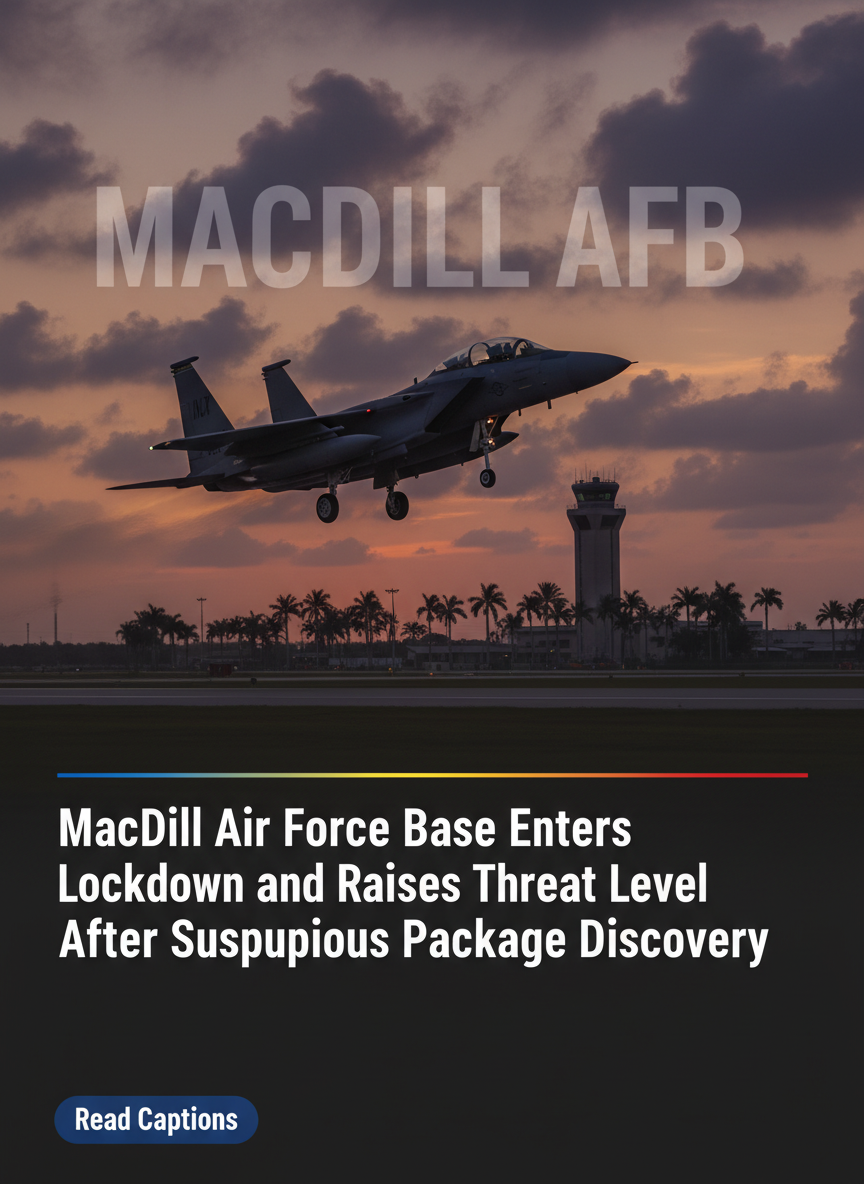
MacDill Air Force Base Placed on High Alert Following Suspicious Package Investigation: Understanding ‘FPCON Charlie’
TAMPA, Fla. — MacDill Air Force Base was placed under a temporary lockdown and a heightened security alert Wednesday morning following the discovery of a suspicious package near the installation’s main entrance. The incident, which triggered a “shelter-in-place” order for personnel, resulted in significant traffic delays and a base-wide elevation of the Force Protection Condition (FPCON) level.
An Early Morning Security Threat
The security situation began during the early morning hours when security forces at MacDill’s Dale Mabry Highway gate identified a suspicious item. Following standard military protocol for potential explosive threats, officials immediately closed the gate and cordoned off the surrounding area. Personnel already on the base were instructed to shelter in place, while those attempting to report for duty were diverted away from the main entrance.
For several hours, the installation remained in a state of high tension as specialized Explosive Ordnance Disposal (EOD) teams were called to the scene to inspect and mitigate the potential threat. The closure of the Dale Mabry gate—the base’s primary artery—caused a massive traffic backup that spilled over into the South Tampa community.
What is ‘FPCON Charlie’?
As the investigation unfolded, MacDill officials announced that the base had transitioned to FPCON Charlie. This specific security designation is part of a five-tier system used by the Department of Defense to dictate security measures at military installations.
According to military guidelines, FPCON Charlie is implemented when an incident occurs or intelligence is received indicating that some form of terrorist action or targeting against personnel or facilities is likely. It is a significant escalation from the more common FPCON Bravo, requiring more stringent security checks, increased guard presence, and often the restriction of access points.
“FPCON Charlie means the threat is no longer just a possibility; it is considered likely,” a security analyst noted during the event. “It mandates a level of vigilance that impacts every person on the installation, from mandatory identification checks to the potential for vehicle searches.”
Resolution and Impact on Operations
By mid-morning, MacDill Air Force Base officials confirmed that the suspicious package had been thoroughly investigated and “rendered safe.” Following the all-clear, the shelter-in-place order was lifted, and the Dale Mabry gate was reopened to traffic. While the immediate danger was resolved, the base remained at a heightened state of awareness as a precautionary measure.
MacDill is a critical strategic hub, serving as the headquarters for both U.S. Central Command (USCENTCOM) and U.S. Special Operations Command (USSOCOM). Because the base hosts high-ranking military leadership and oversees operations in sensitive regions globally, security threats are handled with the utmost gravity.
Community Reaction and Safety
The incident caused concern among South Tampa residents, many of whom are accustomed to the routine noise of aircraft but less familiar with sudden, high-level security lockdowns. Local law enforcement worked in tandem with Air Force security forces to manage traffic flow and ensure the safety of the civilian population living just outside the base perimeter.
In a statement, base officials thanked the community for their patience and emphasized that the safety of service members, their families, and the surrounding neighborhood remains the top priority. “Our security forces are trained to respond to these exact scenarios. The rapid implementation of FPCON Charlie ensured that we were prepared for any outcome,” the statement read.
Conclusion
The suspicious package scare at MacDill Air Force Base serves as a stark reminder of the ongoing security challenges faced by domestic military installations. While the morning’s events ended without injury or damage, the elevation to FPCON Charlie underscores the military’s “zero-fail” approach to protection in an era of unpredictable threats. For now, operations at the base have returned to normal, but the heightened vigilance remains a signature of the current security climate.