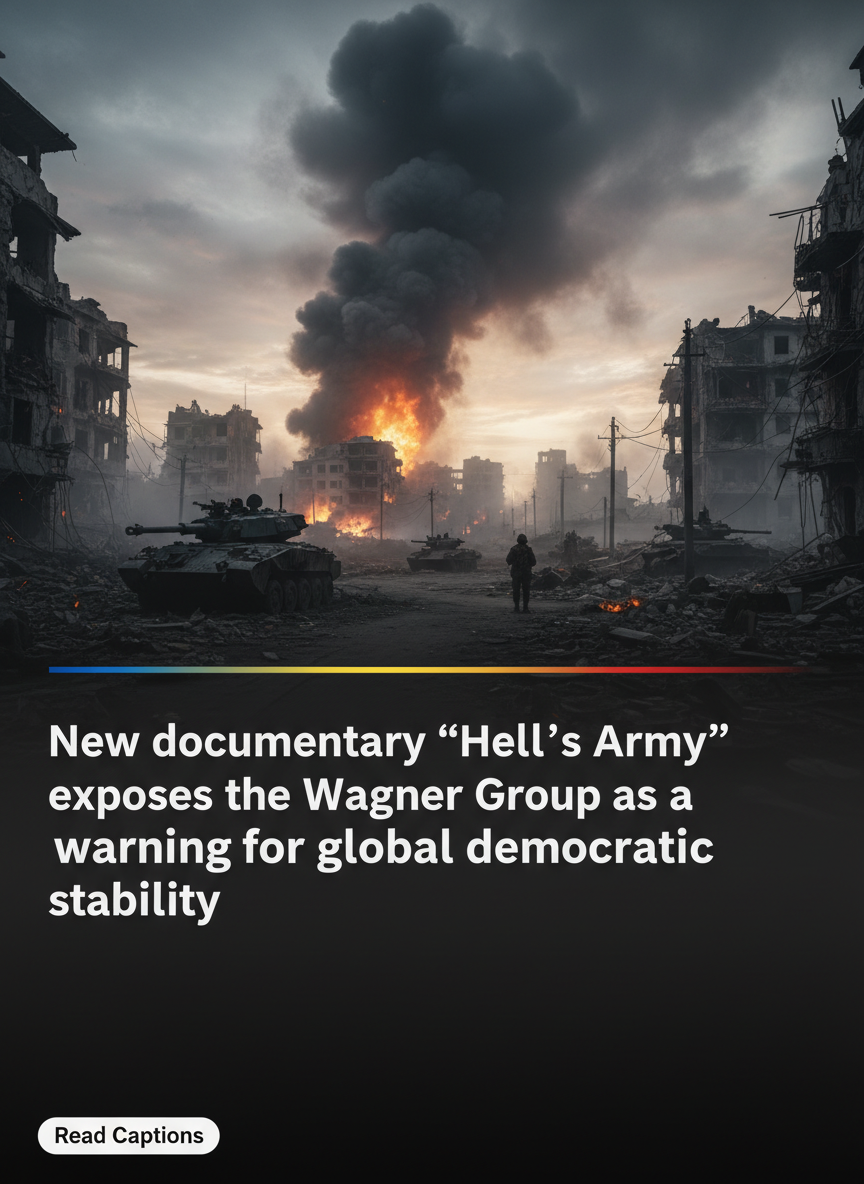
Shadow Soldiers and Stolen States: Inside the Wagner Group Documentary ‘Hell’s Army’
As the geopolitical landscape shifts under the weight of shadow wars and private interests, Oscar-nominated filmmaker Richard Rowley has stepped into the crosshairs to document one of the most enigmatic and brutal forces of the 21st century. His new documentary, Hell’s Army, which recently premiered at the CPH:DOX festival in Copenhagen, offers a chilling deep dive into the rise and near-fall of the Wagner Group, the Russian mercenary outfit that redefined modern warfare.
The Evolution of a Private Empire
For years, the Wagner Group existed in the periphery of international news—a “ghost” army that allowed the Kremlin to exert influence in Africa, Syria, and Ukraine while maintaining a thin veil of plausible deniability. However, as Rowley explains in a recent interview with The Hollywood Reporter, the group’s transition from a secret paramilitary organization to a household name was fueled by the ambitions of its late leader, Yevgeny Prigozhin, and the shifting needs of Vladimir Putin’s regime.
Hell’s Army tracks this evolution with high-stakes reporting, following the group from its early days of shadow operations to its violent prominence during the invasion of Ukraine. Rowley, known for his gritty, investigative style in films like Dirty Wars, spent years tracking Wagner’s footprint across three continents, capturing the moment when the mercenaries stopped hiding and started campaigning for public adoration.
A Warning for Global Democracy
Beyond the battlefield footage and the internal politics of the Kremlin, Rowley’s film carries a much darker thesis. He argues that the existence of the Wagner Group is not merely a Russian anomaly, but a symptom of a global decay in democratic accountability. According to Rowley, the rise of mercenary armies is a direct result of states being hollowed out by elite interests.
“Mercenary armies are what states turn to when they’ve been taken over by oligarchs and authoritarians,” Rowley told The Hollywood Reporter. He posits that when a government can no longer convince its citizens to fight for a shared national cause, it must resort to hiring professionals whose only loyalty is to a paycheck. This “outsourcing of violence” removes the democratic friction that usually accompanies the decision to go to war, making conflict easier to start and harder to end.
The Prigozhin Factor
A significant portion of the documentary focuses on the late Yevgeny Prigozhin, the “caterer” turned warlord whose public feud with the Russian Ministry of Defense culminated in a stunning, short-lived mutiny in June 2023. Rowley explores the cult of personality Prigozhin built around himself—a populist image that resonated with many Russians who felt abandoned by the traditional military bureaucracy.
The film captures the surreal nature of Wagner’s public relations machine, which utilized social media and slickly produced videos to brand war as a lifestyle. This “gamification” of combat, Rowley argues, served to distract from the horrific human rights abuses committed by the group across the globe.
Why ‘Hell’s Army’ Matters Now
While Prigozhin is gone, the model he helped perfect remains. Hell’s Army serves as a cautionary tale for the West. Rowley suggests that the temptation to use private military contractors (PMCs) is not exclusive to Russia. By bypassing the legislative oversight and public debate required for traditional military deployments, states everywhere risk creating “Frankenstein’s monsters”—armed groups that eventually grow powerful enough to challenge the very states that created them.
As the credits roll on Hell’s Army, the audience is left with a sobering realization: the Wagner Group may have been the most visible example of the mercenary turn, but they are unlikely to be the last. In a world where power is increasingly concentrated in the hands of the few, the soldiers of fortune may soon become the primary enforcers of the global order.
Looking Ahead
The premiere at CPH:DOX marks the beginning of the film’s journey to international audiences. As Rowley continues to discuss the project, his message remains clear: the rise of private armies is a signal flare for the health of a nation. When a state stops relying on its people and starts relying on its purse for protection, the foundations of democracy are already crumbling.