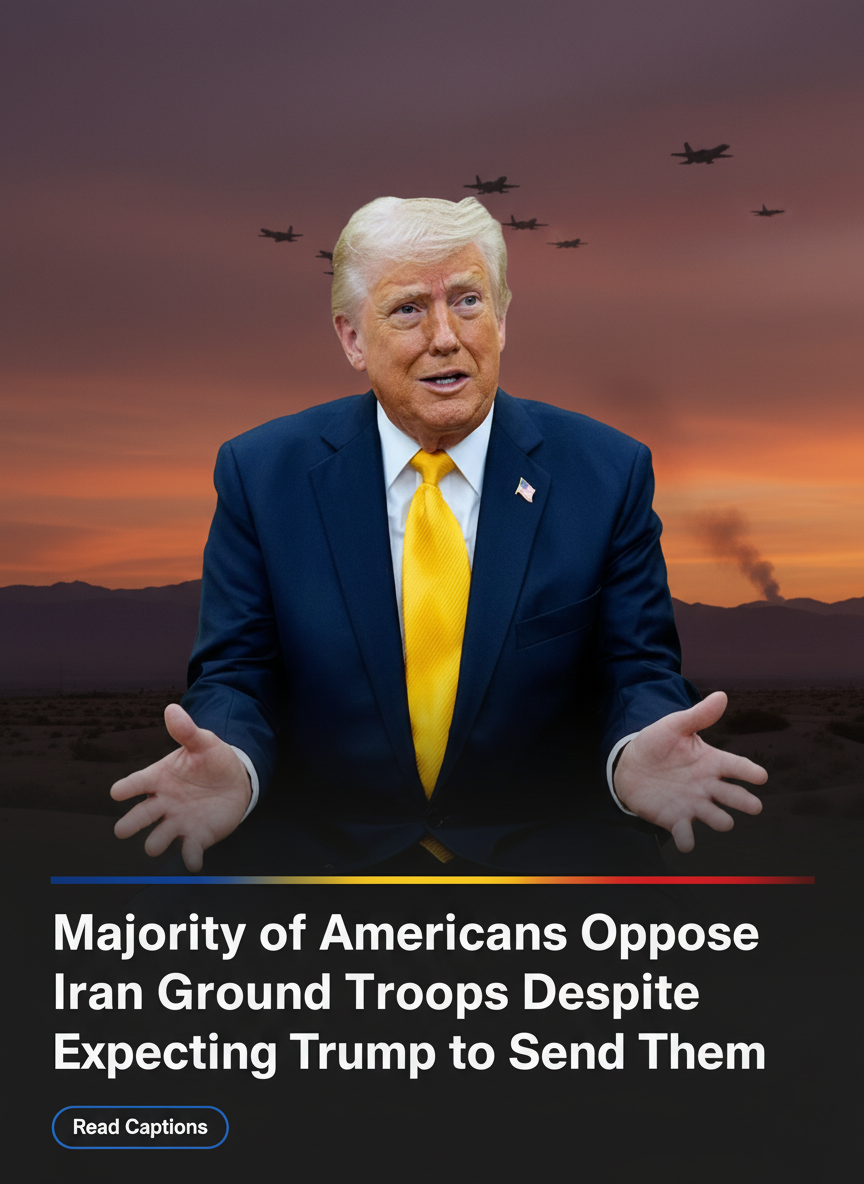
Poll: Majority of Americans Fear “Boots on the Ground” in Iran Despite Widespread Opposition
WASHINGTON — As the military conflict between the United States and Iran enters a critical new phase, a new national poll reveals a deep disconnect between the American public’s expectations and their desires. According to a Reuters/Ipsos survey released Friday, nearly two-thirds of Americans believe President Donald Trump will eventually deploy ground troops to the region, even as a clear majority remains opposed to such an escalation.
The poll, conducted between March 17 and March 19, found that 64% of Americans expect the administration to send “boots on the ground” into the fighting. However, the appetite for a ground war is remarkably low; 55% of respondents explicitly stated they do not support the use of U.S. ground forces in the ongoing operation against Tehran.
Partisan Divide and Tactical Preferences
While the overall sentiment leans toward caution, the survey highlights a stark partisan divide regarding the conflict. Approximately 77% of Republicans expressed support for the current military operations, compared to a mere 6% of Democrats and 28% of independents. Overall, 37% of Americans approve of the fighting, while 59% disapprove.
When asked about specific military tactics, only 7% of those surveyed backed a large-scale strike involving significant American ground forces. A larger portion, 34%, indicated they would support a more limited approach, such as incursions by U.S. Special Forces. Among Republicans, support for special operations is much higher at 63%, while only 21% of the GOP base is entirely opposed to any ground presence.
A Region in Turmoil: “Operation Epic Fury”
The polling comes amid “Operation Epic Fury,” a series of intense U.S. and Israeli military strikes that have decimated much of Iran’s conventional military infrastructure. Reports indicate that these strikes resulted in the death of Iranian Supreme Leader Ayatollah Ali Khamenei and several other high-ranking officials.
Despite these tactical successes, the domestic impact of the conflict is being felt at the gas pump. Iran has retaliated by targeting energy facilities in neighboring Persian Gulf nations and making the Strait of Hormuz—a vital artery for 20% of the world’s oil supply—nearly impassable. This has sent fuel prices skyrocketing globally, further fueling domestic anxiety about the war’s duration and scope.
Administration Response
The Trump administration has sent mixed signals regarding the future of the mission. Defense Secretary Pete Hegseth recently declined to rule out the use of ground forces during a Pentagon briefing. Conversely, President Trump attempted to downplay these fears on Thursday, telling reporters he was “not putting troops anywhere.”
“If I were, I certainly wouldn’t tell you,” the President added, maintaining a characteristic level of strategic ambiguity that has left many Americans guessing about his next move.
Former Vice President Mike Pence has also weighed in, praising the President for “taking the fight directly” to the Iranian regime and suggesting that the administration has successfully ignored isolationist voices within the Republican party to prioritize national security.
Conclusion
The Reuters/Ipsos poll, which surveyed 1,545 adults nationwide, paints a picture of a country bracing for a long-term commitment it does not necessarily want. As oil prices rise and the military situation remains volatile, the administration faces the daunting challenge of managing a high-stakes foreign conflict while navigating a public that is increasingly wary of the human and economic costs of another “forever war.”