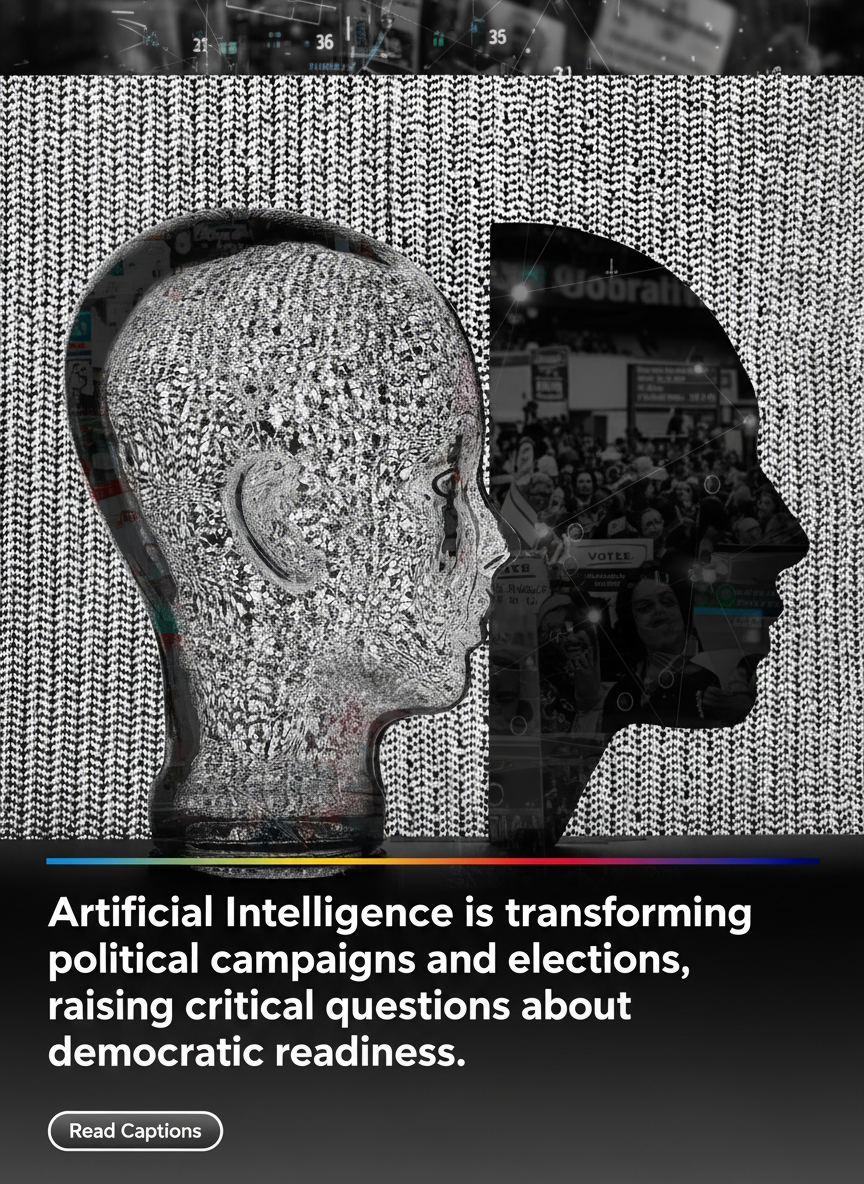
The Silicon Election: How A.I. Is Rewriting the Political Playbook in 2026
By News Desk | Published March 17, 2026
The Intersection of Algorithms and Power
As the 2026 midterm elections approach, the United States finds itself at a historic crossroads where technology and governance are no longer separate entities. In a landscape increasingly defined by the Second Trump Administration’s economic policies, Artificial Intelligence has moved from a Silicon Valley buzzword to the central nervous system of American politics. The question echoing through the halls of Congress and across living rooms in the heartland is no longer if A.I. will change our democracy, but whether we are remotely prepared for the reality already upon us.
Economic Populism Meets the A.I. Boom
The “A.I. Economy” has become the defining feature of the current administration’s domestic agenda. President Trump, blending his “America First” rhetoric with a push for technological dominance, has framed A.I. as the ultimate tool for industrial resurgence. However, this shift has created a complex paradox. While A.I. driven automation has boosted productivity in manufacturing sectors, it has also sparked widespread anxiety regarding job security for the white-collar workforce—a demographic once thought immune to the mechanical looms of the past.
Economists note that the administration’s deregulation efforts have allowed A.I. firms to scale at unprecedented speeds. Yet, this “move fast and break things” approach has left social safety nets strained. As the 2026 fiscal report looms, the tension between explosive corporate growth and the displacement of traditional labor remains the most volatile element of the current political climate.
The Campaign Trail: From Micro-Targeting to Hyper-Realism
If 2016 was the year of social media and 2020 was the year of the virtual rally, 2026 is officially the year of the Generative Campaign. Political consultants are now deploying A.I. agents capable of holding personalized, persuasive conversations with millions of voters simultaneously. This hyper-personalization has made traditional television ads look like relics of a bygone era.
The “readiness” of the American public is being tested by the sheer sophistication of deepfakes and A.I.-generated narratives. In recent weeks, several “synthetic scandals” have rocked the campaign trail, where indistinguishable audio and video clones of candidates have been used to sway sentiment in swing districts. The Federal Election Commission remains deadlocked on how to regulate these digital apparitions, leaving the truth as the most casualty-prone asset in the 2026 cycle.
Institutional Lag: A Governance Gap
A primary concern highlighted by policy experts is the widening gap between the speed of technological evolution and the pace of legislative oversight. While the administration has prioritized the “A.I. Arms Race” against global competitors, domestic guardrails remain sparse. Congressional hearings often reveal a stark reality: many lawmakers are still grappling with the basics of large language models while those models are already influencing the stock market and judicial sentencing guidelines.
“We are driving a Ferrari with the brakes of a horse and buggy,” says Dr. Elena Vance, a senior fellow at the Institute for Digital Democracy. “The A.I. is coming for politics, but our political institutions are still operating on 20th-century hardware.”
Conclusion: Are We Ready?
As March 17, 2026, marks another milestone in this rapid transformation, the summary of our current state is clear: A.I. is no longer a future threat—it is the current environment. The Trump administration’s bet on A.I. as an economic engine is paying dividends in the markets, but the social and political costs are only just beginning to be calculated.
Whether the American electorate can navigate a world where reality is customizable and the economy is algorithmic remains to be seen. One thing is certain: the 2026 midterms will be the first true test of a nation attempting to govern the ungovernable. The A.I. has arrived; the humans are still catching up.