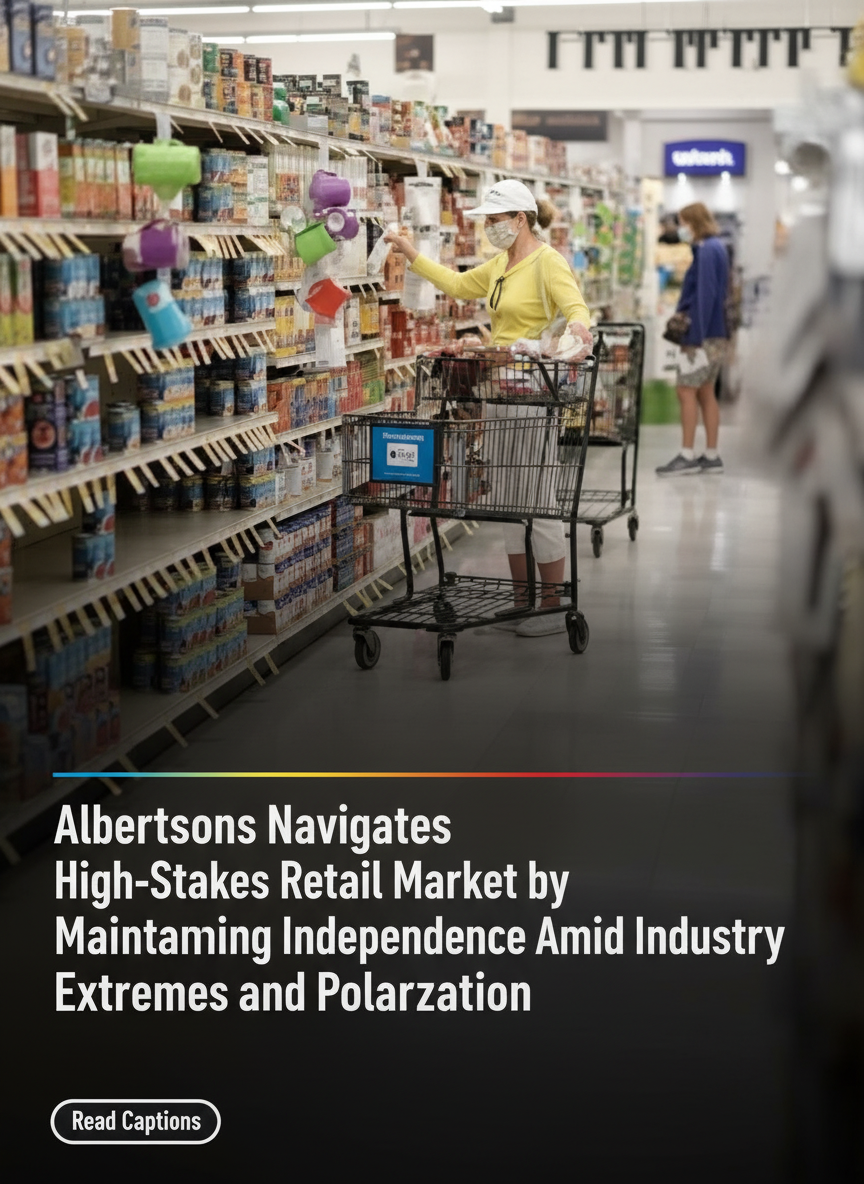
Albertsons’ Tightrope Walk: The High Stakes of Independence in a Polarized Retail World
In an industry increasingly dominated by massive scale and niche discounting, the Boise-based grocer finds itself at a crossroads between a blocked merger and a challenging solo future.
The Middle Ground Dilemma
The American grocery landscape is undergoing a radical transformation, evolving into what economists call a “barbell market.” On one end, behemoths like Walmart and Amazon leverage unprecedented scale to drive prices down. On the other, specialty players and hard discounters like Aldi and Trader Joe’s thrive on curated experiences and lean operations. Caught in the volatile center is Albertsons Companies Inc.
As the legal battle over its proposed $24.6 billion merger with Kroger continues to dominate headlines, a deeper narrative is emerging: can Albertsons survive—and thrive—as an independent entity in a market that increasingly punishes the middle ground?
The Merger Shadow
For over a year, the Federal Trade Commission (FTC) has maintained a firm stance against the Kroger-Albertsons tie-up, arguing it would eliminate vital competition and lead to higher prices for consumers. However, Albertsons’ leadership has countered with a sobering reality. Without the synergy and scale provided by the merger, the company faces an uphill battle to fund the necessary technological and infrastructure upgrades required to compete with non-unionized giants like Walmart.
The “market of extremes” rewards those who can either provide the absolute lowest price or a highly specialized premium experience. Albertsons, with its vast portfolio of legacy banners including Safeway, Vons, and Jewel-Osco, operates a traditional supermarket model that is increasingly expensive to maintain in a high-inflation, high-interest-rate environment.
Strategic Pivots: The Path to Solitude
Should the merger ultimately be blocked, Albertsons will be forced to double down on its “Change for the Better” strategy. This involves a heavy focus on three key pillars:
- Digital Transformation: Expanding its retail media network and enhancing its “FreshPass” loyalty program to capture high-value data.
- Private Label Growth: Strengthening “Own Brands” like Signature Select and O Organics to provide value-conscious consumers an alternative to national brands while boosting profit margins.
- Modernization: Investing in micro-fulfillment centers to solve the “last mile” delivery problem that currently favors Amazon and Walmart.
The Efficiency Gap
The primary challenge for an independent Albertsons remains the “efficiency gap.” Traditional grocers typically operate on razor-thin margins of 1% to 3%. Without the consolidated purchasing power of a combined Kroger-Albertsons entity, the company remains vulnerable to the predatory pricing strategies of the big-box retailers.
Furthermore, Albertsons carries a significant debt load compared to some of its leaner competitors. While the company has remained profitable, the cost of capital to renovate aging stores and integrate AI-driven supply chain logistics is a heavy burden for a standalone player.