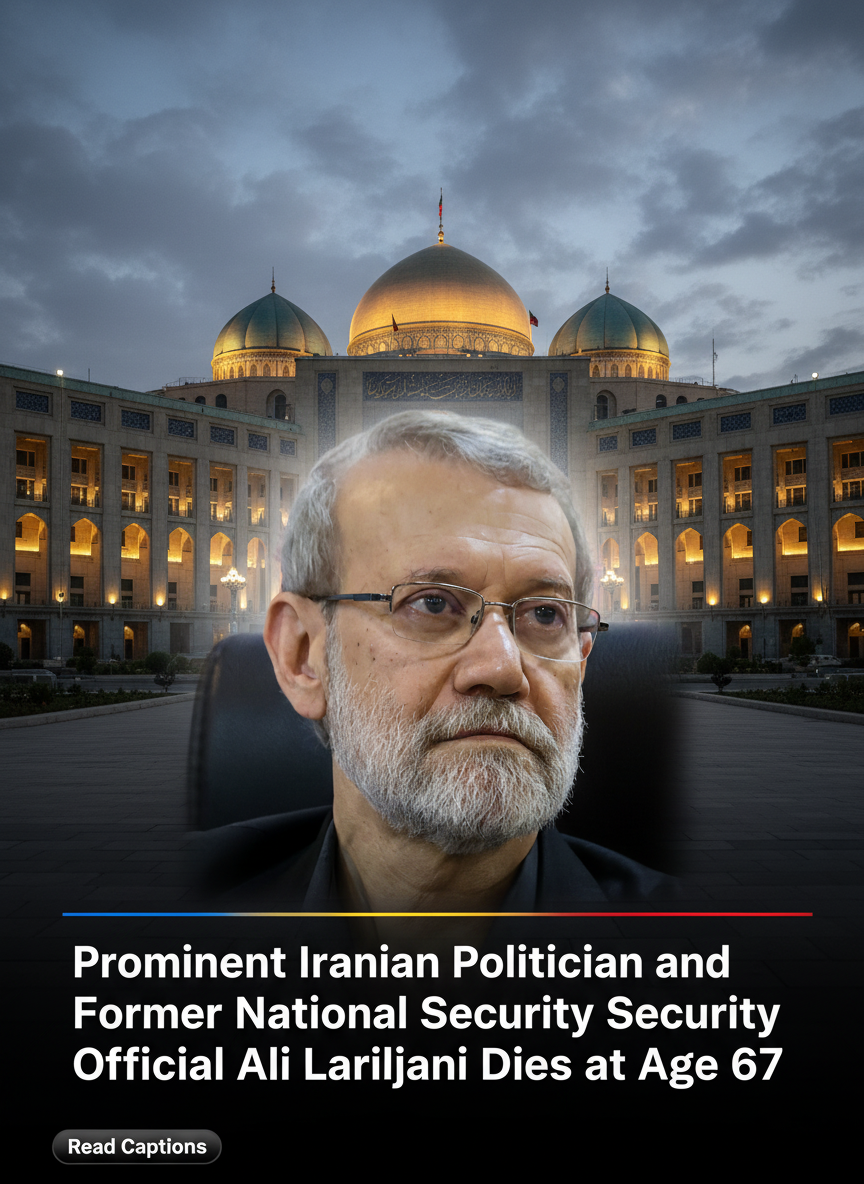
Ali Larijani, Influential Iranian Diplomat and Enforcer of the State, Dies at 67
TEHRAN — Ali Larijani, a towering figure in Iranian politics who for decades served as a vital bridge between the country’s clerical establishment and its security apparatus, has died at the age of 67. His death marks the end of a career defined by high-stakes diplomacy and, most recently, a controversial role in the state’s internal security operations.
A sophisticated political operator and a former speaker of Parliament, Mr. Larijani was widely regarded as the ultimate insider. He was a trusted confidante of the former supreme leader and served as a key architect of Iran’s national security policy. However, his long legacy of public service was increasingly overshadowed in his final year by his leadership in a brutal crackdown on domestic protests that drew international condemnation.
A Dynasty of Power
Born into a prominent family of clerics and politicians, Mr. Larijani was one of five brothers who held significant sway over the Iranian state for nearly forty years. His ascent through the ranks of the Islamic Republic was characterized by an uncanny ability to navigate the fractured and often treacherous landscape of Tehran’s internal politics.
Before his recent role in national security, Mr. Larijani was perhaps best known on the world stage as Iran’s chief nuclear negotiator. In that role, he earned a reputation as a “pragmatic conservative”—a man who was deeply committed to the ideals of the 1979 revolution but possessed the intellectual flexibility to engage with Western powers when it served the regime’s interests.
The Iron Fist of 2026
While his earlier career was defined by the nuances of international diplomacy, Mr. Larijani’s final chapter was written in the streets of Iran’s major cities. As the top national security official during the widespread civil unrest that began earlier this year, he was the primary strategist behind the government’s forceful response.
Human rights organizations and international observers have identified Mr. Larijani as the orchestrator of a “brutal crackdown” aimed at stifling dissent through mass arrests and the deployment of lethal force. This shift from statesman to enforcer solidified his standing within the hard-line core of the government, even as it tarnished his reputation among the Iranian populace and the global community.
A Confidante to the Supreme Leader
Central to Mr. Larijani’s longevity was his unwavering loyalty to the former supreme leader. He functioned as a crucial emissary, carrying out sensitive missions to regional allies and rivals alike. His deep understanding of the regime’s theological underpinnings, combined with his grasp of modern geopolitics, made him an indispensable asset in preserving the status quo during periods of intense transition.
Analysts suggest that his death creates a significant vacuum within the Iranian leadership. “Larijani was the glue that held various factions together,” said one Middle East expert. “He was one of the few figures who could speak the language of the military, the clergy, and the diplomatic corps simultaneously.”
An Uncertain Legacy
In the wake of his passing, Iran remains at a crossroads. To the state, Mr. Larijani will be remembered as a tireless defender of the Islamic Republic who stepped up to preserve order during its most turbulent hours. To his critics and the families of those affected by the recent crackdowns, he represents the uncompromising face of an aging autocracy.
As the government prepares for a state funeral, the question of who will succeed him in the national security apparatus remains unanswered. With the country still reeling from the protests he helped suppress, the loss of Ali Larijani marks not just the end of a political life, but potentially the end of an era of managed stability in Tehran.