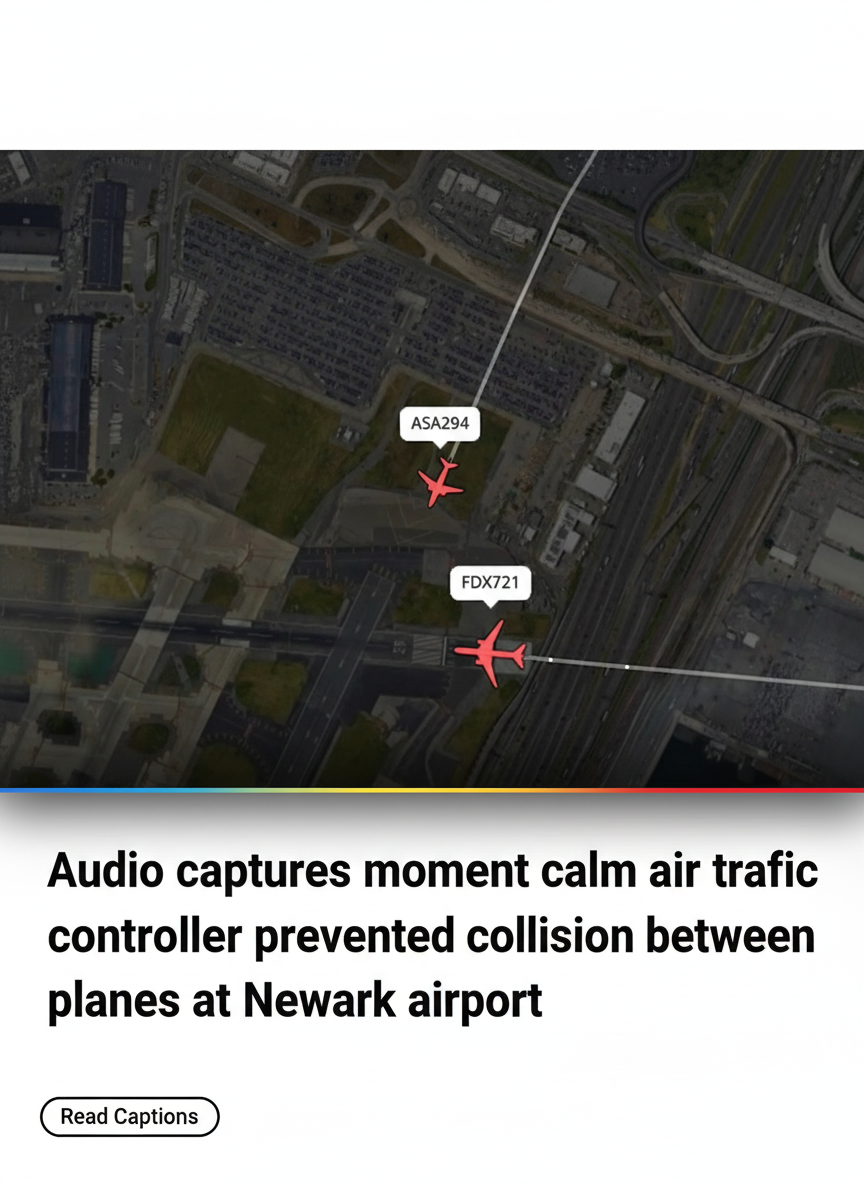
Disaster Averted: Chilling Audio Captures Near-Miss Between Alaska Airlines and FedEx Planes at Newark Liberty
NEWARK, N.J. — Aviation authorities are investigating a terrifying “close call” at Newark Liberty International Airport on Friday, after an Alaska Airlines passenger jet and a FedEx cargo plane nearly collided on the runway. Newly released air traffic control (ATC) audio has revealed just how close the two aircraft came to a catastrophe, highlighting the quick thinking and icy composure of a veteran controller.
A Heart-Stopping Moment on the Tarmac
The incident occurred during the busy Friday afternoon rush on March 20, 2026. According to preliminary flight data, the Alaska Airlines flight was in the middle of its takeoff roll when the FedEx cargo plane was cleared to land on an intersecting runway. The potential for a high-speed T-bone collision became a reality in a matter of seconds.
In the dramatic audio recording obtained by news outlets, the tension is palpable—not in the voice of the air traffic controller, but in the gravity of the commands issued. “Alaska, abort takeoff! Abort takeoff!” the controller is heard saying with remarkable steadiness, despite the looming disaster.
‘Remarkably Calm’ Under Pressure
Aviation experts are praising the controller’s performance, noting that the slightest hint of panic could have led to a delay in pilot reaction time. Instead, the clear, authoritative instructions allowed the Alaska Airlines pilot to immediately engage the emergency braking system.
Witnesses and passengers on the Alaska Airlines flight described a “violent” deceleration that sent carry-on items shifting and left the cabin in a state of stunned silence. “The plane just slammed on the brakes out of nowhere,” said one passenger. “It was terrifying, but the pilots told us later that the tower saved us.”
Investigation Underway
The Federal Aviation Administration (FAA) and the National Transportation Safety Board (NTSB) have both launched investigations into the runway incursion. The primary focus of the probe will be to determine why both aircraft were permitted to occupy the same space at the same time.
While technology like the Airport Surface Detection Equipment (ASDE-X) is designed to prevent these exact scenarios, investigators will look into whether human error, a technical glitch, or a communication breakdown played a role in the near-miss.
A Growing Concern for Aviation Safety
This incident at Newark is the latest in a string of high-profile runway incursions that have plagued major U.S. airports over the last year. The surge in close calls has prompted calls from lawmakers for increased funding for ATC staffing and modernized ground-tracking technology.
“We were seconds away from a national tragedy,” said an aviation safety analyst. “While the controller did an incredible job of mitigating the error, the error should never have happened in the first place. This serves as a wake-up call for the industry.”
Conclusion
Fortunately, no injuries were reported among the passengers or crew on either aircraft. The Alaska Airlines plane was towed back to the gate for a safety inspection of its braking system, while the FedEx flight successfully performed a “go-around” and landed safely minutes later. For now, the focus remains on the “hero of the tower”—the controller whose steady hand prevented a Friday afternoon at Newark from becoming a dark day in aviation history.