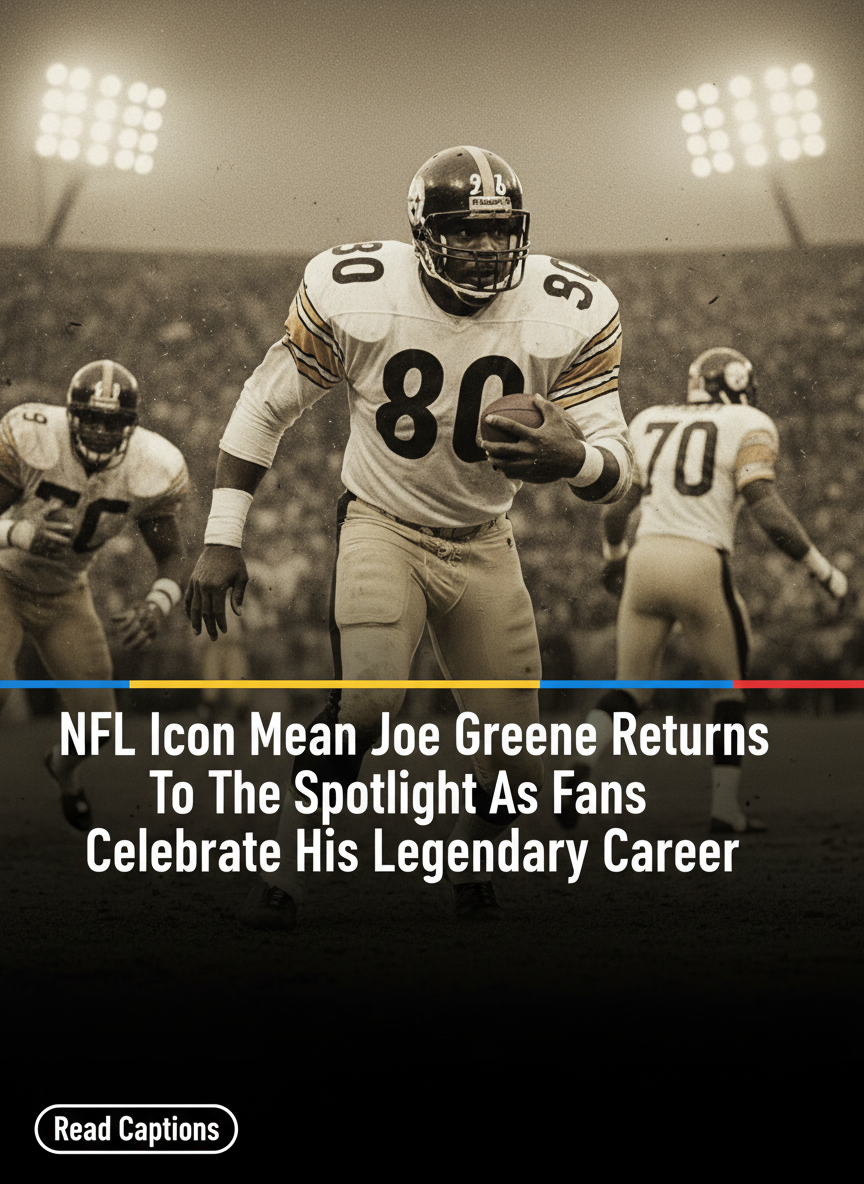
The Pillar of the Steel Curtain: How “Mean” Joe Greene Defined an Era and Transformed a Franchise
PITTSBURGH, PA — In the annals of American professional sports, few figures loom as large or as legendary as Charles Edward “Mean” Joe Greene. As of March 20, 2026, the 79-year-old Hall of Famer remains the definitive symbol of the Pittsburgh Steelers’ identity, even as he navigates a landscape where his physical presence and outspoken views on the modern game continue to spark national conversation.
The Current Impact: A Living Legend Amidst Modern Waves
Recently, the NFL community was reminded of Greene’s immense cultural footprint when false reports regarding his health circulated on social media on March 20, 2026. The Pittsburgh Steelers and family representatives were quick to clarify that the legendary defensive tackle is alive and well, highlighting the deep-seated public affection for a man who hasn’t stepped onto a professional gridiron in over four decades. This occurrence follows a widely discussed appearance Greene made in June 2025, where he critiqued the shift in NFL culture toward individual “entertainment” and celebration, advocating for a return to the team-first professionalism that defined his tenure.
Greene currently serves as the last surviving member of the original “Steel Curtain” front four—a unit that included L.C. Greenwood, Ernie Holmes, and Dwight White. His role as a franchise ambassador and elder statesman of the league continues to provide a bridge between the gritty, foundational era of the 1970s and the high-tech, offensive-heavy NFL of today.
The Career: Four Rings and a Defensive Revolution
Joe Greene was the cornerstone of the greatest dynasty in NFL history. Drafted fourth overall in 1969 by Coach Chuck Noll, Greene arrived at a time when the Steelers were perennial losers. He famously hated losing, once reportedly throwing a football into the stands in frustration during a game against the Chicago Bears. That competitive fire transformed the locker room.
Statistically, Greene’s impact was staggering, despite playing in an era before sacks were an official league statistic. He is credited with approximately 77.5 career sacks and recorded 16 fumble recoveries over 181 games. His accolades include:
- Four Super Bowl Championships: IX, X, XIII, and XIV.
- Two-Time NFL Defensive Player of the Year: 1972 and 1974.
- NFL Defensive Rookie of the Year: 1969.
- Ten Pro Bowl Selections: Spanning from 1969 to 1979.
- NFL Man of the Year: 1979 (now known as the Walter Payton Award).
Technically, Greene revolutionized the defensive tackle position by pioneering the “tilted” nose tackle alignment. By lining up at an angle between the center and guard, he used his explosive first step to penetrate the backfield, a tactic that disrupted traditional blocking schemes and paved the way for the Steelers’ defense to dominate the 1970s.
Beyond the Field: The “Hey Kid, Catch!” Phenomenon
While his “Mean” moniker suggested a terrifying on-field persona, Greene became a household name for a remarkably different reason in late 1979. His Coca-Cola commercial, titled “Hey Kid, Catch!”, debuted on October 1, 1979, and reached iconic status during Super Bowl XIV in 1980. The 60-second ad, featuring a limping, bruised Greene and a young fan played by Tommy Okon, humanized the fierce defender and became one of the most celebrated advertisements in history, winning a Clio Award.
This duality—the terrifying defender on Sunday and the smiling, jersey-tossing icon in the tunnel—helped bridge the gap between football and the broader American public. It proved that athletes could be both gladiators and role models, a standard Greene has maintained through his extensive charitable work, including the scholarship foundation he established in honor of his late wife, Agnes.
History and Roots: The Making of “Mean” Joe
Born September 24, 1946, in Temple, Texas, Greene’s journey began at North Texas State University (now the University of North Texas). It was here that he earned his nickname; contrary to popular belief, it was originally a reference to the school’s “Mean Green” defense rather than his personal temperament. However, his fierce play soon made the name synonymous with his individual identity.
When Chuck Noll selected him in 1969, many Pittsburgh fans were skeptical, but Noll famously insisted that Greene was the foundational piece required to change the culture. The pick proved to be the most important in franchise history. In 2014, the Steelers officially retired his number 75, making him only the second player in the team’s long history to receive such an honor (alongside Ernie Stautner; Franco Harris’s #32 was later retired in 2022).
Conclusion
Today, Joe Greene remains the gold standard for what it means to be a “Pittsburgh Steeler.” His legacy is not merely found in the four Super Bowl rings he wears or his bust in the Pro Football Hall of Fame in Canton, Ohio, but in the standard of excellence he demanded from himself and his teammates. As the NFL evolves, the legend of “Mean” Joe Greene stands as a permanent reminder of an era when the game was defined by grit, defensive dominance, and a relentless pursuit of victory.