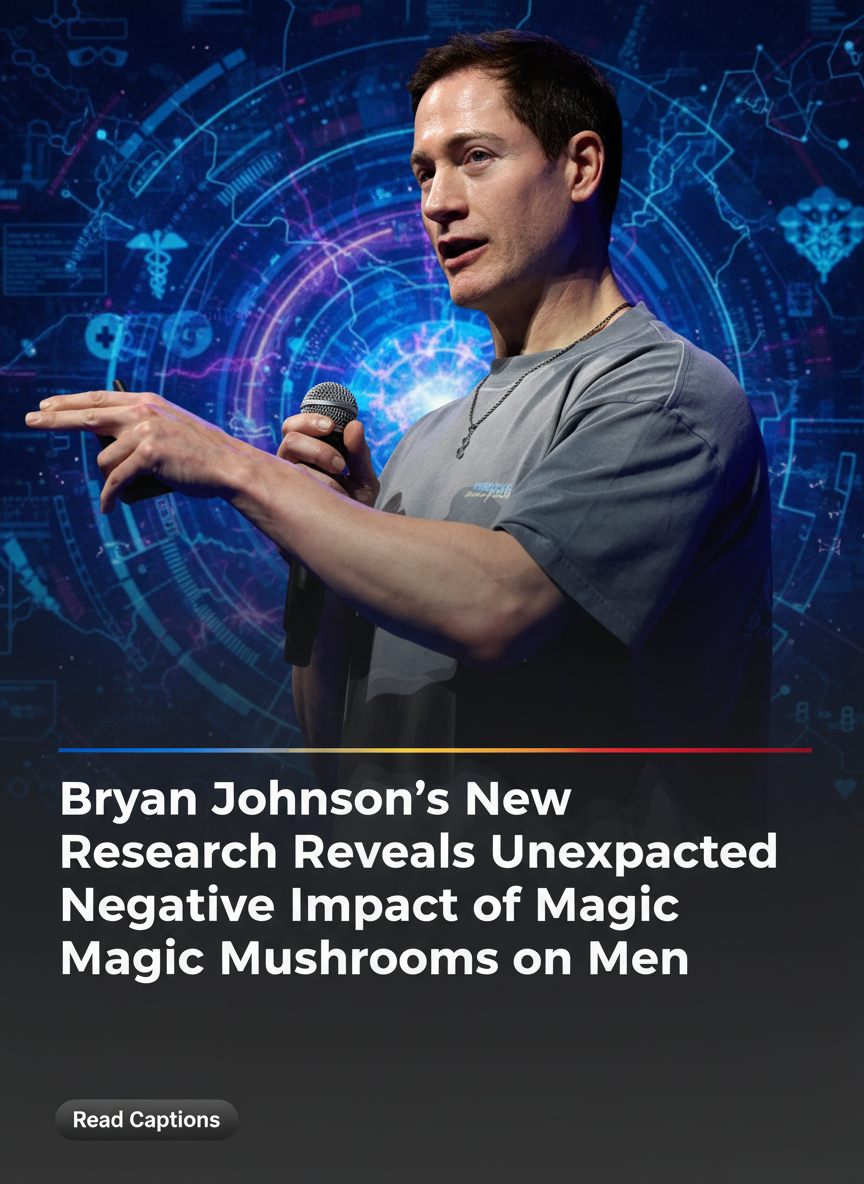
Biohacker Bryan Johnson Unveils ‘First-in-Human Observation’ Suggesting Potential Risks of Psilocybin for Men
LOS ANGELES — Bryan Johnson, the centimillionaire tech mogul famously dedicated to reversing his biological age, has released new data from his rigorous “Project Blueprint” that may challenge the current golden era of psychedelic research. In what he calls a “first-in-human observation,” Johnson revealed that psilocybin—the active compound in magic mushrooms—may have previously undocumented negative impacts on male physiology.
The Blueprint Data: A New Perspective on Psychedelics
Johnson, who spends upwards of $2 million annually to monitor every organ and biological function in his body, recently integrated controlled psilocybin use into his protocol. While the drug has been hailed in recent years as a breakthrough treatment for depression and anxiety, Johnson’s granular data suggests a more complicated story regarding physical recovery and cardiovascular health.
According to his findings, the administration of psilocybin triggered a significant and sustained “stress response” in his autonomic nervous system. Specifically, Johnson noted a sharp decline in Heart Rate Variability (HRV) and a disruption in deep sleep cycles that lasted well beyond the acute duration of the “trip.”
A “Negative Impact” on Men?
The core of Johnson’s observation centers on how psilocybin interacts with the male endocrine and cardiovascular systems. Johnson reported that his data showed a spike in nighttime resting heart rate and a suppression of testosterone-related recovery markers during the 48 hours following ingestion.
“While the psychological insights may be profound, the biological cost is measurable,” Johnson stated in his report. “We are seeing a discordance between the ‘mind’ feeling healed and the ‘body’ showing signs of significant physiological strain. For men focused on longevity and peak performance, this is a critical trade-off that hasn’t been quantified until now.”
Challenging the Modern Narrative
For the past decade, psilocybin has been the darling of the wellness and psychiatric industries. Clinical trials from institutions like Johns Hopkins have shown its efficacy in treating PTSD and end-of-life anxiety. However, Johnson argues that these studies often prioritize psychological outcomes over long-term biological data.
Johnson’s observation suggests that for men, the “metabolic price” of magic mushrooms might manifest as increased cardiovascular aging or decreased “readiness” scores—metrics that his Blueprint project tracks with obsessive precision. He suggests that the substance may keep the male nervous system in a “sympathetic” (fight or flight) state longer than previously understood.
The Scientific Community Reacts
While Johnson’s data is anecdotal—based on an N-of-1 trial (himself)—his level of measurement is more sophisticated than that of most clinical settings. Critics argue that one man’s data cannot dictate public health policy, but supporters in the biohacking community say Johnson is providing the “canary in the coal mine” for substances that are being fast-tracked into the mainstream.
Independent researchers have noted that psilocybin is known to bind to 5-HT2B receptors, which are found in the heart. Johnson’s observation of cardiovascular strain could provide a roadmap for future studies to look more closely at the physical toll of frequent psychedelic use.
Conclusion: Data Over Hype
As the push for the legalization and medicalization of magic mushrooms gains momentum across the United States, Bryan Johnson’s latest revelation serves as a cautionary note for the “longevity-obsessed.” For Johnson, the path to living forever is paved with data, not just experiences.
“The goal is to move from ‘I feel’ to ‘I know,'” Johnson concluded. “If psilocybin accelerates biological aging or strains the heart, we need to know that—regardless of how ‘enlightened’ it makes us feel.”
For more updates on Bryan Johnson’s Project Blueprint and the latest in longevity science, stay tuned to our Health & Tech coverage.