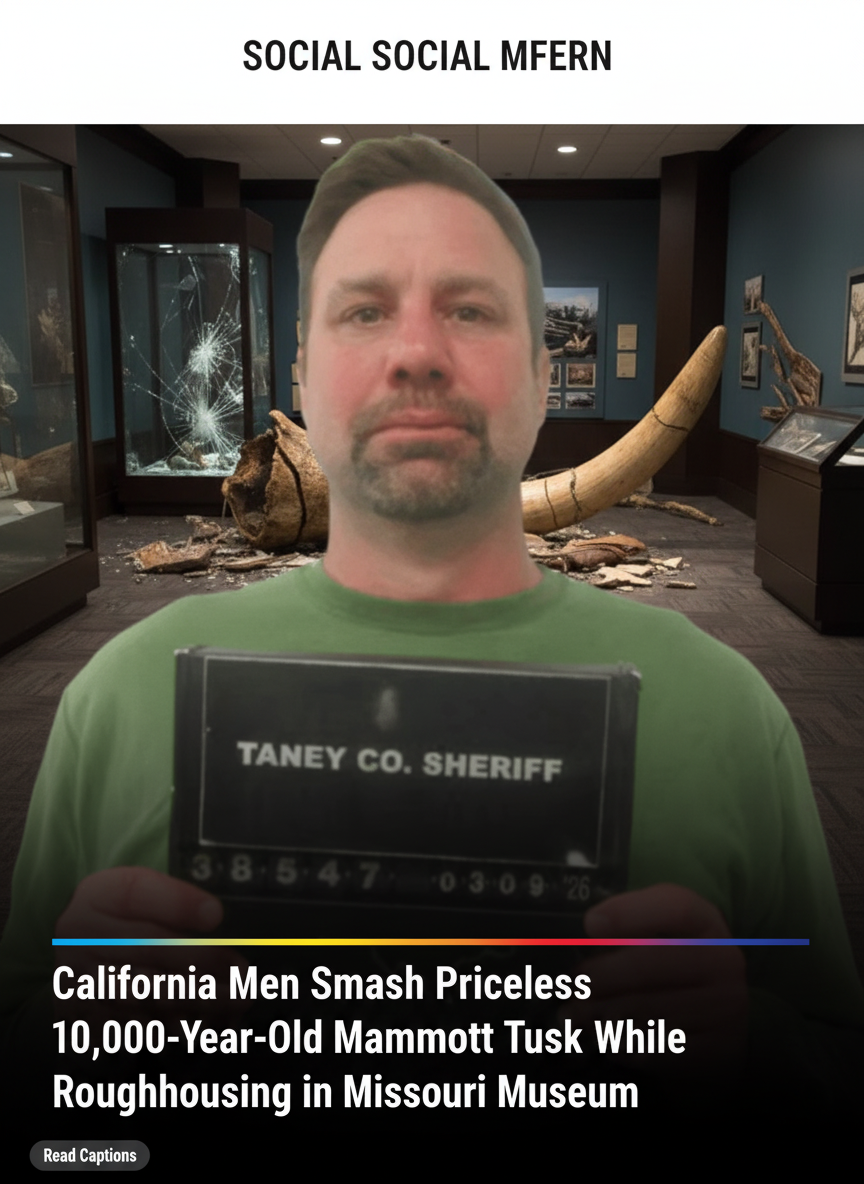
‘Priceless’ History Shattered: Bay Area Men Under Investigation After Destroying 10,000-Year-Old Mammoth Tusk
A pair of visitors from Northern California are facing potential legal consequences and the ire of the scientific community after a bout of “roughhousing” led to the destruction of a 10,000-year-old mammoth tusk at a Missouri museum this week.
The incident, which occurred at a prominent Missouri natural history institution, has left curators devastated and a rare piece of the Pleistocene era in fragments. What began as a vacation for the two Bay Area men ended in a cultural catastrophe when their physical horseplay near an unsecured exhibit resulted in the ancient artifact being knocked from its pedestal and shattered upon the floor.
A Moment of Folly, a Millennium of Loss
According to museum security footage and witness accounts, the two men—whose identities are currently being withheld pending formal charges—were seen pushing and shoving one another in a jovial manner through the “Ice Age Giants” wing. The play turned tragic when one man lost his balance and collided with the display case housing the prehistoric tusk.
The tusk, which measured nearly seven feet in length, was a centerpiece of the museum’s collection. Recovered decades ago from a riverbed, it served as a vital record of the woolly mammoths that once roamed the American Midwest. Experts say the specimen was worth “a fortune,” with market values for such rare, intact fossils reaching well into the six-figure range—though curators argue its historical value was truly priceless.
“Beyond Repair”
“It’s a heartbreaking sight,” said Dr. Helena Vance, the museum’s lead paleontologist. “This wasn’t just a rock; it was a biological archive of a world long gone. Because of the way fossilized ivory crystallizes over ten thousand years, it doesn’t just break—it shatters. Our conservation team is assessing the damage, but early reports suggest it may be beyond reasonable repair.”
Museum officials noted that while many artifacts are behind reinforced glass, some larger specimens are kept in open-air displays to allow visitors a more intimate look at their scale. This trust in the public was, in this instance, misplaced.
Legal and Financial Repercussions
Local law enforcement was called to the scene immediately following the incident. While no arrests were made on-site, the Missouri State Prosecutor’s office is reportedly reviewing the case to determine if charges of felony property damage or institutional vandalism are warranted.
Legal experts suggest the duo could also face a massive civil lawsuit from the museum’s insurance providers. “When you destroy a piece of state or museum property through negligence, you aren’t just looking at a slap on the wrist,” said legal analyst Marcus Thorne. “The financial liability for an item of this rarity could follow these individuals for the rest of their lives.”
A Growing Trend of Tourist Negligence
The destruction of the mammoth tusk is the latest in a string of incidents involving tourists damaging irreplaceable landmarks and artifacts for the sake of social media or general carelessness. From graffiti on ancient ruins to the toppling of rock formations in national parks, cultural institutions are increasingly struggling to balance public access with preservation.
As for the “dimwitted” Bay Area pals, their vacation has likely come to an expensive and shameful end. The museum has confirmed that they have been banned for life, and a sign now hangs in the empty space where the tusk once stood, citing the “unfortunate incident” as the reason for the exhibit’s closure.
The investigation remains ongoing, and the museum is expected to release a full statement regarding the future of the specimen later this month.