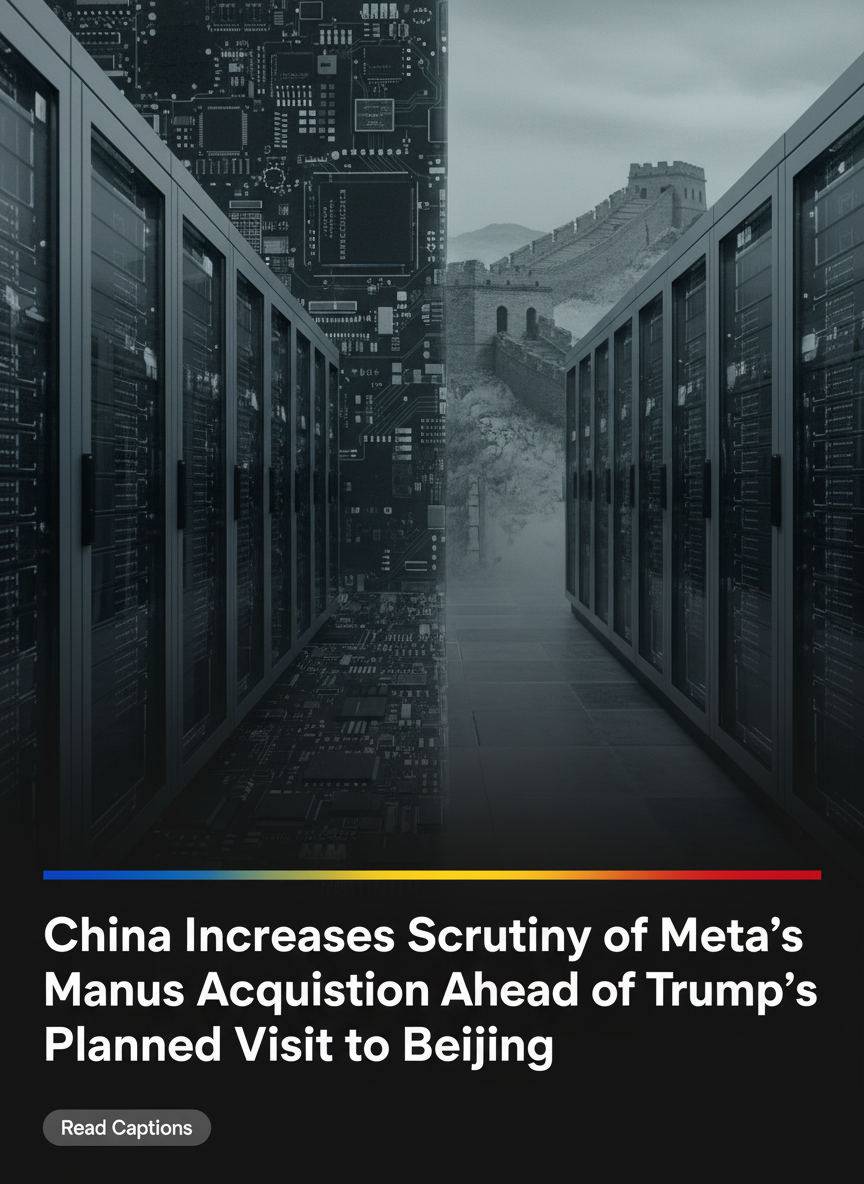
Beijing Casts Shadow Over Meta’s Manus Deal as Trump Visit Looms
BEIJING — In a move that has sent ripples through the global tech sector, Chinese authorities have significantly intensified their scrutiny of Meta’s recent acquisition of Manus, a Singapore-based startup with deep Chinese origins. The escalating investigation comes at a high-stakes diplomatic moment, as President Donald J. Trump prepares for a high-profile state visit to Beijing next week.
A Crackdown on Personnel
Reports emerging from the region suggest that Chinese security and regulatory agencies have begun questioning several individuals linked to the Manus deal. Sources familiar with the matter, speaking on the condition of anonymity, indicate that at least three former executives and several high-level engineers have been served with exit bans or placed under “administrative detention” for questioning regarding the transfer of intellectual property.
The crackdown appears to be a direct response to the sale of Manus to Meta, the American social media and AI giant. While Manus is legally headquartered in Singapore, its founding team and much of its core research and development were originally based in Shenzhen, China’s primary hardware and software hub. Beijing’s regulators are reportedly concerned that proprietary AI algorithms, developed partially on Chinese soil, have been offshored without proper state clearance.
The Manus Factor: Why It Matters
Manus rose to prominence over the last eighteen months for its breakthrough work in “autonomous agents”—AI systems capable of performing complex digital tasks across various platforms with minimal human intervention. For Meta, the acquisition was seen as a strategic cornerstone to bolster its “Meta AI” ecosystem and regain a competitive edge against domestic rivals like OpenAI and Google.
However, the deal has now become a flashpoint for “technological sovereignty.” Chinese officials are increasingly wary of “talent flight” and the loss of critical AI infrastructure to the United States. “The message is clear,” said Zhang Wei, a senior tech analyst in Shanghai. “Any company with significant Chinese roots is now considered a national asset, regardless of where their corporate registration currently sits.”
Diplomatic Poker: The Trump Visit
The timing of the crackdown is being viewed by many as a calculated geopolitical maneuver. President Trump is scheduled to arrive in Beijing for a three-day summit intended to address trade imbalances and the ongoing “tech cold war.” By putting pressure on Meta—a marquee American firm—Beijing may be seeking leverage in broader negotiations regarding semiconductor export bans and tariffs.
The White House has not yet issued a formal statement on the detentions, but senior administration officials have hinted that the “weaponization of corporate investigations” will be high on the President’s agenda. For Mr. Trump, who has vacillated between praising Chinese leadership and imposing strict trade barriers, the Meta-Manus situation presents a complex challenge: defending U.S. corporate interests while maintaining the momentum for a new trade deal.
Chilling Effects on Global Tech
The investigation is already having a chilling effect on the venture capital landscape in Southeast Asia. For years, Singapore has served as a “neutral ground” for startups with Chinese founders to attract Western capital. The scrutiny of Manus suggests that this “Singapore bypass” may no longer offer protection from Beijing’s long-arm jurisdiction.
Meta, which has sought to distance itself from the controversies surrounding its acquisition, released a brief statement on Tuesday: “We comply with all local laws and regulations in every jurisdiction where we operate. We remain committed to the integration of the Manus team and the development of open, accessible AI technologies.”
Looking Ahead
As the diplomatic motorcade prepares to roll through Beijing, the fate of the individuals linked to Manus remains uncertain. The situation serves as a stark reminder that in the current era of tech nationalism, a corporate merger is rarely just a business transaction; it is a move on a global chessboard where the pieces are increasingly human.
Whether the pressure on Meta will ease following the Trump-Xi summit remains to be seen, but for now, the tech industry is on high alert, watching for the next signal from a Chinese government determined to keep its innovations within its borders.