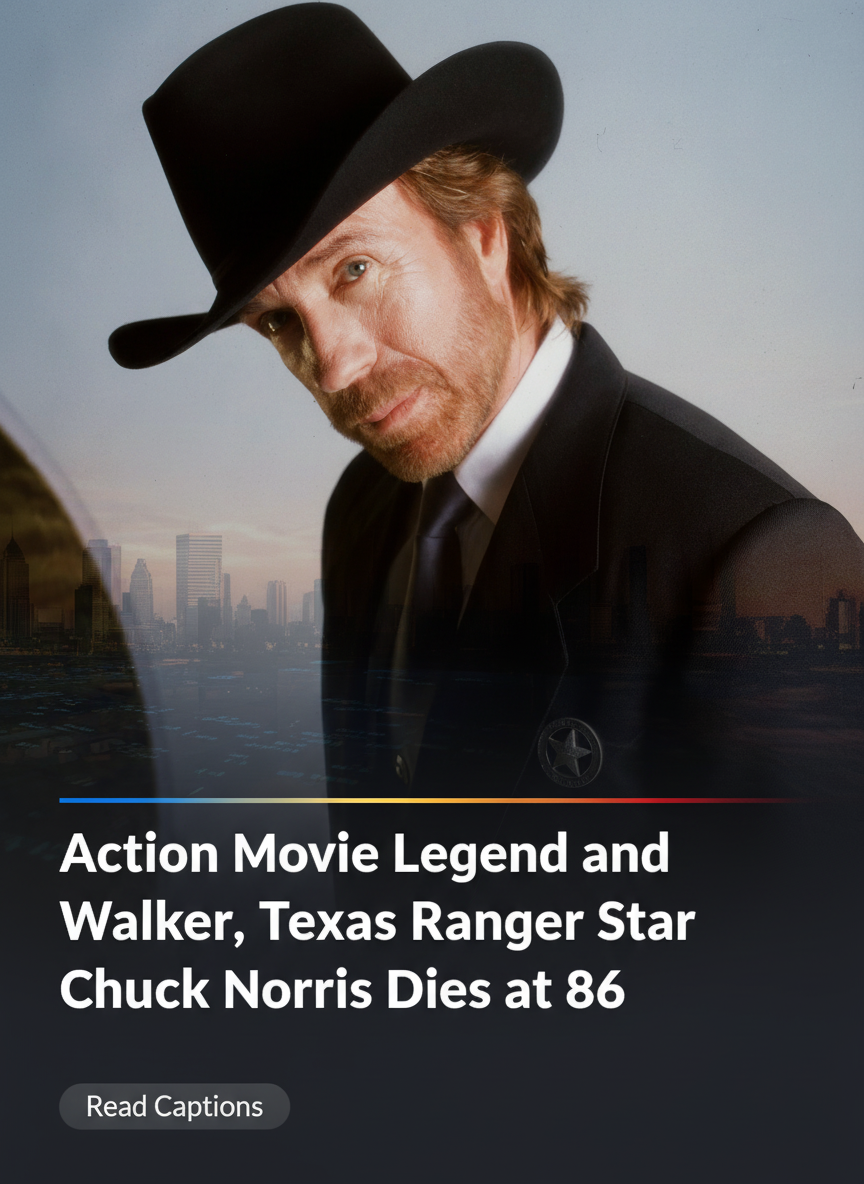
Chuck Norris, Martial Arts Legend and Action Cinema Icon, Dies at 86
Chuck Norris, the world-renowned martial artist who transitioned from a decorated karate champion to a global action movie powerhouse and the face of the long-running television hit Walker, Texas Ranger, has died. He was 86.
His passing marks the end of an era for Hollywood’s golden age of action cinema. Known for his stoic demeanor, signature beard, and a roundhouse kick that became the stuff of legend—and eventually internet lore—Norris remained a symbol of rugged American heroism for over five decades.
From the Air Force to the Dojo
Born Carlos Ray Norris in Ryan, Oklahoma, in 1940, Norris was a shy child who found his confidence through the military. While serving in the U.S. Air Force in South Korea, he began training in Tang Soo Do, a martial art that would change the trajectory of his life. Upon returning to the United States, he opened a chain of karate schools, eventually teaching celebrities like Steve McQueen and Priscilla Presley.
Before he was a movie star, Norris was a formidable competitor. He reigned as the undefeated World Professional Middleweight Karate Champion for six consecutive years, retiring in 1974 with a record that solidified his status as one of the greatest martial artists of his generation.
The Rise of an Action Hero
Norris’s big-screen breakthrough came in 1972 when he faced off against Bruce Lee in the climactic Colosseum battle of Way of the Dragon. Though he played the antagonist, the fight remains one of the most celebrated martial arts sequences in film history.
By the 1980s, Norris had become a cornerstone of the action genre. He signed a multi-film deal with Cannon Films, leading a string of box-office hits including Missing in Action (1984), where he played a Vietnam veteran returning to rescue POWs, and The Delta Force (1986), an ensemble piece that showcased his ability to lead high-stakes military thrillers. His roles often mirrored his real-life values: the silent, disciplined protector who used violence only as a last resort, but with devastating efficiency.
Cordell Walker and Television Stardom
In 1993, Norris pivoted to the small screen with Walker, Texas Ranger. Playing Cordell Walker, a contemporary lawman who preferred martial arts to gunplay, Norris found his most enduring role. The series ran for eight seasons on CBS, becoming a Saturday night staple for millions of families. The show cemented his image as an infallible force for justice, a persona that would later fuel a massive cultural resurgence.
A Digital Legacy: “Chuck Norris Facts”
In the mid-2000s, Norris experienced an unexpected career second act when he became the subject of “Chuck Norris Facts”—a series of hyperbolic, satirical myths about his toughness and invincibility (e.g., “Chuck Norris doesn’t wear a watch; he decides what time it is”).
While many stars might have balked at being the subject of such memes, Norris embraced the phenomenon with good humor, often citing his favorites in interviews and even making a self-referential cameo in The Expendables 2 (2012). The memes introduced him to a new generation of fans, ensuring his legacy stayed relevant in the digital age.
A Life of Philanthropy and Discipline
Beyond the screen, Norris was a dedicated philanthropist. He founded Kickstart Kids, a program that uses martial arts to teach character and discipline to at-risk youth. He remained a staunch advocate for veterans’ rights and physical fitness well into his eighties.
Chuck Norris is survived by his wife, Gena O’Kelley, and his children. While the man who once famously “counted to infinity—twice” may have passed, his influence on martial arts, film, and popular culture remains an immovable force. In the hearts of his fans, Chuck Norris didn’t die; death just finally got the courage to tell him it was time to move on.