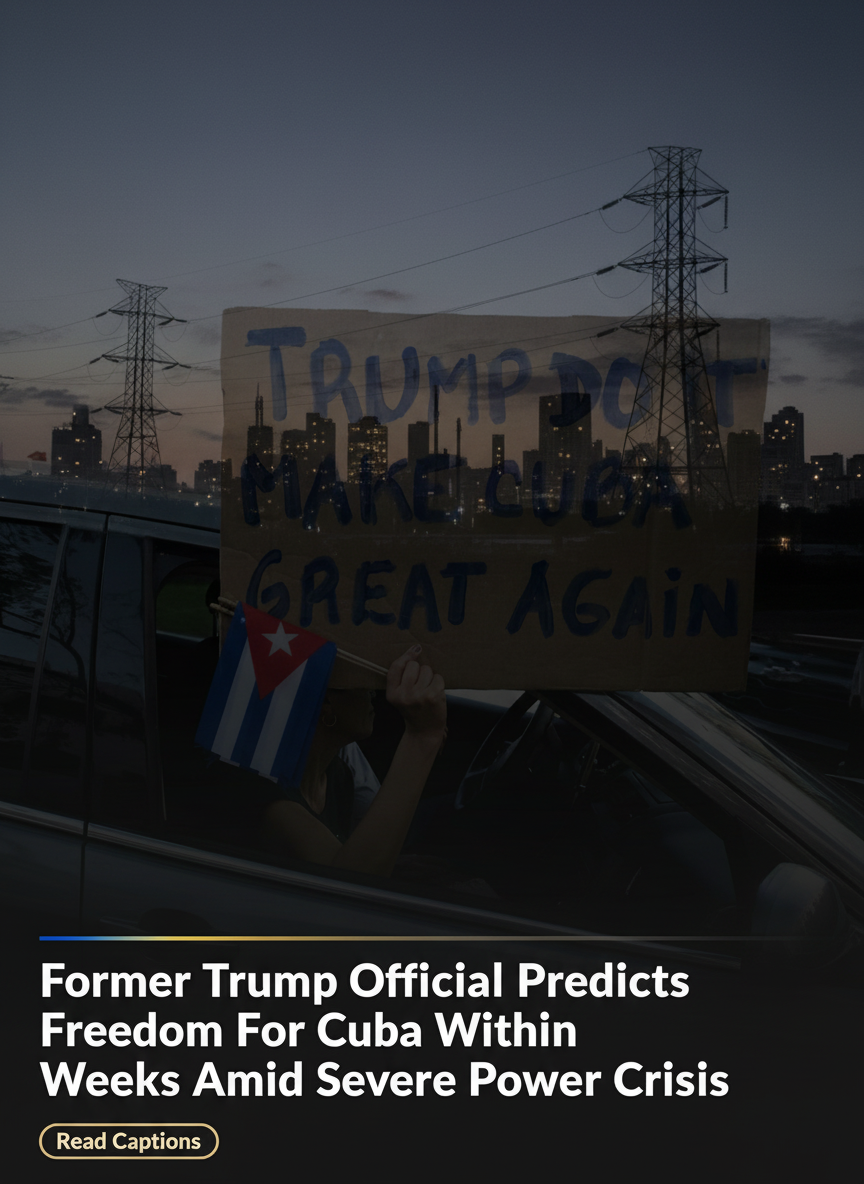
Historical Turning Point? Former Trump Official Predicts Cuban Regime Collapse Within Weeks
MIAMI — As Cuba grapples with a catastrophic collapse of its national power grid and mounting social unrest, a former high-ranking Trump administration official is making a bold prediction: the island nation could experience “freedom for the first time in 70 years” within a matter of weeks.
Mauricio Claver-Carone, who served as the National Security Council’s senior director for Western Hemisphere Affairs under President Donald Trump, suggests that the convergence of total infrastructure failure and a lack of foreign subsidies has pushed the communist regime to a point of no return. The prediction comes as millions of Cubans remain in the dark, facing acute shortages of food, water, and medicine.
A Systemic Collapse
The current crisis was triggered by the failure of the Antonio Guiteras power plant, the island’s largest, which led to a total blackout across the country. While the Cuban government has attempted to restore partial power, the underlying issues—decrepit infrastructure, lack of fuel, and the absence of investment—have left the grid in a state of perpetual fragility.
“What we are seeing is the physical manifestation of the regime’s bankruptcy,” Claver-Carone stated in a recent interview. He argued that unlike previous crises where the Soviet Union or Venezuela stepped in to provide an economic lifeline, Havana now finds itself isolated. “The regime has no more rabbits to pull out of the hat. The collapse is no longer a question of ‘if,’ but ‘when,’ and that ‘when’ looks like it’s just weeks away.”
Trump’s ‘Maximum Pressure’ Strategy
The timing of these predictions aligns with a renewed focus on Cuba within the U.S. political landscape. Former President Donald Trump has frequently asserted that his administration’s “maximum pressure” campaign—which included designating Cuba as a state sponsor of terrorism and tightening travel and trade restrictions—was on the verge of toppling the regime before he left office.
Trump recently doubled down on this rhetoric, suggesting that a return to his policies would provide the final push necessary to bring democracy to the island. Supporters of this approach argue that the current administration’s perceived “thaw” in relations provided the Cuban leadership with a temporary reprieve, which has now been exhausted by the sheer weight of economic mismanagement.
Desperation on the Ground
For the average Cuban citizen, the political maneuvering in Washington takes a backseat to the daily struggle for survival. Protests have broken out in various provinces, with citizens banging pots and pans (cacerolazos) to demand electricity and liberty. The 2021 “Patria y Vida” protests served as a precursor to the current tension, but observers note that the current desperation is even more widespread.
Human rights organizations warn that as the regime feels the walls closing in, the risk of a violent crackdown increases. However, Claver-Carone and other hardliners believe the military’s loyalty may be wavering as even the families of soldiers are forced to endure the same darkness and hunger as the general population.
The Road Ahead
While skeptics point out that the Cuban regime has survived decades of embargoes and internal strife, the scale of the current energy crisis is unprecedented. If the prediction of a transition within weeks holds true, it would mark the end of an era that began with the 1959 revolution led by Fidel Castro.
As the international community watches closely, the situation remains fluid. Whether this is the final gasp of a failing system or another chapter in Cuba’s long history of resilience remains to be seen. However, for those advocating for a democratic transition, the current darkness over the island may, ironically, be the clearest sign yet of a coming dawn.
This report was based on recent developments and interviews regarding the ongoing humanitarian and political crisis in Cuba.