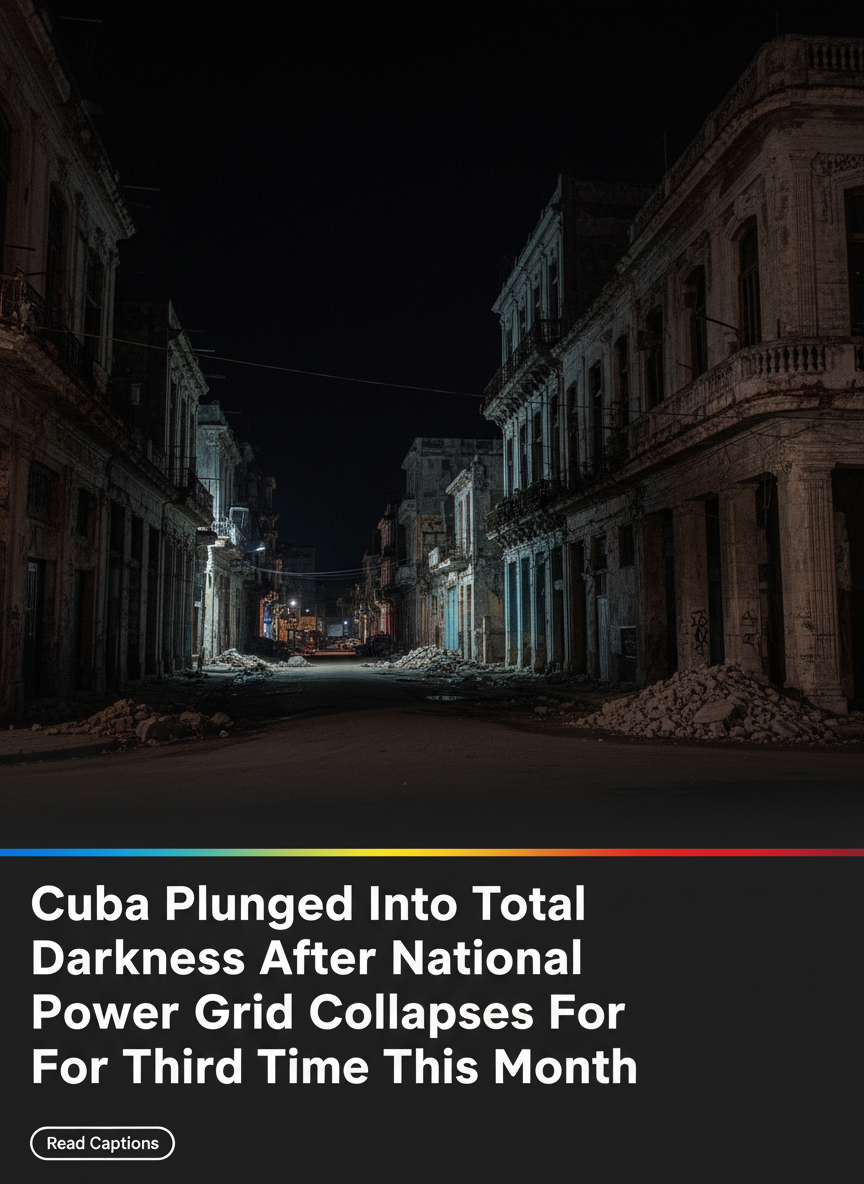
Island in the Dark: Cuba’s Power Grid Collapses for the Third Time This Month
HAVANA — For the third time in less than thirty days, the nation of Cuba has been plunged into a total blackout. On Sunday, the Cuban Electric Union (UNE) announced a complete failure of the national electrical system (SEN), leaving the island’s 10 million residents without power and raising urgent questions about the stability of the country’s aging infrastructure.
The Ministry of Energy and Mines confirmed the total collapse via a brief statement, noting that the grid “disconnected” entirely. While officials have not yet provided a specific technical cause for this latest failure, the incident follows a pattern of systemic fragility that has characterized the Cuban energy sector for years.
A Month of Darkness
This latest event marks a grim milestone for the Caribbean nation. Throughout March, the grid has repeatedly failed to handle the load required to power the country. Previous collapses this month were attributed to a combination of mechanical failures at major thermoelectric plants—specifically the Antonio Guiteras plant in Matanzas—and a chronic shortage of fuel required to run distributed generation units.
For residents, the frequency of these total blackouts is reaching a breaking point. “It is not just the lack of lights,” said one Havana resident via a spotty cellular connection. “It is the food rotting in the fridge, the lack of water pumps working, and the heat. We are living in a state of constant uncertainty.”
The Roots of the Crisis
The Cuban energy crisis is the result of a “perfect storm” of economic and logistical hurdles. The government has frequently pointed to the decades-long U.S. embargo as a primary obstacle, claiming it prevents the acquisition of necessary spare parts and complicates the financing of fuel imports.
However, independent energy analysts argue that the crisis is also driven by internal mismanagement and a lack of investment in renewable energy. Most of Cuba’s thermoelectric plants are over 40 years old, well past their intended lifespan, and require constant maintenance that the cash-strapped government can ill afford. Furthermore, shifts in regional geopolitics have led to inconsistent oil shipments from long-time allies like Venezuela and Russia.
Government Response and Social Tensions
President Miguel Díaz-Canel and his administration have called for “unity and patience” as crews work to restore the system. The process of “black starting” a national grid is a delicate operation; technicians must carefully synchronize various plants to avoid a surge that could cause another collapse. In previous weeks, restoration efforts were hampered by “micro-grid” failures that occurred just as power was being returned to major cities.
The outages have also fueled social unrest. In recent months, small-scale protests have broken out in various provinces, with citizens demanding “corriente y comida” (power and food). The government has responded with a mix of promised reforms and increased security presence in the streets to prevent larger demonstrations similar to those seen in July 2021.
A Precarious Future
As of Sunday evening, small pockets of Havana reported the return of some electricity, but the vast majority of the island remains in the dark. With the peak summer months approaching—bringing higher temperatures and increased demand for air conditioning—the pressure on the Cuban Electric Union is expected to intensify.
For now, the people of Cuba wait in the shadows, hoping that the next time the lights come on, they will stay on. But with three total collapses in a single month, the structural integrity of the nation’s power supply has never looked more precarious.