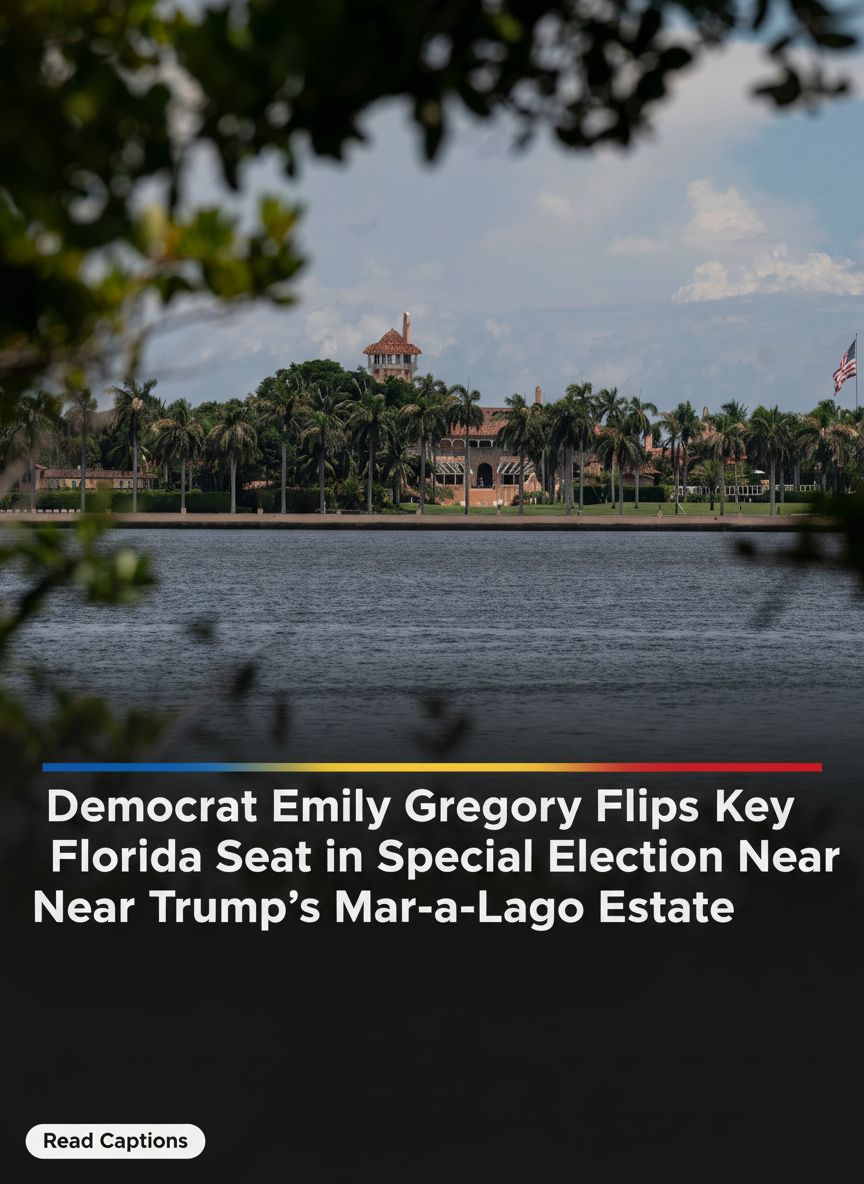
Blue Wave Hits Mar-a-Lago: Democrat Emily Gregory Flips Key Florida District in Special Election
PALM BEACH, Fla. — In a result that has sent shockwaves through both Tallahassee and Washington, Democrat Emily Gregory emerged victorious on Tuesday in a special election for Florida’s 89th House District. The victory brings the burgeoning “Democratic surge” directly to the doorstep of Mar-a-Lago, the primary residence of former President Donald J. Trump, marking a significant shift in the political landscape of a once-reliably Republican stronghold.
A Symbolic Victory in the GOP Heartland
The race, triggered by the unexpected resignation of the Republican incumbent, was seen as a litmus test for voter sentiment heading into the 2026 midterms. Gregory, a local attorney and community activist, ran a campaign focused heavily on Florida’s skyrocketing property insurance rates and reproductive rights—issues that clearly resonated with the affluent but increasingly moderate coastal electorate.
“Tonight, the voters of Palm Beach sent a message that could be heard all the way from Ocean Boulevard to the state capital,” Gregory told a jubilant crowd of supporters late Tuesday night. “They said they are ready for solutions, not slogans. They said they want a Florida that works for everyone, not just the well-connected.”
The “Mar-a-Lago Factor”
The 89th District includes some of the most expensive real estate in the country, including the Mar-a-Lago Club. While the area has historically leaned Republican, changing demographics and a growing frustration among suburban voters have steadily eroded the GOP’s margin of error. Political analysts suggest that Gregory’s win is not just a local fluke, but a sign of a broader realignment.
“To lose a seat that encompasses the former President’s home is more than just a mathematical loss for the GOP; it’s a massive symbolic blow,” said Dr. Elena Vasquez, a political science professor at Florida Atlantic University. “This suggests that the ‘Florida is deep red’ narrative may be more fragile than Republicans anticipated.”
Union Strength in the State Senate Race
The night brought further good news for Florida Democrats in a second high-stakes contest. In the race for a State Senate seat recently vacated by Florida’s Lieutenant Governor—who stepped down to join the private sector—a prominent union leader has taken a commanding lead.
With nearly 90% of the precincts reporting, Marcus Thorne, a veteran labor organizer, leads his Republican challenger by nearly five percentage points. Thorne’s campaign centered on labor protections and expanding Medicaid, drawing heavy support from the state’s working-class corridors. If his lead holds, it would represent another significant flip for a Democratic party that had been struggling for relevance in the state just two years ago.
Republicans Face Internal Reckoning
The Republican Party of Florida (RPOF) issued a brief statement late Tuesday, acknowledging the disappointing results in Palm Beach while emphasizing their commitment to “regrouping and focusing on the general election.” Internal finger-pointing has already begun, with some party insiders questioning whether the campaign’s heavy reliance on national culture-war issues alienated the district’s more pragmatic voters.
Meanwhile, national Democratic organizations are already looking to capitalize on the momentum. The Democratic National Committee (DNC) heralded Gregory’s win as proof that “no district is off-limits” when candidates focus on local kitchen-table issues.
Looking Ahead
As Emily Gregory prepares to head to Tallahassee, the broader implications of Tuesday’s special elections will be scrutinized by strategists across the country. For the GOP, it is a warning that their grip on the Sunshine State may be slipping. For Democrats, it is a much-needed infusion of energy and a roadmap for how to compete in Florida’s increasingly complex political environment.
The certification of the results is expected by the end of the week, with Gregory slated to be sworn in shortly thereafter, just in time for the upcoming legislative session.