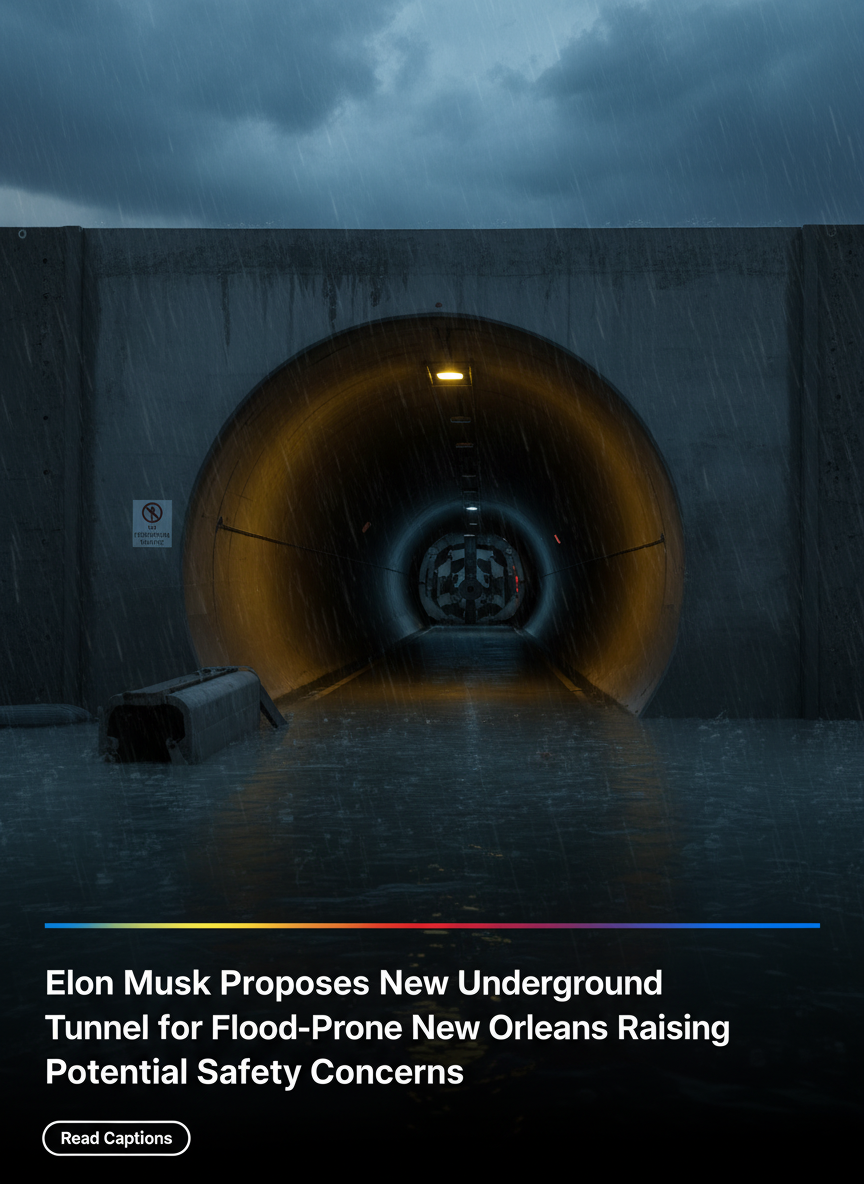
Beneath the Big Easy: Elon Musk Targets Flood-Prone New Orleans for Next Underground Tunnel
NEW ORLEANS — Elon Musk, the billionaire entrepreneur known for tackling high-stakes engineering challenges, has set his sights on one of the most geographically precarious cities in America. The Boring Company, Musk’s tunnel-construction venture, has officially identified New Orleans as a potential site for its next subterranean transit project, sparking a mix of futuristic excitement and deep-seated skepticism.
The proposal, which surfaced this week, outlines a plan for a tunnel stretching up to one mile in length with a 12-foot inner diameter. While the specific route within the city remains undisclosed, the mere prospect of digging deep into New Orleans’ notoriously soft, water-logged soil has experts and locals alike asking a pointed question: “What could go wrong?”
A Technical Gamble in the “Sinking City”
New Orleans presents a unique set of challenges that would test the limits of modern boring technology. Much of the city sits below sea level, built atop a volatile mix of river silt, clay, and swampy marshland. The city’s infrastructure is famously locked in a constant battle with water, relying on a massive network of pumps to prevent flooding during heavy rains.
Engineers point out that the “water table” in New Orleans is exceptionally high, often resting just a few feet below the surface. Constructing a dry, stable tunnel in these conditions requires sophisticated pressurized tunneling shields and constant moisture management—a feat that becomes significantly more expensive and risky in an environment prone to subsidence and hurricanes.
The Boring Company’s Vision
Despite the environmental hurdles, Musk’s Boring Company maintains that its technology is designed to make tunneling faster and more cost-effective than traditional methods. The proposed 12-foot diameter is standard for the company’s “Loop” system, which uses autonomous electric vehicles to ferry passengers underground, bypassing surface-level traffic congestion.
Proponents of the project argue that if Musk can successfully navigate the “Mississippi mud,” it would serve as a global proof-of-concept. A successful tunnel in New Orleans would demonstrate that The Boring Company can operate in even the most difficult geological conditions, potentially opening the door for similar projects in other coastal cities facing rising sea levels and traffic woes.
Skepticism from the Streets
The reaction from New Orleans residents has been a blend of trademark “Big Easy” humor and genuine concern. Given the city’s history with crumbling roads and drainage issues, many are wary of a private entity digging deep beneath their feet. On social media, the announcement was met with memes of “underwater subways” and jokes about the tunnel inevitably becoming the world’s most expensive drainage pipe.
Local urban planners have also raised questions regarding how such a project would integrate with the city’s existing, fragile sewage and water lines. “We struggle to keep the potholes filled on the surface,” noted one local resident. “The idea of a high-tech tunnel staying dry during a tropical storm feels like science fiction.”
What’s Next?
As of now, the project remains in the preliminary “possible site” phase. Neither The Boring Company nor city officials have confirmed a timeline for a formal feasibility study or a public hearing. For now, the proposal remains a bold—and some might say audacious—gamble by a man who has already sent rockets to space and electric cars to the mass market.
Whether Musk will actually break ground in the Crescent City remains to be seen. If he does, he won’t just be fighting traffic; he’ll be fighting the very geography of the Gulf Coast. In New Orleans, where the water always wants in, the stakes for a “Boring” project have never been higher.