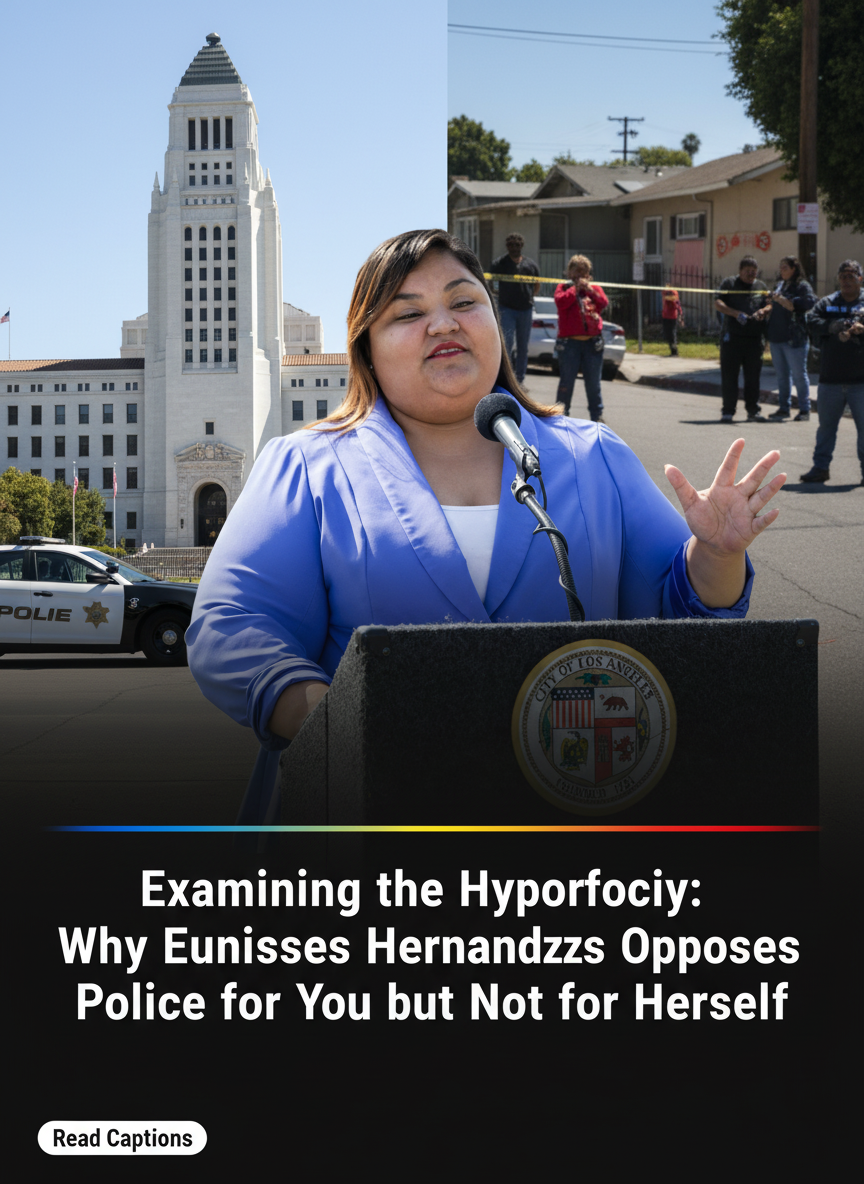
Public Safety Paradox: LA Councilmember Eunisses Hernandez Under Fire for Opposing Police Funding While Benefiting from Security
LOS ANGELES — In the heart of one of America’s most complex urban landscapes, a fierce debate over the future of law enforcement is intensifying. At the center of this firestorm is Los Angeles City Councilmember Eunisses Hernandez, whose recent legislative actions have sparked a national conversation about the intersection of progressive ideology and personal security.
The “Police for Me, But Not for Thee” Controversy
Councilmember Hernandez, representing District 1, has long been a vocal proponent of “reimagining” public safety. This platform primarily involves shifting resources away from the Los Angeles Police Department (LAPD) and toward social services and community-led initiatives. However, a new wave of criticism suggests a stark disconnect between the policies she advocates for her constituents and the protections she receives as a public official.
The controversy reached a fever pitch following Hernandez’s consistent votes against expanding the LAPD budget and her opposition to new police contracts. Critics, including those highlighted in a recent New York Post analysis, argue that while Hernandez works to reduce the police presence in Los Angeles neighborhoods, she continues to benefit from the very system she critiques through city-funded security details and rapid-response capabilities afforded to elected officials.
Voting Records and Public Safety
Since taking office, Hernandez has positioned herself as a disruptor of the status quo. She was one of the few dissenting voices against a major multi-year contract intended to increase pay and retention for LAPD officers. Her rationale is rooted in the belief that the “carceral state” has failed to address the root causes of crime, such as poverty, mental health, and housing instability.
However, residents in her district—which includes neighborhoods like Highland Park and Westlake—are expressing growing concerns. While the Councilmember advocates for a long-term transition to non-police interventions, the immediate reality for many Angelenos involves rising retail theft, open-air drug use, and violent crime. The optics of a lawmaker voting to decrease police resources while living behind the “thin blue line” of executive protection has led to accusations of hypocrisy.
“It is the height of irony to tell your constituents that fewer police will make them safer, while your own safety is ensured by those same officers,” one local community leader stated, echoing sentiments found in the growing backlash against Hernandez’s voting record.
The Progressive Defense
In response to these criticisms, Hernandez and her supporters argue that the “police for me” narrative is a reductive distraction. They maintain that security for public officials is a standard administrative necessity, often mandated by the city due to threats received by high-profile politicians. Furthermore, they argue that her votes are not “anti-safety,” but rather “pro-community.”
Hernandez has frequently stated that every dollar spent on a police officer is a dollar taken away from permanent supportive housing or youth programs. Her supporters contend that the transition to a new model of safety will inevitably have “growing pains,” but is necessary to break the cycle of mass incarceration.
A Divided City
The tension surrounding Hernandez’s office reflects a broader schism within the Los Angeles City Council. As the city prepares for upcoming budgetary cycles, the rift between the progressive wing—led by Hernandez and colleagues like Hugo Soto-Martinez—and more moderate members focused on traditional law and order is widening.
For the average resident of District 1, the debate is less about ideology and more about results. As the “Police for me, but not for thee” headline continues to circulate, Hernandez faces the challenge of proving that her vision for a police-free future can actually protect the public as effectively as it protects its leaders.
Conclusion
The scrutiny facing Eunisses Hernandez serves as a microcosm of the national struggle over policing. As Los Angeles continues to grapple with a shortage of officers and a burgeoning homelessness crisis, the actions of its leaders remain under a microscope. Whether Hernandez can reconcile her personal security needs with her public policy goals remains to be seen, but for now, the debate over who gets protected—and how—continues to simmer in the City of Angels.
Reporting by City Desk. Updated March 22, 2026.