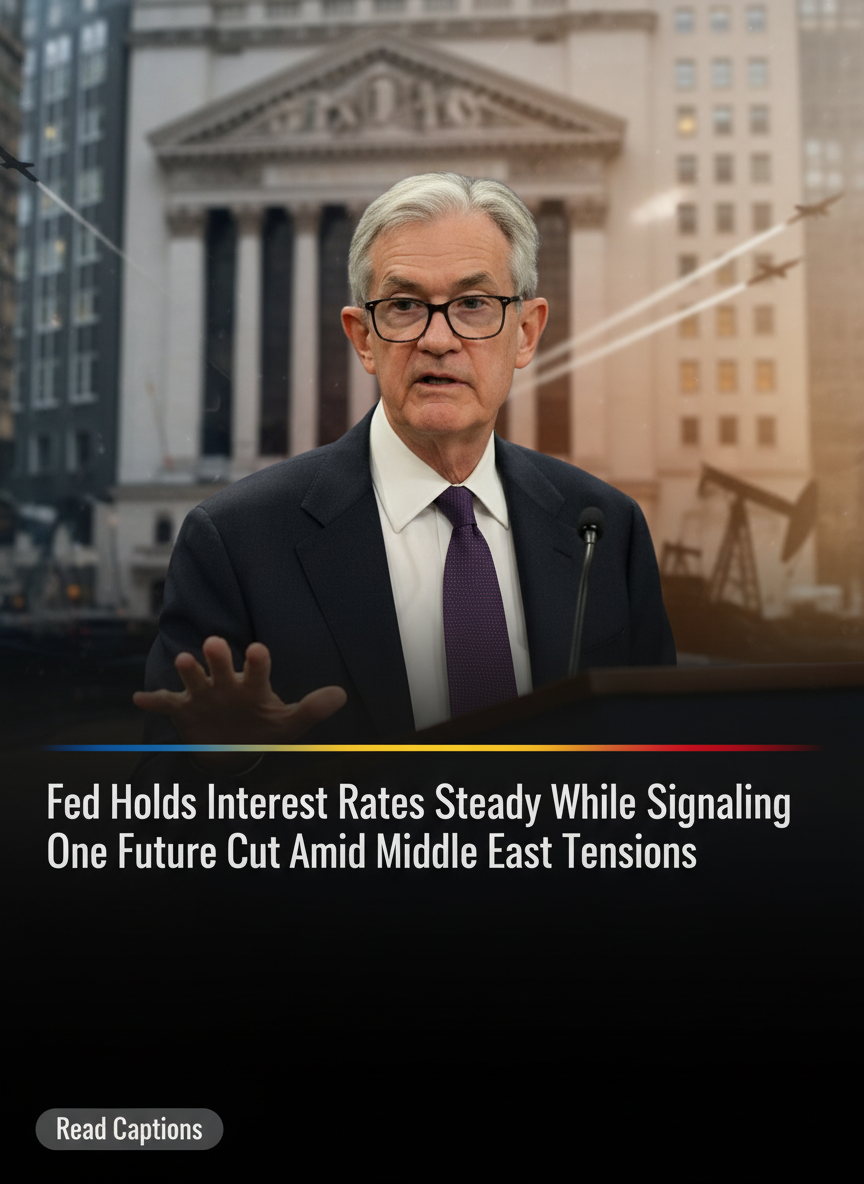
Fed Holds Rates Steady Amid Middle East Turmoil, Signals Single Cut for 2026
WASHINGTON D.C. — The Federal Reserve opted to maintain its benchmark interest rate on Wednesday, choosing stability over stimulus as a widening conflict in the Middle East casts a long shadow over the global economy. While the central bank hinted that a pivot toward easing is still on the horizon, officials scaled back their expectations, signaling only a single quarter-point rate cut before the end of the year.
A Cautious Stance in Volatile Times
Concluding its two-day policy meeting, the Federal Open Market Committee (FOMC) announced it would keep the federal funds rate in its current range of 5.25% to 5.50%. The decision reflects the Fed’s ongoing struggle to stomp out the final embers of inflation, which has proven more “sticky” than economists predicted at the start of the year.
The updated “dot plot”—a visual representation of where central bank officials expect rates to head—revealed a significant hawkish shift. Whereas previous projections suggested three cuts in 2026, the majority of policymakers now see room for only one, citing “significant geopolitical risks” as the primary driver for their caution.
The Iran Factor: War and Inflation
The primary catalyst for the Fed’s hesitation is the escalating war involving Iran. The conflict has sent shockwaves through energy markets, with Brent crude prices surging past $95 a barrel in recent weeks. For Fed Chair Jerome Powell, the math is simple: higher energy prices lead to higher transportation and manufacturing costs, which ultimately prevents inflation from reaching the bank’s 2% target.
“We are mindful of the fact that geopolitical events are currently out of our control but very much within our purview of risk,” Powell stated during his post-meeting press conference. “The situation in the Middle East has introduced a new layer of uncertainty that requires us to be more patient with our policy restrictive stance.”
Market Reaction and Economic Outlook
Wall Street responded with a mix of resignation and relief. Major indices, including the S&P 500 and the Nasdaq, saw modest fluctuations as investors digested the news. While the prospect of fewer rate cuts was a disappointment to some, the Fed’s acknowledgment that a cut is still likely this year provided a floor for the market.
Treasury yields ticked slightly higher as the “higher for longer” narrative gained new traction. Analysts suggest that the Fed is effectively in a “wait-and-see” mode, hoping that the conflict does not escalate into a broader regional war that could trigger a global energy crisis.
The Path Forward
Despite the geopolitical headwinds, the U.S. labor market remains resilient, and consumer spending has held up better than expected. However, the Fed’s statement emphasized that they remain “highly attentive to inflation risks.”
The single projected rate cut is currently penciled in for the November or December meeting, though Powell was quick to note that nothing is set in stone. “We do not have a pre-set path,” Powell told reporters. “If the data—and the world—change, our policy will change with it.”
As the 2026 fiscal year progresses, the Federal Reserve finds itself walking a tightrope: trying to normalize interest rates without reigniting inflation in a world that feels increasingly unstable.
For more updates on the Federal Reserve and global markets, follow our trending coverage at [Your News Outlet].