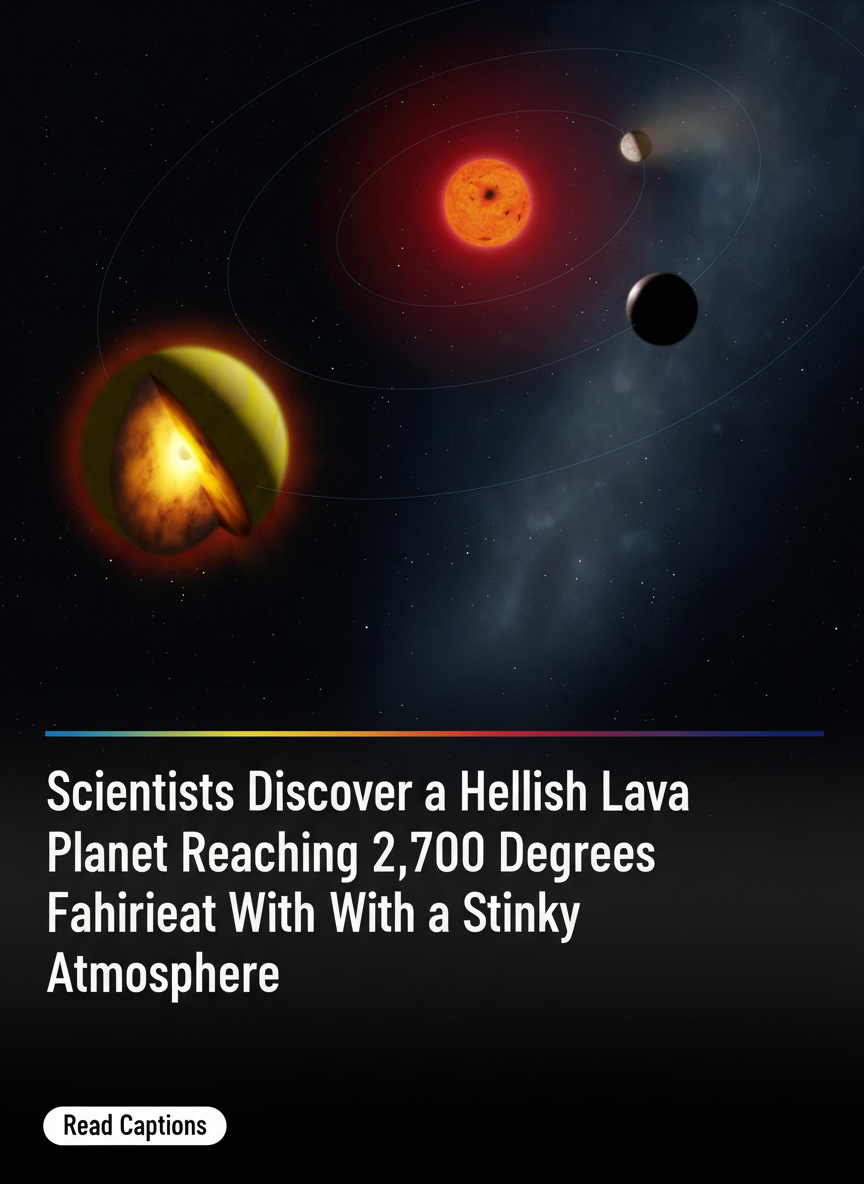
Inferno in Deep Space: Scientists Discover ‘Lava Planet’ Reaching Hellish 2,700 Degrees
In a discovery that highlights the sheer atmospheric diversity of our galaxy, astronomers have identified a new exoplanet that redefines the term “hostile environment.” Located light-years away from our solar system, this newly unveiled world is a chaotic landscape of molten rock, searing heat, and a pungent atmosphere that scientists describe as nothing short of hellish.
A World of Perpetual Fire
The planet, a “lava world” orbiting dangerously close to its host star, boasts surface temperatures that can soar to a staggering 2,700 degrees Fahrenheit. At these temperatures, the environment is hot enough to melt steel and vaporize most organic compounds instantly. Unlike Earth, which features a solid crust and vast oceans of water, this planet is believed to be covered in massive, global oceans of liquid magma.
According to the research team, the planet’s extreme heat is a result of its proximity to its sun. It completes an orbit in a fraction of the time it takes Earth to circle the sun, essentially “hugging” its star in a gravitational embrace that keeps the surface in a constant state of flux.
A “Stinky” Atmosphere
Beyond the blistering heat, the planet offers another sensory assault: a foul-smelling atmosphere. Preliminary spectral analysis suggests the air is thick with chemical compounds such as sulfur dioxide—the same gas responsible for the “rotten egg” smell of volcanic eruptions on Earth. This toxic cocktail of gases creates a hazy, shimmering sky above the glowing orange plains of lava.
“It’s a world that proves space is far more volatile than we often imagine,” said one researcher involved in the study. “This isn’t just a hot rock; it’s a dynamic, stinky, and deadly cauldron that challenges our understanding of how planets evolve under extreme solar pressure.”
The Science of “Lava Worlds”
While Earth-like planets are the ultimate prize for astronomers searching for life, “lava planets” like this one provide crucial data for planetary scientists. By studying the light filtered through the planet’s thick, sulfurous atmosphere, researchers can learn more about the interior composition of rocky planets. The extreme conditions allow scientists to see “inside” the planet’s geological makeup, as the molten surface acts as a window into the core materials that are usually hidden deep beneath a planet’s crust.
Furthermore, the discovery sheds light on the process of atmospheric stripping. At 2,700°F, the planet is likely losing its atmosphere to space at a rapid rate, creating a comet-like tail of gas trailing behind it as it orbits. This process helps scientists predict the long-term fate of planets that reside in the “inner sanctum” of their solar systems.
Conclusion: A Reminder of Earth’s Rarity
As telescope technology continues to advance, the discovery of such extreme worlds serves as a stark reminder of the delicate balance required for a planet to be habitable. While this fiery, stinky world is a marvel of physics and chemistry, it stands in silent contrast to the cool, life-sustaining temperatures of Earth.
For now, this “lava planet” remains a distant, glowing curiosity—a hellish reminder of the violent wonders that exist in the far reaches of the final frontier.