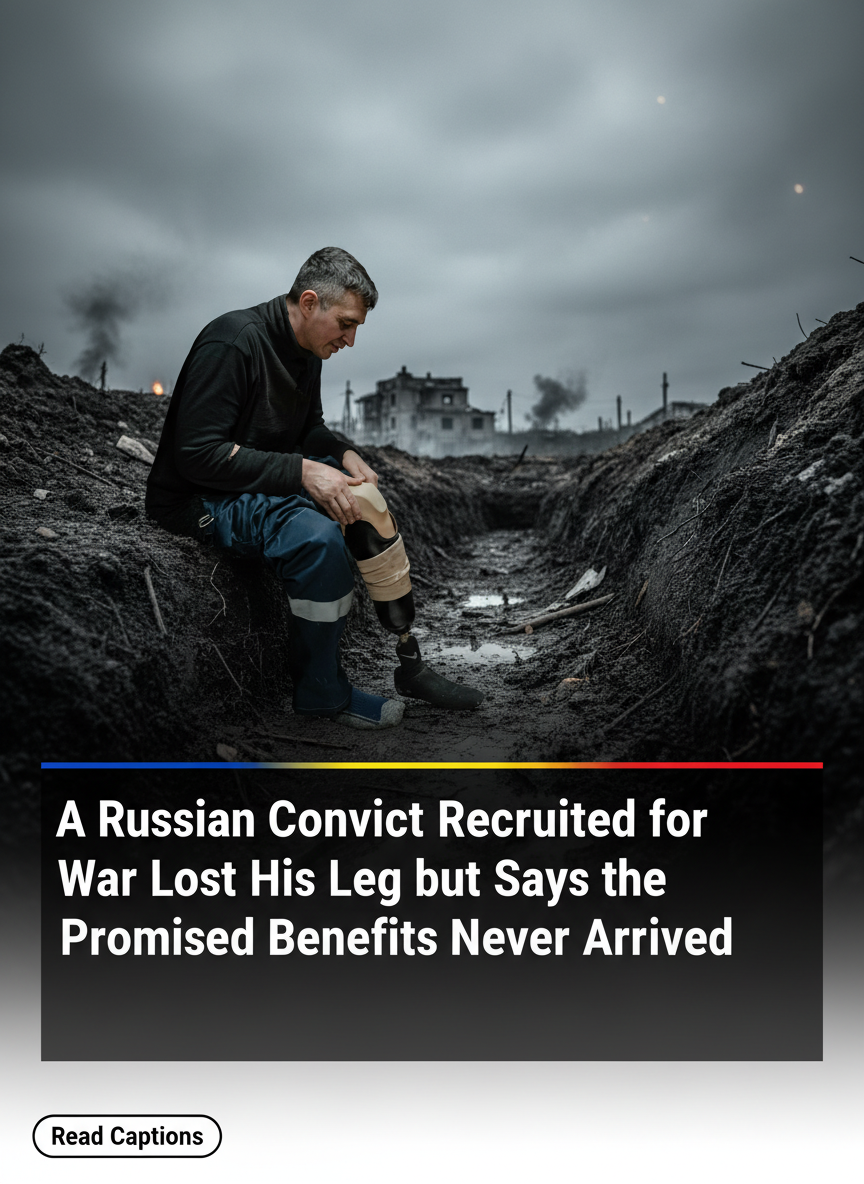
The Price of Redemption: He Lost a Leg for Russia, Then He Says His Country Betrayed Him
MOSCOW — When Aleksandr Abbasov-Derskhan traded his prison cell for a camouflage uniform, he believed he was finally marching toward a clean slate. Convicted of murder and facing years behind bars, the promise was clear: six months on the front lines in Ukraine in exchange for a full presidential pardon and the social standing of a veteran.
Today, Abbasov-Derskhan sits in a cramped apartment on the outskirts of Russia, looking at the stump where his left leg used to be. The freedom he was promised has arrived, but the dignity and financial security he says were guaranteed by the state have proven to be as fragile as the glass shards in a bombed-out trench.
A Deal With the Devil
Like tens of thousands of other Russian inmates, Abbasov-Derskhan was recruited during the height of the military’s drive to bolster its ranks without a full-scale national mobilization. Initially spearheaded by the Wagner Group and later institutionalized by the Ministry of Defense through “Storm-Z” and “Storm-V” units, the program offered convicts a literal lifeline.
“I wanted to wash away my past with blood, as they told us,” Abbasov-Derskhan said in an interview. “They said we would be heroes. They said our families would be taken care of. But once the leg was gone, I became a ghost to them.”
His story reflects a growing crisis within Russia as the first waves of convict-soldiers return home. While the Kremlin has touted the “heroism” of its fighters, the reality for those with criminal records is often a bureaucratic nightmare. Upon returning, many find that the verbal promises of recruitment officers do not match the fine print of their contracts—if they were even given copies of those contracts at all.
“Storm-V” and the Bureaucratic Wall
Abbasov-Derskhan’s injury occurred during a frantic assault in the Donbas region. He describes a landscape of “meat-grinder” tactics where prisoner units were sent first to draw out Ukrainian fire. After a mortar shell claimed his limb, he was evacuated through a series of field hospitals.
However, the betrayal he feels didn’t happen on the battlefield, but in the social security offices of his hometown. Despite his sacrifice, Abbasov-Derskhan says he has been denied the standard “veteran of combat operations” status, a designation that unlocks lifelong monthly stipends, tax breaks, and priority medical care. The reason? His status as a former prisoner places him in a legal gray zone that local officials seem unwilling—or unable—to navigate.
“They told me my service was ‘special’ and doesn’t qualify for the same benefits as a regular contract soldier,” he said. “How is my blood different? Does a leg lost by a prisoner weigh less than a leg lost by a conscript?”
A Growing Class of Discarded Veterans
Legal advocates and human rights groups have begun to see a surge in cases like Abbasov-Derskhan’s. “The state made a tactical decision to use prisoners to save ‘clean’ Russian citizens from the draft,” says one Moscow-based legal analyst who requested anonymity for safety reasons. “Now that these men are returning, the state is realizing the immense long-term cost of their healthcare and pensions. The easiest way to save money is to find legal loopholes to deny them.”
For many, the “new start” has turned into a return to the margins of society. Without the promised payouts, many disabled former convicts find themselves unable to work and without the social safety net they were led to expect. The result is a volatile population of trained combatants who feel abandoned by the government they bled for.
Conclusion: The Ghost of the Front
For Aleksandr Abbasov-Derskhan, the struggle for a pardon was successful—his criminal record is technically clear—but he remains a prisoner of his circumstances. He spends his days navigating a maze of paperwork, filing appeals that are often met with silence.
“I paid my debt to society,” he said, tapping his prosthetic. “I just didn’t realize society would stop paying its debt to me the moment I couldn’t carry a rifle.”
As Russia continues to lean on unconventional recruitment to sustain its war effort, the stories of men like Abbasov-Derskhan serve as a grim warning: in the eyes of the state, the path to redemption may be a one-way street that ends the moment the soldier is no longer useful.