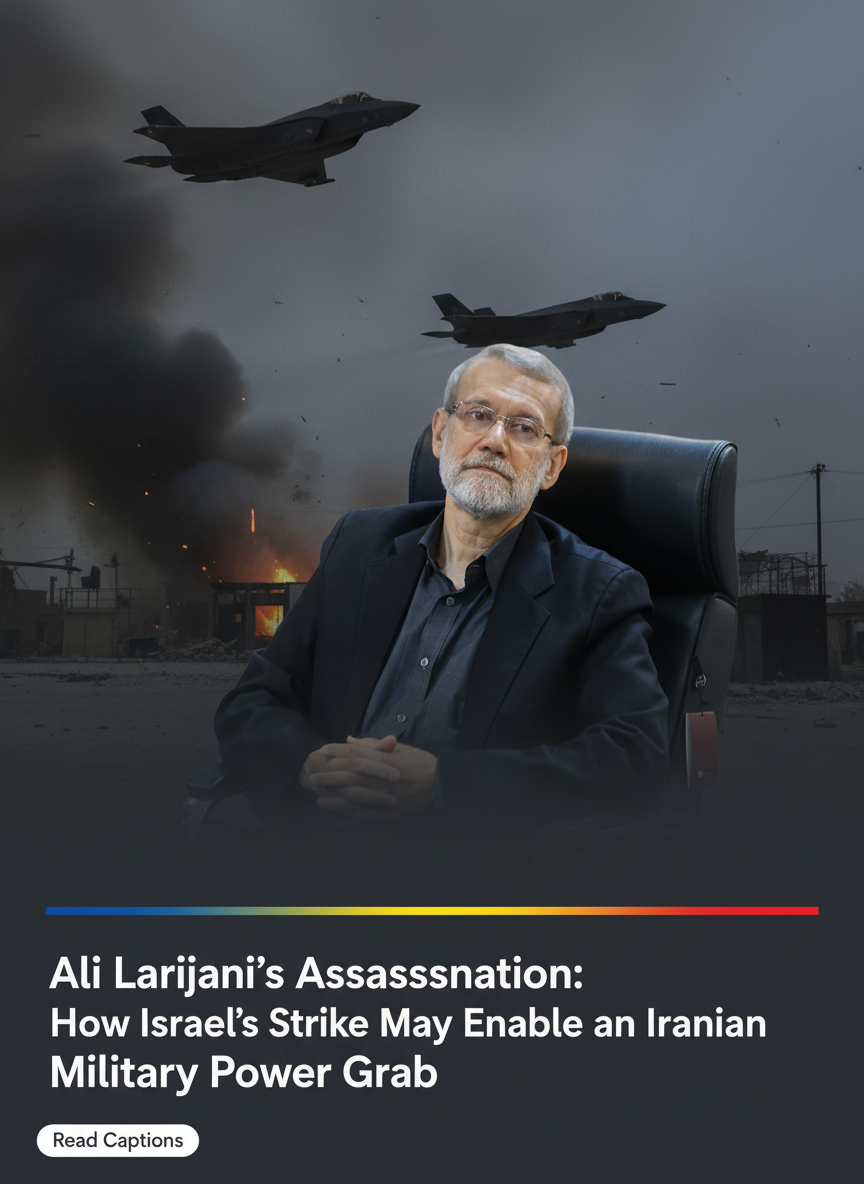
A Bridge Collapses: How Ali Larijani’s Death Hands Iran’s Future to the Military
TEHRAN — The targeted killing of Ali Larijani, Iran’s most seasoned political navigator and a titan of its national security establishment, has sent shockwaves through the Middle East. But as the smoke clears from the Israeli strike that claimed his life, a more permanent and perhaps more dangerous transformation is taking shape within the halls of power in Tehran: the total ascendancy of the military over the state.
Mr. Larijani, who served as a critical advisor to the Supreme Leader and was a former Speaker of the Parliament, was unique in the Iranian hierarchy. He was a man of the system who possessed the rare ability to speak the language of the Islamic Revolutionary Guard Corps (IRGC) while maintaining the diplomatic finesse required to engage with the West and domestic moderates. With his removal, analysts warn that the last remaining buffer against a full military autocracy has vanished.
The Strike That Changed the Board
The operation, attributed to Israeli intelligence and air assets, struck a high-security compound where Mr. Larijani was reportedly meeting with strategic planners. While Israel has maintained its standard policy of ambiguity regarding such operations, the precision of the strike underscores a significant intelligence breach within Iran’s most protected circles. For Israel, Larijani was a high-value target—a strategist who bridged the gap between Tehran’s regional proxy wars and its nuclear ambitions.
However, the geopolitical fallout may outweigh the immediate tactical victory. By removing a figure known for “pragmatic conservatism,” the strike has inadvertently cleared the path for the IRGC to consolidate its grip on the Iranian government, effectively sidelining the remnants of the country’s civilian political factions.
The “Ultimate Insider” and His Disappearing Middle Ground
Ali Larijani was often described as the “ultimate insider.” During his decades in power, he navigated the treacherous waters of Iranian factionalism with unparalleled skill. He was the man the Supreme Leader, Ayatollah Ali Khamenei, turned to when the military’s zeal threatened to alienate necessary diplomatic backchannels.
“Larijani was the glue,” said Sanam Vakil, a director at the Middle East and North Africa program at Chatham House. “He could walk into a room of IRGC generals and demand discipline, and then walk into a meeting with European diplomats and talk about nuclear enrichment limits. Without him, the military no longer feels the need to perform that balancing act.”
A Hard-Line Resurgence
The immediate aftermath of the killing has seen a surge in nationalist rhetoric and a visible increase in IRGC presence on the streets of Tehran and at key government installations. Hard-line commanders have already begun to frame Larijani’s death as a failure of the “diplomatic class,” arguing that only a militarized state can truly protect the Islamic Republic from foreign aggression.
This shift is expected to manifest in two major ways. Domestically, the IRGC is likely to tighten its control over the economy and suppress any remaining moderate voices ahead of upcoming electoral cycles. Internationally, the prospect of returning to the negotiating table regarding Iran’s nuclear program appears more remote than ever. The military wing of the regime has long viewed diplomacy as a sign of weakness; with Larijani gone, there is no one left in the inner circle with the clout to argue otherwise.
The Regional Consequences
For Israel and the United States, a more military-heavy Iranian government presents a daunting challenge. While a purely military regime might be more predictable in its hostility, it is also significantly less likely to engage in the “shadow diplomacy” that has prevented regional tensions from boiling over into a full-scale conflagration in the past.
As Tehran prepares for a massive state funeral, the atmosphere is one of mourning shadowed by fear. The death of Ali Larijani marks the end of an era of sophisticated political maneuvering. In its place, a new era is emerging—one defined by the rigid, uncompromising rule of the IRGC, leaving the world to wonder if the bridge to Iran has been burned for good.
Looking Ahead
The Supreme Leader now faces a pivotal choice: appoint another bridge-builder, if one even exists, or allow the military to finalize its takeover of the state’s strategic decision-making. If current trends hold, the killing of Ali Larijani may be remembered not just as an assassination of a man, but as the final blow to the civilian political structure of the Islamic Republic.