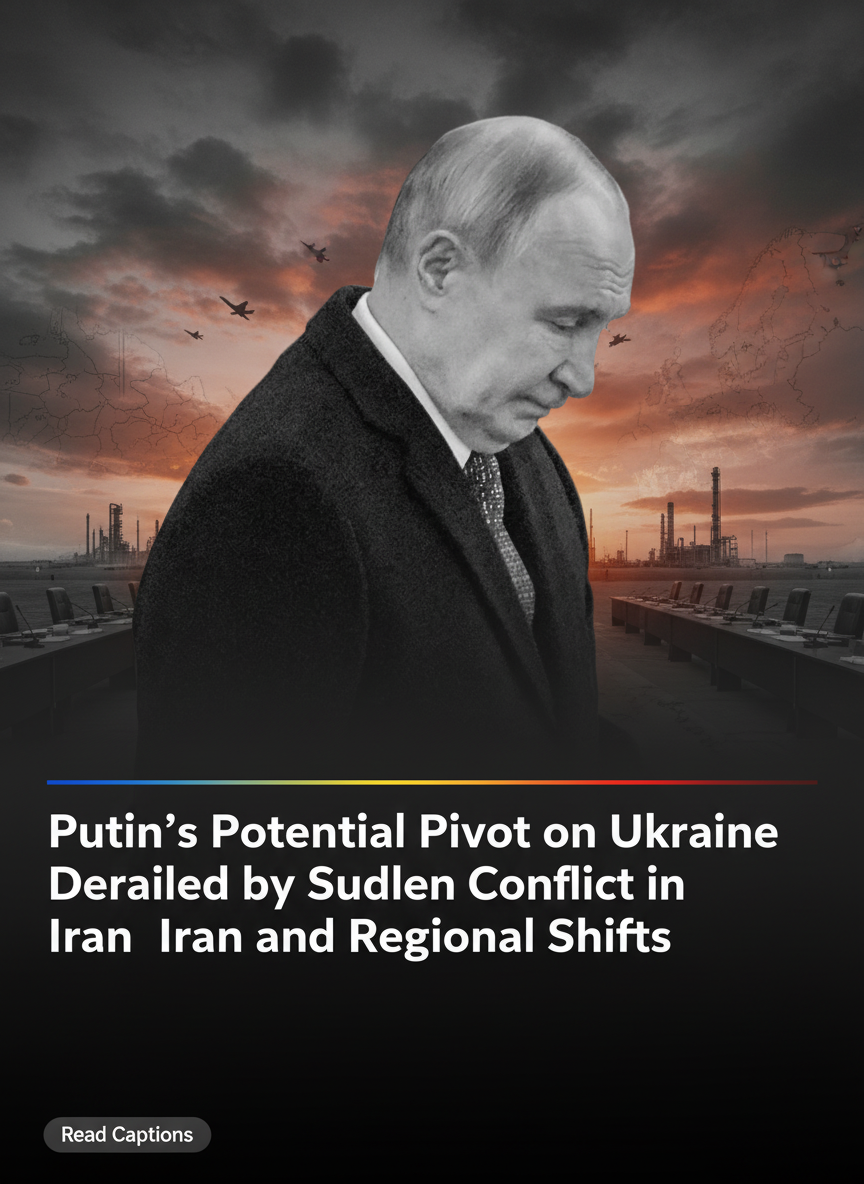
Putin Was Changing His Mind on Ukraine. Then Came the War in Iran.
By Global Affairs Desk | March 25, 2026
A Sudden Shift in the Geopolitical Winds
For the better part of early 2026, the diplomatic corridors of Geneva and Ankara were buzzing with a rare sense of optimism. After years of grinding attrition in Ukraine, intelligence reports and back-channel communications suggested that Russian President Vladimir Putin was finally ready to blink. Economic stagnation, a restive domestic population, and a military stalemate had seemingly pushed the Kremlin toward the unthinkable: a negotiated conciliation.
That optimism evaporated in a single weekend. The sudden eruption of full-scale war in Iran has not only set the Middle East ablaze but has fundamentally overturned the strategic calculus in Moscow. What was once a path toward a settled Ukraine has now become a secondary theater in a much larger, more volatile global confrontation.
The Softening Before the Storm
Before the first missiles fell on Tehran, the signs of a Russian pivot were subtle but significant. Kremlin spokespeople had softened their rhetoric regarding “denazification,” focusing instead on “regional security guarantees.” Western officials noted a decrease in offensive maneuvers in the Donbas, interpreted by many as a precursor to a ceasefire. There was a palpable sense that Putin was looking for an exit strategy that would allow him to claim a nominal victory while ending the drain on Russia’s remaining resources.
“The conditions for a deal were the best they had been since 2022,” says Dr. Elena Volkov, a senior fellow at the Institute for Global Security. “Putin was facing a choice: total economic isolation or a return to the international fold through a compromised peace in Ukraine. He appeared to be choosing the latter.”
Iran: The Ultimate Distraction
The outbreak of war in Iran changed the math overnight. For Putin, the conflict is a geopolitical windfall. Firstly, it has forced the United States and its NATO allies to pivot their military and financial attention away from the plains of Eastern Europe to the Persian Gulf. With the U.S. Navy heavily committed to securing the Strait of Hormuz, the flow of munitions and high-tech weaponry to Kyiv faces inevitable delays.
Secondly, the war has sent global oil prices soaring past $150 a barrel. This massive infusion of energy revenue has replenished the Kremlin’s war chest, effectively neutralizing the sting of Western sanctions. With a renewed flow of “petrodollars,” the economic pressure that was forcing Putin to the table has vanished.
A Hardened Resolve
Rather than seeking an exit, the Kremlin now appears emboldened. Military analysts report that Russian forces in Ukraine are digging in for a longer, more aggressive campaign, sensing that the West no longer has the stomach—or the bandwidth—to support two major regional wars simultaneously. The “conciliation” that seemed within reach weeks ago has been replaced by a familiar, defiant posture from Moscow.
“The war in Iran gave Putin exactly what he needed: a world in chaos and a distracted West,” notes Volkov. “The incentive to compromise in Ukraine is gone. Why negotiate when your enemy is overextended and your treasury is full?”
Conclusion: A New Era of Global Instability
As the conflict in the Middle East escalates, the tragic irony for Ukraine is that its fate may no longer be decided in Kyiv or Moscow, but in the heat of a separate war a thousand miles away. The brief window for peace has slammed shut, replaced by a grim reality where the interconnectedness of global conflicts serves only to prolong the suffering on the ground. For now, the prospect of a settled Europe remains a casualty of the flames rising in Iran.