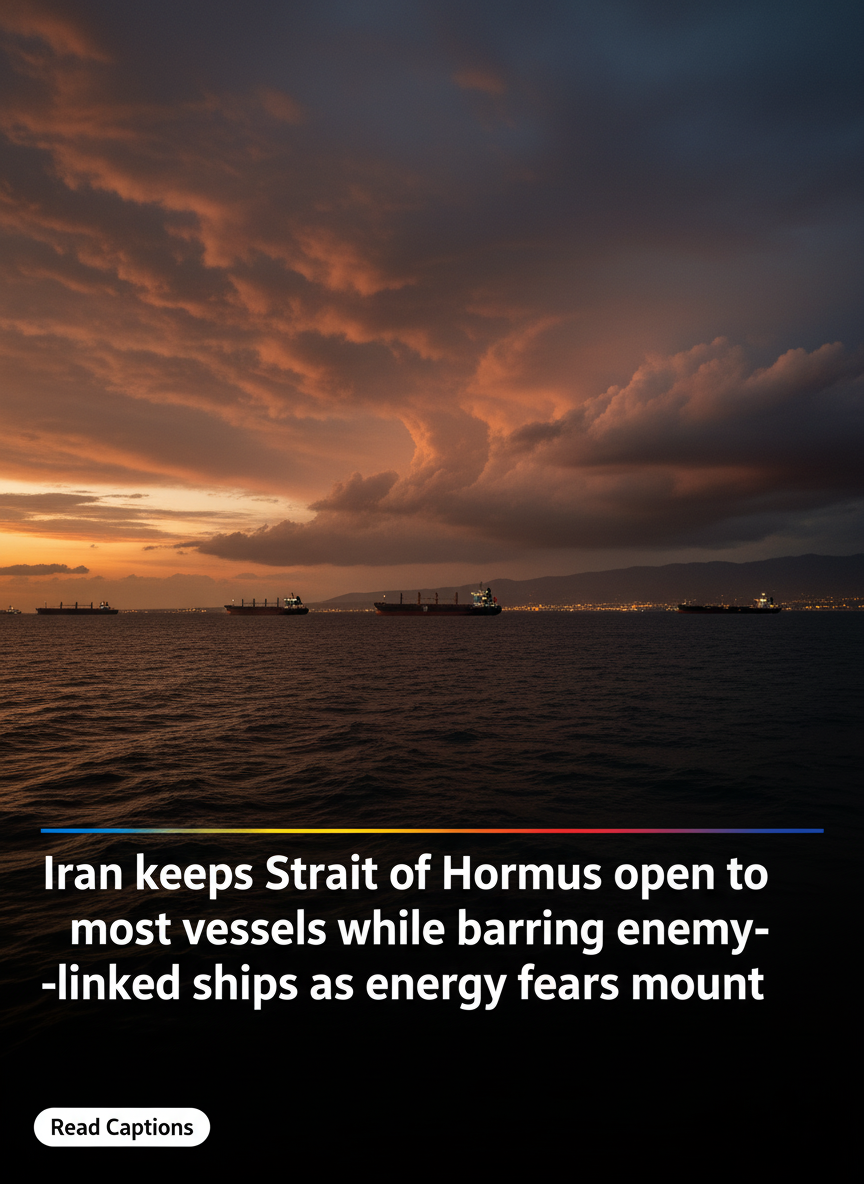
Tensions Peak as Iran Limits Strait of Hormuz Access Following Trump’s 48-Hour Ultimatum
TEHRAN / WASHINGTON — In a move that has sent tremors through global energy markets, Tehran announced on Sunday that the Strait of Hormuz will remain open to international maritime traffic—with the critical exception of any vessels deemed “enemy-linked.” The declaration comes as a direct response to a 48-hour ultimatum issued by U.S. President Donald Trump, marking a dangerous new chapter in the ongoing US-Israeli conflict with Iran.
A Selective Blockade
The Iranian government’s statement, released via state-run media, clarified that while they do not intend to execute a total shutdown of the world’s most vital maritime artery, they will exercise “strict oversight.” According to Iranian officials, any ship associated with the United States, Israel, or their immediate military allies will be denied passage through the narrow waterway.
This “selective blockade” strategy appears designed to circumvent international condemnation for a total closure while still asserting control over the region’s strategic geography. However, the definition of “enemy-linked” remains intentionally vague, leaving global shipping companies in a state of high alert and confusion.
Trump’s 48-Hour Threat
The escalation follows a high-stakes warning from the White House. President Trump recently issued a 48-hour window for Iran to cease all hostile maritime maneuvers and dismantle missile batteries overlooking the Strait, or face “overwhelming” military consequences. As that deadline looms, the international community is bracing for a potential direct confrontation.
“The United States will not allow the world’s energy supply to be held hostage by a rogue regime,” the President stated in a recent press briefing. Military analysts suggest that the U.S. Fifth Fleet has already increased its presence in the Gulf of Oman, signaling that the administration is prepared to follow through on its threats if the “selective” blockade interferes with global trade.
Global Energy at a Breaking Point
The Strait of Hormuz is the world’s most important oil transit chokepoint. Approximately one-fifth of the world’s total consumption of liquid petroleum and a massive portion of its liquefied natural gas (LNG) pass through the 21-mile-wide passage daily. Even the threat of restricted access has been enough to paralyze the industry.
Major shipping conglomerates have reportedly begun rerouting tankers around the Cape of Good Hope—a journey that adds weeks to delivery times and millions of dollars in fuel costs. Insurance premiums for vessels entering the Persian Gulf have skyrocketed to “war risk” levels, effectively pricing many smaller operators out of the market. Experts warn that a prolonged standoff could trigger a global energy shock not seen since the 1970s, potentially leading to record-high gas prices and industrial slowdowns across Europe and Asia.
A Region on the Brink
As the US-Israeli military campaign against Iranian targets continues to evolve, the Strait of Hormuz has become the primary theater for psychological and economic warfare. For Iran, the Strait is its most powerful leverage; for the U.S. and its allies, it is a “red line” that justifies full-scale intervention.
Diplomatic efforts by the United Nations and regional intermediaries like Qatar and Oman have so far failed to de-escalate the situation. With the 48-hour clock ticking down, the world watches the narrow waters of the Gulf, where a single miscalculation could ignite a conflict with global consequences.
Conclusion
The coming days will determine whether the “enemy-linked” restriction is a bluff intended to force a diplomatic concession or the opening salvo of a maritime war. As tankers sit idle and the military presence in the region reaches a fever pitch, the stability of the global economy hangs in the balance of a 21-mile stretch of sea.