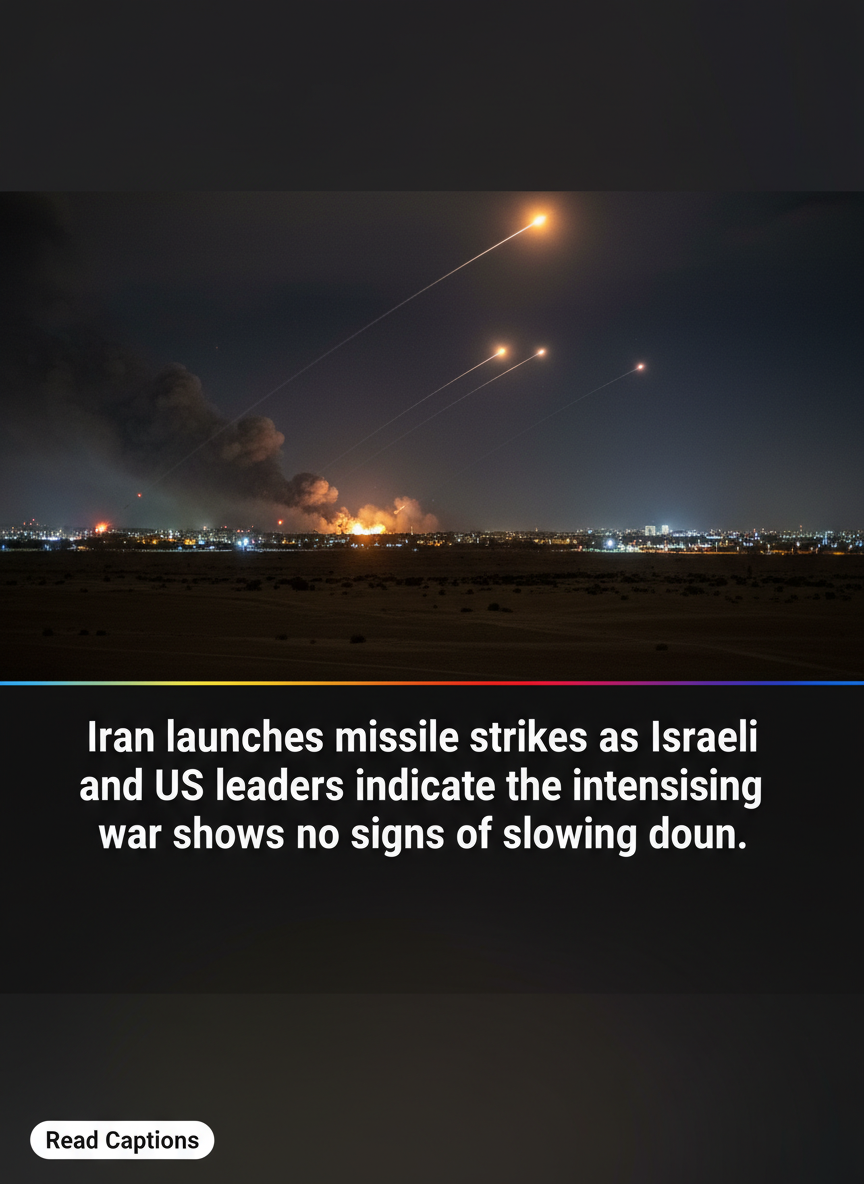
Flashpoint: Iran Launches Massive Missile Barrage as Middle East Braces for All-Out War
TEHRAN/JERUSALEM — The conflict in the Middle East reached a perilous new threshold on Tuesday as Iran launched a direct missile offensive against Israel, marking a significant escalation in a war that has now entered its 19th day. The retaliation follows a series of high-profile assassinations attributed to Israel, signaling that the regional shadow war has transitioned into an overt, high-stakes military confrontation.
Iran Strikes Back: A Calculated Retaliation
The Iranian Revolutionary Guard Corps (IRGC) confirmed the launch of dozens of ballistic missiles targeting key Israeli military and intelligence installations. Tehran characterized the strikes as a “necessary and proportionate” response to the targeted killings of senior military leaders and allied commanders over the past week. Air raid sirens blared across Tel Aviv and Jerusalem as Israel’s “Iron Dome” and “Arrow” defense systems intercepted a majority of the incoming projectiles, though reports of shrapnel damage and localized impacts continue to emerge.
In a televised address, Iranian officials warned that any further “acts of aggression” by Israel would be met with “crushing and destructive” counter-measures, suggesting that the current barrage may only be the opening salvo of a broader offensive.
Netanyahu: “The War is Only Intensifying”
In Jerusalem, Israeli Prime Minister Benjamin Netanyahu remained defiant, convening an emergency meeting of the security cabinet. Despite the scale of the Iranian attack, Netanyahu signaled that Israel has no intention of seeking a ceasefire. Instead, he underscored that the Israel Defense Forces (IDF) are prepared to expand their operations on multiple fronts.
“Iran made a big mistake tonight, and it will pay for it,” Netanyahu stated in a brief press conference. “The war is not winding down; it is intensifying. We will continue to strike our enemies with a heavy hand until the security of our citizens is guaranteed.”
The U.S. Response: Trump Signals Unwavering Support
The escalation comes as President Trump maintains a firm stance on the burgeoning conflict. From Washington, the administration indicated that there is no immediate push for a diplomatic exit ramp. Instead, the White House has reinforced its military presence in the Persian Gulf, moving carrier strike groups toward the Strait of Hormuz to safeguard global shipping lanes and deter further Iranian movement.
President Trump, who has frequently advocated for a “maximum pressure” policy against Tehran, gave no indication that he would pressure Israel to de-escalate. Critics warn that the lack of a diplomatic channel between the three nations increases the risk of a miscalculation that could lead to a broader global economic shock, particularly regarding the volatility of oil prices in the region.
A Region on the Brink
Nineteen days into the conflict, the humanitarian and economic toll is mounting. Neighboring nations are on high alert, fearing that the Strait of Hormuz—a vital artery for the world’s energy supply—could become a primary battleground. International leaders have called for restraint, yet the rhetoric coming from both Tehran and Jerusalem suggests that the window for mediation is rapidly closing.
As the sun rises over a smoke-filled horizon in the Levant, the world watches with bated breath. With neither side willing to blink and the United States providing a strategic backstop for Israel, the 19-day war shows every sign of evolving into a generational conflict with consequences that will be felt far beyond the borders of the Middle East.
This is a developing story. Updates will follow as more information becomes available.