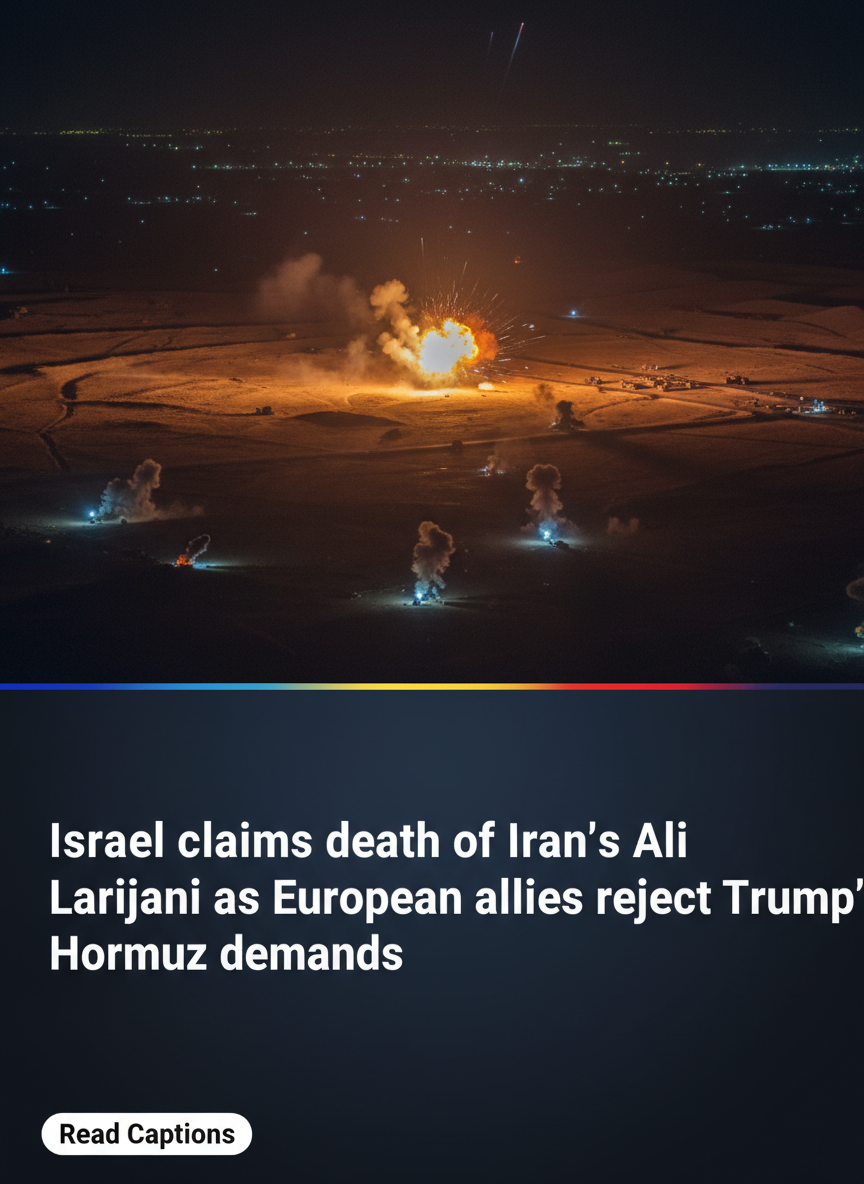
Israel Targets High-Ranking Iranian Leadership as EU Allies Rebuff Trump’s Demands for Hormuz Intervention
JERUSALEM / BRUSSELS — The Middle East stands on the precipice of a broader regional conflict following a series of high-stakes military and diplomatic maneuvers. Israel has officially confirmed the targeted killing of Ali Larijani, Iran’s most prominent security official and a veteran political heavyweight, marking a significant escalation in the ongoing shadow war between the two nations. Simultaneously, a diplomatic rift has opened across the Atlantic as European allies flatly rejected President Trump’s calls for a military coalition to secure the Strait of Hormuz.
The Fall of Ali Larijani: A Major Blow to Tehran
In a statement released early Tuesday, the Israel Defense Forces (IDF) confirmed that a precision strike had successfully eliminated Ali Larijani. A long-time advisor to the Supreme Leader and a former speaker of the Iranian parliament, Larijani was considered a cornerstone of Iran’s national security apparatus and a key architect of its regional influence.
Israeli intelligence officials characterized the operation as a “preemptive necessity,” alleging that Larijani was directly involved in coordinating multi-front attacks against Israeli interests. The assassination represents the most significant blow to the Iranian leadership since the killing of Qasem Soleimani in 2020. In Tehran, the government has declared three days of mourning, with high-ranking officials vowing “crushing retaliation” against what they termed the “Zionist regime.”
Europe Rejects Trump’s Call to Arms
While the military situation intensifies, the diplomatic front is equally volatile. President Donald Trump issued an urgent demand this week for European allies to contribute naval assets and military personnel to a joint task force in the Strait of Hormuz. The President argued that the international community must take a “firm stand” to ensure the free flow of global energy supplies amid Iranian threats.
However, the response from Brussels and major European capitals has been one of stark defiance. Leaders from France, Germany, and the European Union issued a joint statement rejecting the demand, citing concerns that increased military presence would only serve to inflame an already explosive situation. “Our priority remains de-escalation and the preservation of diplomatic channels,” a spokesperson for the EU stated. “We will not be drawn into a conflict that risks a total regional conflagration.”
Oil Markets and Economic Anxiety
The combination of a top-tier assassination and a fractured Western alliance has sent shockwaves through global markets. The Strait of Hormuz, a narrow waterway through which a fifth of the world’s oil passes, is now the focal point of intense economic anxiety. Analysts warn that if Iran follows through on threats to disrupt shipping in the Strait, oil prices could see a historic surge.
Energy experts are already reporting a 4% jump in crude futures following the news of Larijani’s death. “The markets hate uncertainty, and right now, we have a ‘perfect storm’ of geopolitical instability and a lack of unified Western strategy,” said one senior energy analyst. Consumers are being warned to prepare for an immediate impact on gas prices at the pump if the standoff continues.
A Region in Flux
The coming days will be critical in determining whether this cycle of violence can be contained. With Israel continuing its campaign against Iranian leadership and the U.S. administration finding itself at odds with its traditional European partners, the geopolitical landscape of the Middle East is shifting more rapidly than at any point in the last decade.
As Tehran weighs its response, the international community remains on high alert. The rejection by the EU marks a significant moment of isolation for the Trump administration’s Middle East policy, leaving the United States to decide whether it will move forward with unilateral action in the Persian Gulf or seek a new path toward stability.
This is a developing story. Updates will be provided as more information becomes available.