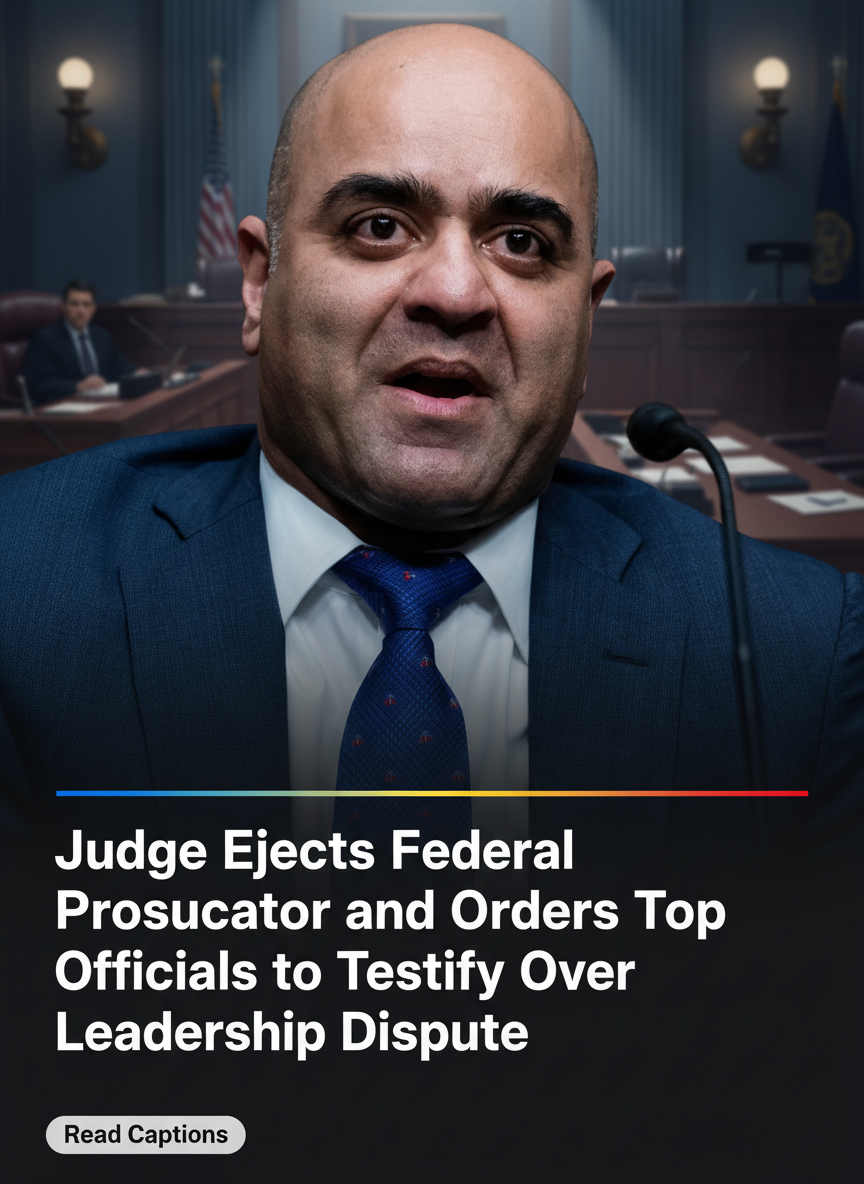
Judicial Showdown: Judge Quraishi Ejects Federal Prosecutor, Orders U.S. Attorney’s Office Leadership to Testify
NEWARK, N.J. — In a stunning and rare display of judicial defiance, U.S. District Judge Zahid Quraishi brought a federal proceeding to a grinding halt on Tuesday, ejecting a federal prosecutor from his courtroom and demanding that top leadership from the U.S. Attorney’s Office for the District of New Jersey appear to justify their legal standing.
The confrontation, which sent shockwaves through the state’s legal community, centers on a fundamental question of constitutional and statutory authority: Who exactly is legally authorized to lead New Jersey’s top federal law enforcement office?
An Unprecedented Ouster
The tension peaked during what was expected to be a routine hearing. According to witnesses, Judge Quraishi questioned the credentials and the specific authorization of the Assistant U.S. Attorney present in the courtroom. When the prosecutor failed to provide a satisfactory legal basis for their authority to represent the United States in the matter, the judge ordered the attorney to leave the well of the court.
“This court requires certainty that the individuals appearing before it are doing so under a valid chain of command,” Judge Quraishi reportedly stated. The judge then took the extraordinary step of ordering a formal hearing, requiring the office’s “bosses”—the senior leadership currently overseeing the District of New Jersey—to testify under oath regarding their appointments.
Questions Over Leadership Authority
At the heart of the dispute is the administrative status of the U.S. Attorney’s leadership. The District of New Jersey has been operating under interim leadership, a situation that often arises when a presidential appointee has not yet been confirmed by the Senate. Typically, interim leaders are appointed either by the U.S. Attorney General or by the judges of the District Court under the Federal Vacancies Reform Act.
Judge Quraishi’s order suggests a burgeoning skepticism over whether the current leadership has overstayed its legal welcome or if the proper procedures for succession were followed. Legal experts note that if the leadership’s authority is found to be invalid, it could potentially jeopardize hundreds of active criminal and civil cases handled by the office.
A History of Independence
Judge Quraishi, who made history as the first Muslim American to serve as a federal district judge, has earned a reputation for a meticulous adherence to procedural rules and judicial independence. His decision to challenge the Executive Branch’s representation in his courtroom is seen by some as a necessary check on power, while others view it as an aggressive escalation of a technical administrative issue.
“It is exceptionally rare for a judge to look a federal prosecutor in the eye and tell them they have no standing to be there,” said Michael Saunders, a veteran defense attorney and former federal prosecutor. “This indicates a deep-seated concern about the legitimacy of the office’s current structure.”
What Lies Ahead
The U.S. Attorney’s Office has not yet issued a formal statement regarding the ejection, though a spokesperson confirmed they are “reviewing the court’s order.” The Department of Justice in Washington is also expected to monitor the situation closely, as a ruling against the New Jersey office could set a precedent for other districts operating under interim leadership.
The upcoming hearing is expected to draw significant attention from both the legal community and political observers. For now, the work of the U.S. Attorney’s Office in Judge Quraishi’s court remains in a state of precarious limbo, waiting for the “bosses” to prove they have the right to lead.
This is a developing story. Updates will be provided as the hearing date approaches.