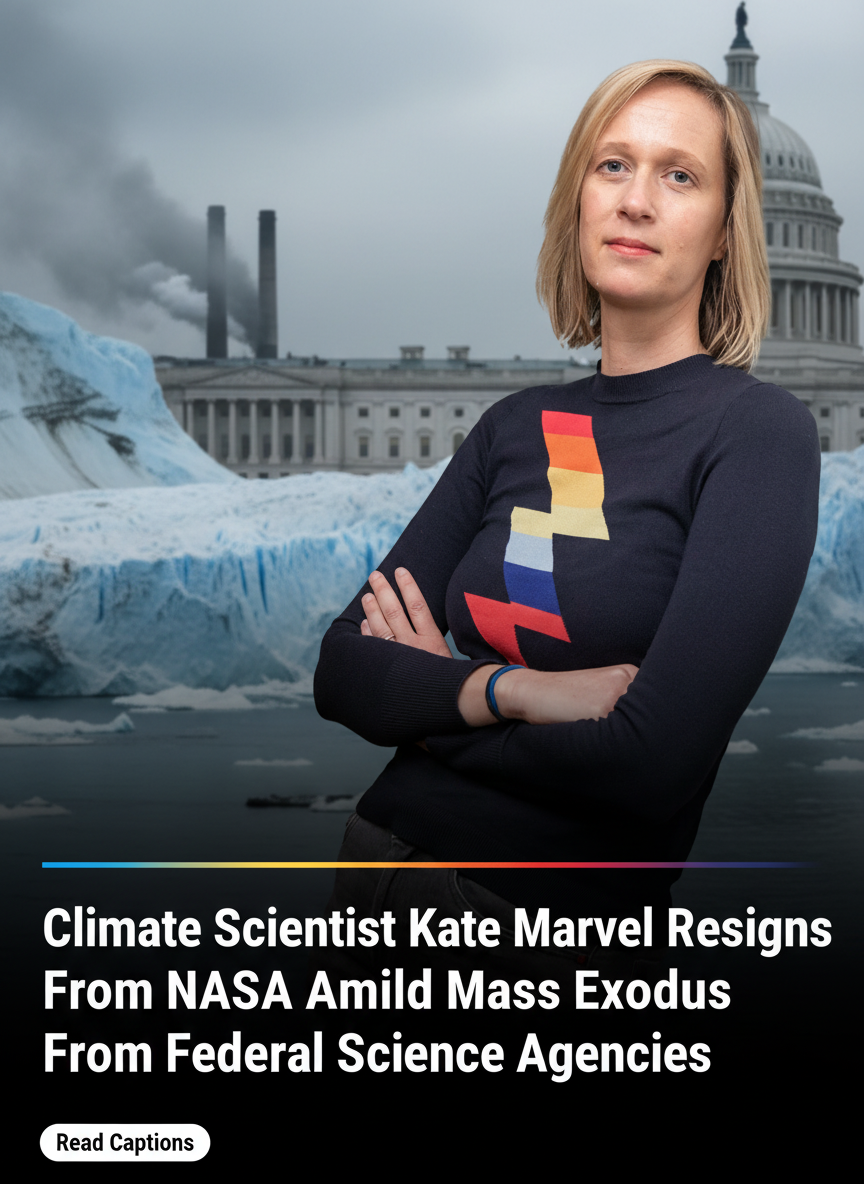
Science in Retreat: Kate Marvel’s NASA Resignation Signals Deepening Federal Brain Drain
NEW YORK — Dr. Kate Marvel, one of the most recognizable voices in climate science and a pillar of NASA’s Goddard Institute for Space Studies, has announced her resignation. Her departure marks a high-profile exit from a federal workforce that is rapidly shrinking under the current administration’s return to power.
A Symbolic Departure
Dr. Marvel, a physicist and climate scientist known as much for her rigorous research into cloud patterns as for her lyrical ability to communicate the stakes of the climate crisis, confirmed her resignation on Wednesday. As the author of the acclaimed book All We Can Save and a frequent contributor to major scientific publications, Marvel has served as a bridge between complex atmospheric data and public understanding.
While Marvel has not yet detailed her next steps, her departure is being viewed by colleagues as a “canary in the coal mine” for the future of government-funded climate research. At NASA, her work focused on how human activities influence the climate and what the future of the planet looks like under various warming scenarios—a field that has increasingly found itself at odds with the current administration’s policy priorities.
The 95,000: An Unprecedented Exodus
Marvel does not stand alone. According to internal data and estimates from federal workforce unions, she joins approximately 95,000 scientists, researchers, and civil servants who have left federal agencies since President Trump returned to the White House. This mass migration of talent—often referred to as a “brain drain”—has gutted departments ranging from the Environmental Protection Agency (EPA) to the National Oceanic and Atmospheric Administration (NOAA).
The reasons for the exodus are multifaceted. They include the relocation of key research offices to distant locations, the elimination of climate-centric departments, and a perceived shift toward the politicization of raw scientific data. For many, the choice to leave is a matter of professional integrity and the ability to continue their work without political interference.
The Impact on Climate Science
The loss of an expert like Marvel is more than just a headcount reduction; it represents a loss of institutional memory and international prestige. NASA’s Goddard Institute has long been considered a global leader in climate modeling. Experts warn that as top-tier talent moves to academia or the private sector, the U.S. government’s ability to predict and prepare for extreme weather events may be severely compromised.
“When you lose someone of Kate’s caliber, you lose years of specialized expertise that cannot be replaced overnight,” said a former senior administrator at NASA who spoke on the condition of anonymity. “The signal being sent to young scientists is clear: the federal government is no longer the place for cutting-edge climate research.”
A Global Reputation at Stake
The resignation comes at a time when global climate negotiations are at a critical juncture. The United States’ withdrawal from key research initiatives has left a vacuum that other nations, including China and members of the European Union, are moving to fill. Domestically, the departure of 95,000 federal employees creates a massive challenge for the administration, which insists it is streamlining a “bloated” bureaucracy to focus on economic deregulation.
Conclusion
As Dr. Kate Marvel transitions from public service to the private or academic sphere, her exit serves as a stark reminder of the changing landscape of American science. While the administration views these departures as necessary reform, the scientific community sees a dismantling of the infrastructure required to face the 21st century’s greatest challenge. For now, one of the world’s most prominent climate voices will continue her work, but it will be from outside the halls of the agency she called home for years.