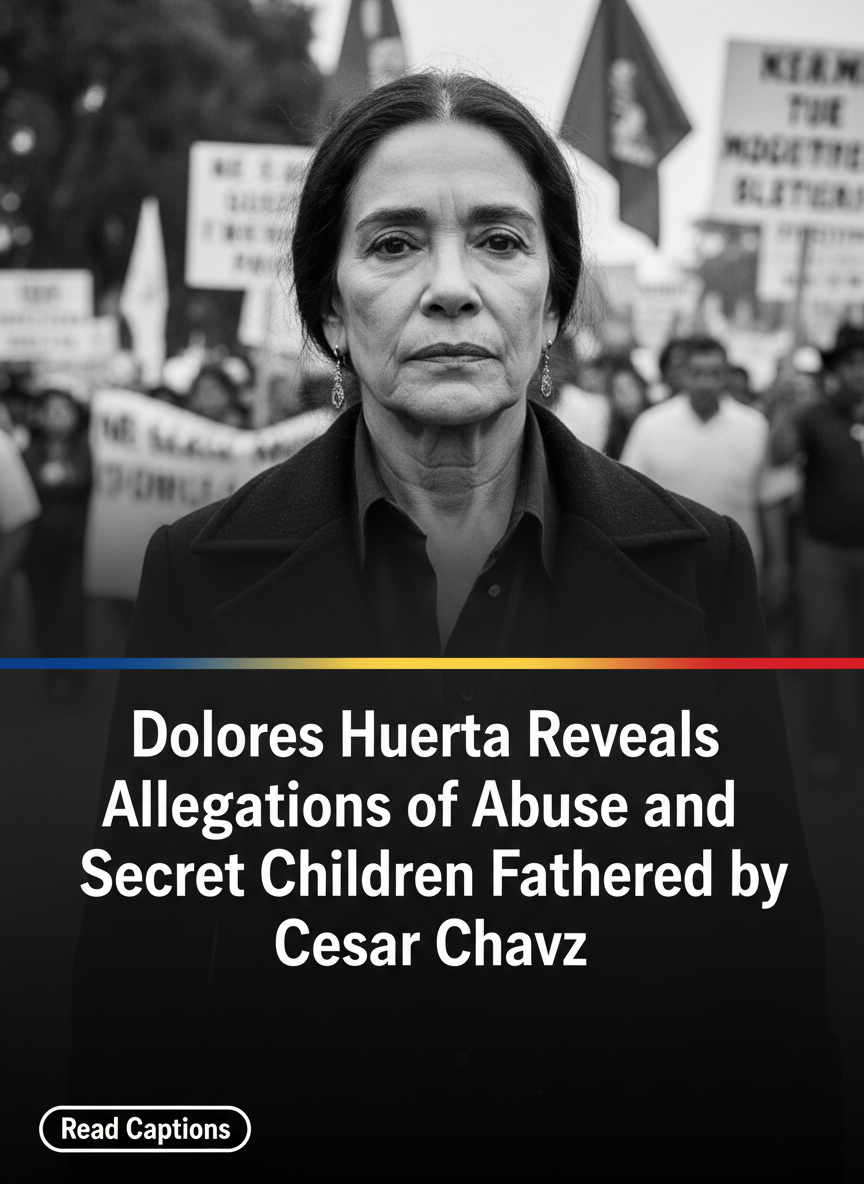
A Legend Eclipsed: Dolores Huerta Breaks Silence as Cesar Chavez Faces Explosive Abuse Allegations
SACRAMENTO, CA — The legacy of the American labor movement was shaken to its core this week following a series of explosive revelations involving Cesar Chavez, the revered co-founder of the United Farm Workers (UFW). As trending searches for civil rights icon Dolores Huerta surge past 5,000 on Google, the public is grappling with a narrative shift that threatens to dismantle the “saint-like” image of one of the 20th century’s most celebrated figures.
The Silence is Broken: Huerta Reveals Secret Children
In a stunning interview with KCRA, 95-year-old Dolores Huerta, who stood shoulder-to-shoulder with Chavez during the historic Grape Boycotts of the 1960s, revealed a harrowing private history. Huerta disclosed that Chavez used his position of power to pressure her into sexual relations over the course of their partnership. Most shocking was Huerta’s admission that this coerced relationship resulted in secret children—a fact hidden from the public and the labor movement for decades.
“There was a pressure that felt impossible to escape,” Huerta stated during the broadcast, describing a dynamic where the movement’s success was often used as leverage to ensure her compliance and silence. Her revelation has served as the catalyst for a broader reckoning regarding the internal culture of the UFW during its peak years.
A Pattern of Abuse: The New York Times Investigation
Huerta’s account is only one piece of a larger, more disturbing puzzle. An investigative report published by The New York Times on March 18, 2026, has brought forward multiple women who accuse Chavez of predatory behavior and sexual abuse dating back decades. Perhaps most damaging are the allegations that Chavez targeted and abused young girls within the farmworking communities he claimed to protect.
The Times report details a “culture of untouchability” surrounding Chavez, where his status as a national hero shielded him from scrutiny. According to the investigation, complaints were often suppressed by inner circles who feared that disparaging Chavez would destroy the farmworkers’ cause. The report includes corroborating testimony from former union organizers who admit to witnessing or hearing of misconduct but felt “politically paralyzed” to act.
Political Fallout: California’s Labor Movement in Turmoil
The ripples of these allegations have reached the highest levels of California politics. As reported by Politico, the revelations have sent a “jolt” through the state’s labor movement. For decades, Chavez has been the foundational symbol of Latino political power in California, with his name adorning dozens of schools, parks, and a state holiday.
Labor leaders and lawmakers are now facing a crisis of identity. “We are devastated,” said one anonymous union official. “We have built our entire moral framework on the back of a man who we are now learning was a predator. How do we honor the movement without honoring the man?” There are already mounting calls to rename public institutions and remove statues of Chavez across the Central Valley and Los Angeles.
The Legacy of “Sí, Se Puede”
As the public processes the duality of Chavez—a man who secured historic rights for thousands of workers while allegedly destroying the lives of women and children in private—the focus has shifted to the victims. Dolores Huerta’s decision to come forward at this stage of her life is being hailed by many as her final, and perhaps most difficult, act of civil rights leadership.
While the UFW has not yet issued a definitive statement regarding the removal of Chavez’s name from their branding, the organization released a brief comment acknowledging the “painful nature of these testimonies” and pledging to support “a process of truth and reconciliation.”
Conclusion
The story of Cesar Chavez is currently being rewritten from a tale of pure heroism to a complex tragedy of power and abuse. As more details emerge from the New York Times investigation and as Dolores Huerta continues to speak out, the American public is left to reconcile the vital progress of the labor movement with the dark reality of the man who led it. The “Si, Se Puede” (Yes, We Can) slogan, once a cry for economic justice, is now being reclaimed by survivors demanding accountability, no matter how iconic the accused may be.
This is a developing story. Follow our live updates for more information on the evolving investigations and community responses.