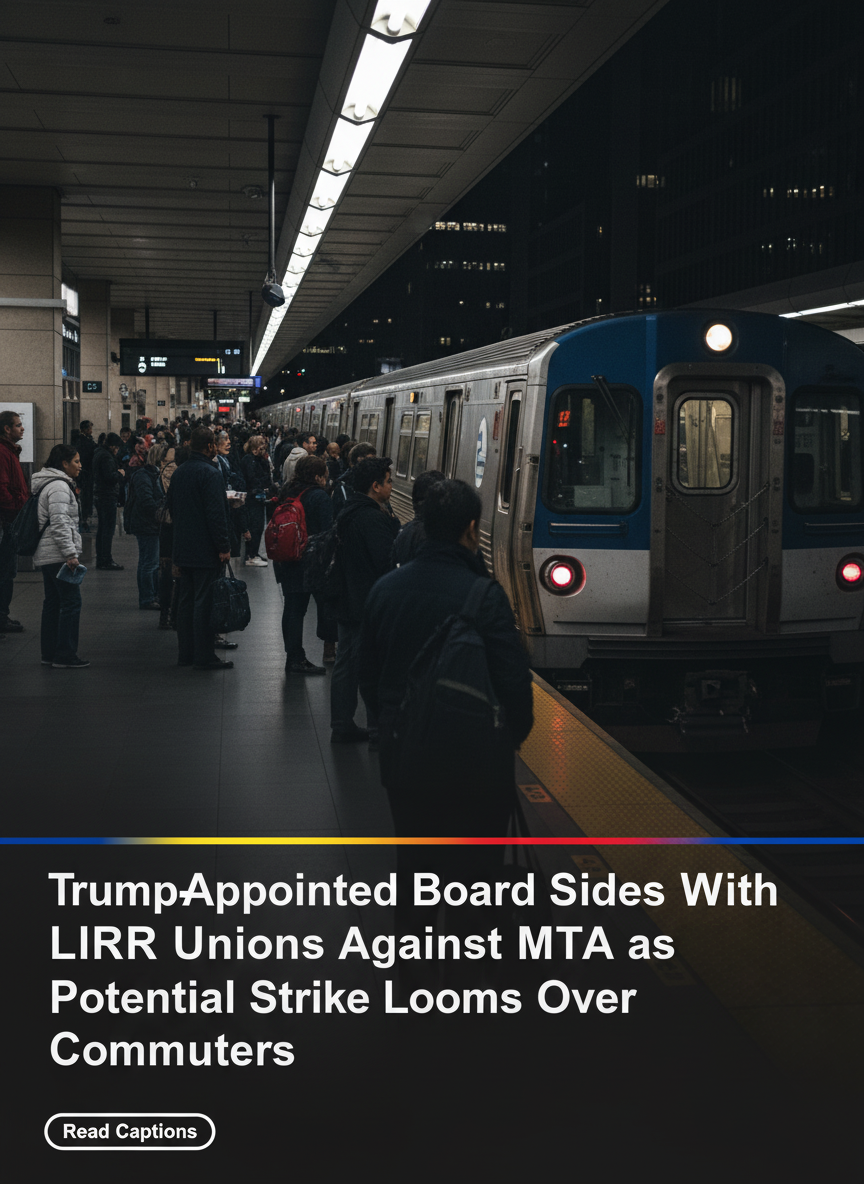
Commuter Crisis Looms: Trump-Appointed Federal Board Sides with Unions in LIRR Contract Standoff
NEW YORK — The prospect of a major disruption for hundreds of thousands of Long Island commuters has intensified this week. A Presidential Emergency Board (PEB) appointed by President Donald Trump has officially sided with Long Island Rail Road (LIRR) labor unions, dealing a significant blow to the Metropolitan Transportation Authority’s (MTA) current negotiation strategy.
A Major Victory for Labor
The federal mediators, known as PEB 254, issued their long-awaited recommendations on Monday. In a move that surprised some fiscal hawks but emboldened transit workers, the board largely adopted the unions’ arguments regarding wage increases and benefit protections. This marks the second time a federal board has intervened in this specific cycle of negotiations and found in favor of the workers over the MTA’s proposed austerity measures.
Labor leaders hailed the decision as a validation of their members’ hard work. “This board saw the facts for what they are,” said a union spokesperson. “Our workers keep the busiest commuter railroad in North America running every day, and they deserve a contract that reflects the cost of living in the New York metropolitan area.”
The MTA’s Financial Dilemma
The MTA, which oversees the LIRR, has expressed deep concern over the board’s recommendations. The agency has consistently argued that the unions’ demands are financially unsustainable given the authority’s current debt load and operational deficits. The MTA had been pushing for significant concessions, including higher healthcare contributions from employees and changes to work rules to increase efficiency.
With the federal board siding with labor, the MTA now finds itself in a difficult political and financial corner. If the agency refuses to accept the recommendations, they risk being blamed for any service stoppage that may follow.
The “Trump Factor” and Political Implications
The intervention of a “Trump-appointed” board adds a unique political layer to the dispute. Traditionally, Republican administrations are viewed as more aligned with management during labor disputes. However, the PEB’s decision to back the unions suggests that the labor’s case was supported by data that transcended partisan lines. Observers note that this ruling puts additional pressure on the MTA, as they can no longer argue that the mediators’ suggestions are the result of a pro-labor political bias from the executive branch.
The Road to a Strike: What’s Next?
The issuance of the PEB 254 report triggers a mandatory 30-day “cooling-off” period. During this time, both the MTA and the LIRR unions are legally barred from taking “self-help” actions, such as strikes or lockouts. This window is intended to force both parties back to the bargaining table to reach a settlement based on the board’s findings.
However, if no agreement is reached by the end of this period, the unions will be legally permitted to walk off the job. A LIRR strike would effectively paralyze transportation for over 300,000 daily riders, forcing commuters onto already congested highways and potentially crippling the regional economy.
Conclusion
As the clock begins to tick on the 30-day countdown, the eyes of the region are on the MTA headquarters. While both sides express a desire to avoid a strike, the gap between the MTA’s budget and the PEB’s recommendations remains wide. For the millions of New Yorkers who rely on the “Route of the Dashing Dan,” the coming weeks will determine whether their morning commute remains a routine or becomes a casualty of labor warfare.