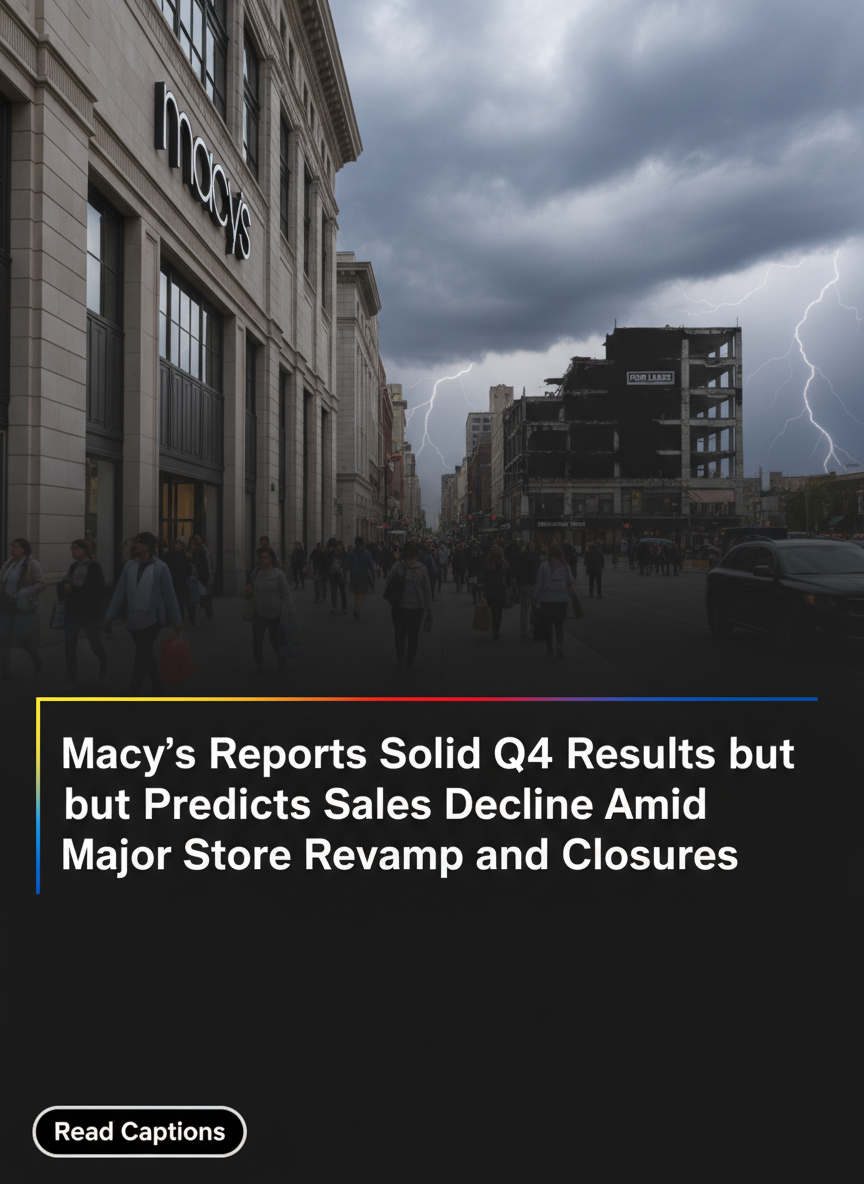
Macy’s Transformation Strategy Shows Promise, but Retailer Forecasts Sales Dip for 2026
NEW YORK — Macy’s Inc. reported fourth-quarter results on Wednesday that exceeded market expectations, offering a glimmer of hope for its ongoing turnaround strategy. However, the department store giant coupled the positive news with a cautious outlook, warning investors that sales are expected to soften in the coming year as the company continues to shutter underperforming locations.
A Solid Finish to 2025
Despite a volatile retail landscape, Macy’s posted a resilient fourth quarter for 2025. The company’s performance was bolstered by a refined inventory management system and strong holiday demand in key categories such as beauty and luxury. Analysts noted that the retailer’s focus on high-margin private labels and its “First 50” revamped stores contributed significantly to the bottom line.
While the broader department store sector has struggled to maintain foot traffic, Macy’s reported that its revamped store format—which features improved layouts, better lighting, and more localized merchandise—is showing higher conversion rates and customer satisfaction scores compared to the rest of its fleet.
The “Bold New Chapter” Progress
The latest earnings report serves as a progress report for CEO Tony Spring’s “A Bold New Chapter” strategy. This multi-year plan involves closing approximately 150 underperforming Macy’s locations by 2026 while investing heavily in the remaining 350 “go-forward” stores.
In addition to the Macy’s brand, the company’s luxury banners, Bloomingdale’s and Bluemercury, continued to outperform. These segments have become a cornerstone of the company’s growth strategy, with management planning to open more small-format Bloomingdale’s stores and expand the Bluemercury footprint to capture the resilient high-end consumer market.
Navigating a Challenging 2026 Outlook
The optimistic Q4 results were tempered by a conservative forecast for the upcoming fiscal year. Macy’s leadership expects net sales to fall in 2026, citing the planned store closures and a cautious consumer spending environment. The company anticipates that while the closures will reduce total revenue, they will ultimately lead to a leaner, more profitable organization.
“We are seeing the early fruits of our transformation, particularly in our revamped locations where the customer response has been overwhelmingly positive,” said Tony Spring during the earnings call. “However, we remain clear-eyed about the macroeconomic headwinds and the impact of our store optimization strategy on short-term top-line growth.”
Investor Sentiment and the Road Ahead
Wall Street’s reaction was mixed but generally supportive of the long-term vision. Investors are closely watching Macy’s ability to transition from a legacy department store model to a modern, omnichannel retailer. The company’s digital sales remain a focal point, as Macy’s works to integrate its online presence more seamlessly with its physical “First 50” upgrades.
As 2026 begins, Macy’s finds itself at a critical crossroads. The company must prove that its smaller, more focused store footprint can generate enough profit to offset the loss of scale. For now, the “Bold New Chapter” appears to be heading in the right direction, even if the path forward involves a period of shrinking to eventually grow stronger.
For more updates on retail earnings and market trends, stay tuned to our business news coverage.